The Wild Flower Fragrance

It has been raining intermittently for the past two days, though it is not unusual for the month of August in Delhi. I invited my 4 friends, Gora, Topshe, Babua and Pulki with the motive of playing the card game of TwentyNine like we used to during our youthful days. Pulki called up to inform that he was in Purulia to meet some of his relatives and as such won’t be able to make it. Since it has been raining, the menu was simple, Khichudi and fries (papad, aloo bhaja, omlette and fish fries).

We played few rounds before lunch and afterwards as well till tea was served. As my friends were leaving, the sky opened up with torrential rain. It was impossible to step out. I suggested that they wait till the rain subsides. The weather had turned bleak with dark clouds engulfing the skies. It seemed like night but it was only few minutes past 5 O’clock. I spread out the cards once more.

“We have played a lot, let me tell you a real story appropriate for today’s climate.” Babua announced.

“We are all ears.” Gora spoke on behalf of others.

Babua began his story…

It happened long time ago, when I got promoted as Regional Manager for East Zone. I was touring the Bengal region and as per the itinerary, scheduled to visit Bolepur/ Shantiniketan with my medical representative, Sudhangshu. Let me tell you, the RM’s are not supposed to visit any doctor or clinic or hospital without their MR’s for pitching business. Sudhangshu was to meet me at the lodge, Aponghor, Bolepur in the morning around 9 am and take me along to meet few doctors in the area. I have worked with him earlier and knew him to be very punctual, so I was ready for him. But there was no sign of him as the clock ticked towards 10 am. I was restless and wondered what happened to him. I thought Sudhangshu probably has forgotten about our program and was visiting the doctors on his own. I knew the doctors we were to visit, so I called up the doctor, first on our list to check if he is there at his chamber. The answer was negative. I called up the other doctors and each of them said that Sudhangshu didn’t visit them as yet on that day. Now, I was worried, I had no idea how to contact him. I came down to the reception to check if they had received any telephone for me. It was negative.

I came out on the road, still hoping for Sudhangshu to appear. I was going to admonish him definitely. A rickshaw came and stopped inches from me. I was about to shout at the rickshaw puller when I saw Diptesh Guha, our District Manager of Burdwan alight from it, sweating profusely. He asked the rickshaw to wait and came to me.

“Sir, please come with me, Sudhangshu had met with an accident and admitted in the government hospital here.”

“When, what happened?”

“I don’t know the details; I got a call from Kolkata office in the morning. They said to contact you here and visit the hospital. I have spoken to his wife and she informed that tomorrow is their first marriage anniversary. Sudhangshu had planned to finish work here today and take the evening train to Kolkata. She’s in extreme distress and wanted to come but I told her to hold back for now.”

“Okay, let’s go and check on him.”

We reached the hospital and saw few people at the ward corridor discussing some issue very animatedly. I gathered a few fleeting words as we passed by them. One of them was asking, “How did he veered so much into the interior from the main road. He is not a villager but a city dweller.”

Sudhangshu was sleeping, the visible injuries looked minor, scratches on the face, on arms and on the forehead. Probably from the fall from the bike. Diptesh found the doctor and brought him along. I introduced myself and asked for the diagnosis.  

“It’s an accident, the bike must have skidded in the slush. He fell and was probably dragged by the bike’s momentum. The injuries are not serious but the shock is the reason for the fever. I have given the medication and will observe him today. Will release him tomorrow.”

We spent some time with Sudhangshu at the hospital. Diptesh suggested that since the doctor’s visit is not happening, he can take me to Shantiniketan to see the Vishwa Bharati University and Tagore’s Ashram. And in the evening we can experience the scenic sunset at Khoyai. We had a hearty meal at a local “Pice Hotel” before going to Shantiniketan.

Diptesh had stayed back and after breakfast we went to the hospital. Sudhangshu had recovered overnight, the fever had subsided but was feeling weak with body ache. The doctor checked on him and released him with advice to take ample rest. We brought him back to the guesthouse. As we were checking him to a room, a woman in her 20’s came rushing and hugged Sudhangshu. Though none of us knew of his family, it became quite apparent that the woman was his wife. Sudhangshu, grimaced in pain as his wife hugged him tightly while crying. He introduced her, “This is my wife, Diya.”

“I believe, today is your first marriage anniversary, congratulations. I suggest, you rest for now, we will celebrate in the evening with a grand feast.”

In the evening, we all gathered in my room, being the largest with separate sitting arrangements, Sudhangshu had recovered fully though still walking with a slight limp. Diptesh had gone out and brought a cake and biriyani from the local market. I had requested the guesthouse to make mutton curry and rice pudding, appropriate for Bong celebration.

Once, everyone settled down comfortably, I asked Sudhangshu, “How are you feeling? Would you like to tell us what happened? Where did you go and how you reached the accident site?”

Sudhangshu thought for a while, composing the narrative in his mind, then spoke…

Well, my visit to Dr. Ashim Roy, in village Shantipur, about 30km from here was long overdue. It’s a remote village and not on our list. As I left his chamber, it started to rain, delaying me by an hour. I had taken a bike on hire from here, I usually do, and driving steadily on the rain-soaked road. The sky was getting darker with cloud formation as well as the setting sun. In the twilight of the evening, I saw this village woman, alone on the road with a load on her head. She was walking on the middle of the road; I slowed down and honked. She stopped and turned towards me, the headlight of the bike fell on her and I could see her clearly. She must have been in her early thirties with dark expressive eyes and mysterious smile on her lips, a lithesome figure that could envy the ramp models. I was mesmerized.

She spoke softly in the local dialect but I couldn’t understand. Realizing my confusion, she gestured if I can drop her to the village ahead. Normally, I don’t give a lift to strangers but I don’t know what spirit possessed me, I agreed. She hopped on the pillion and we started off. I asked her name, she replied, “My parents called me Roopmati, but my fiancé used to call me Rupashi.” I thought both the names are quite appropriate.

After driving a distance, she directed me to take a left turn on the makeshift village road. A voice in my head told me drop her there and continue to Bolepur while another voice spoke loudly, “How can you leave the woman in this lonely place? Go drop her to her village.” The louder voice won and I followed her direction. The road patchy with potholes and uneven levels, I kept the balance often putting my foot on the muddy surface. At one point, I felt very light and dizzy, almost dozing. I called out to her, “Are you okay?” The response came from few feet ahead instead of the rear, it shook me up. She said, “You are dozing off and driving so slow, I can reach home faster if I walk.”

“No, no, I will drop you to home, come back.” I was on drugs; I could smell an intoxicating fragrance of some wild flower when she was sitting on the pillion. I wanted to be with that woman as long as was possible. She sat again and we continued as she directed through the narrow passes of the villages and abandoned farms. I lost track of the turns we made when we reached a deserted village. She asked me to stop in front of a house that once stood firm but now looked haunted and abandoned with the thatched roof at most places gone creating a blackhole. The woman called Roopmati or Rupashi dropped the load on the porch and called out, “Saheb, you must be thirsty, let me offer you something nice that will ease your tiredness.”

She went inside the dark room and after some time came out with bowl, “Drink this, you will feel nice.” The liquid in the bowl was not clear but wheatish colour with bubbles forming around the wall of the bowl. It smelled a bit pungent and tasted as well. I drank the whole potion in one shot. I felt very light headed and happy.

Rupashi looked at me with intent and laughed loudly. The sound of her laughter echoed through the surrounding and hit me hard. My head started spinning and the temples throbbed with pain. She suddenly stopped laughing and said, “I am so happy, let’s dance” and without waiting for my response, she clapped thrice while making a weird sound from her mouth. It perhaps was a call to her friends because out of thin air five or six females in bright attires and two males carrying drums and some kind of flute materialized. They started singing and dancing to the beat of drum and sound of flute. I could not understand even one word of what they were singing but the rhythm made me wanting to dance with them. Rupashi came towards me and jerked me to stand… we started dancing going round and round on the porch. I forgot about the time and place, the wild flower fragrance had become very strong and I was breathing it in with every breath. It was euphoric.

Rupashi increased the speed in her movement, spinning us violently with rising beats of drums and clapping by her friends. I wanted her to stop as I struggled to keep up with her and my heart started pounding ready to explode. Suddenly, she let go of my hands and I flew out of the porch on to the muddy outfield. Just before I could get up, I saw Rupashi standing over me with a cleaver in her hand, raised high, ready to strike. She was saying…   

“You, city dwellers are all the same, you come to the village to exploit the young girls. You take away their honours with a promise of marriage and good life. Once your lusts and desires are met, you forget about us. You throw us out like garbage.”

She stopped to breathe and the continued…

“Look at me, few years ago, I was a happy-go-lucky beautiful young girl of this village. There were suitors lining up every other day for my hand in marriage but I fell for an urban guy. He would visit the village every weekend to photograph the villagers and especially me. He took some very compromising pictures of mine professing love for me and wanting to marry me. I, like a fool, believed him and surrendered to his lusts. After that evening, he never came back. What did I get? An unborn child in my belly. I went to the city searching for him and found him too. He was happily married with a child. I confronted him. he coward under my threat of exposure and promised to come back to the village.”

She paused. Her temper somewhat in control now…

“He came one evening, took me to the hillside temple, there were two other persons, he said they are witnesses for our marriage. Again, I believed him not knowing that the bastard was going to snuff out two lives in one go. As I bent down to pay obeisance to the Goddess Kali, he put a rope around my neck while the other two guys incapacitate me by holding my hands and feet tightly. It was over in matter of minutes. They carried my body to the crematorium behind the temple and burned the body leaving no trace of my existence.”

She stopped, the fire in her eyes was back, her breathing was quick, she lifted the cleaver high and brought it down. With the last drop of strength, I rolled to the left and went down to the ditch. After that I don’t know what happened, I woke up in the hospital.

“I know how you reached the hospital.” Diptesh spoke.

I looked at Diptesh and asked, “How do you know?”

“You remember those guys at the hospital corridor when we visited Sudhangshu? They are the ones who brought him to the hospital. I spoke to them. They are resident of the neighbouring village and were passing by when they noticed the motorcycle lying on the mud. They looked for the rider realising the person must have met with an accident. They found him in the ditch, unconscious but breathing. They brought him to the hospital on a flatbed rickshaw while another person drove the bike.”

“So, was it an accident or what Sudhangshu says is true?” I asked.

“I don’t know but tell me why would Sudhangshu drive so deep into the village from the main road?” countered Diptesh.

I had no answer and nobody in the room could offer any logical reason.

Few days later, as I was packing up for my return to Delhi, Diptesh called, “Sir, as per your advice, I had met the villagers and offered our gratitude and money but they refused to take the money as they felt it was their duty to help another human being in distress. Interestingly, when I asked, the villagers said they knew of the woman named Roopmati aka Rupashi and she simply vanished one day leaving her grieving parents and two siblings.”    

Gora went out to the balcony to check the weather. He came inside and said, “Rain has stopped but there’s a very strong fragrance of some wild flower in your balcony.”   

A Journey to Kalpa

Our planned trip to Spiti Valley, Kaza and Chandratal had to be cancelled due to logistical issues. Topshe and I had been eagerly looking for this coveted trip after watching numerous reels on Instagram. We were sad for missing out.

Topshe and I kept in touch brooding about the missed trip. Deepika having overheard our conversation said “Last week of May, I am free, let’s go someplace if not Spiti.” That charged us up and Topshe with renewed vigour got on to the planning for the trip. After spending a day in researching the availability of the hotel(s), he came up with the destination – Kalpa in Himachal Pradesh. It was about 12-14 hours (realistic) journey with ample breaks on the way for refreshing ourselves. We decided to stopover at Sainj, ahead of Narkanda on our way to Kalpa and stay over at Narkanda on our way back. The hotels at both places were known to us to be clean with decent amenities. At Kalpa, we could get HPTDC Hotel for one night only and booked another private hotel for the second night.

Tapas, Sudipta, Shamik, Sumita, Deepika and I waited eagerly for the day of journey. We decided to take one car – Kia Carens, a 7-seater and only a year old, serviced recently, owned by Topshe.

DAY ONE

As agreed, Sumita stayed overnight at our place and we were ready by 5:30 am for Topshe to pick us up. I made cheese sandwiches and boiled eggs for the road, especially if we get stuck in traffic jams on the hills. Each of us carried enough snacks, food and beverages that could feed a football team.

On the way, we picked up Shamik from Delhi Cantt Metro Station and started our long journey at 6:00 am sharp. The first stop being Zhilmil Dhaba, Karnal. The Google map said 2 hours 20 minutes to the destination. Topshe drove steadily with me on the passenger seat, the middle row being dedicated to the ladies while Shamik squeezed into the third-row seat.

Shamik came with lots paraphernalia, a seat cushion, a stainless-steel retractable stick (as gift for Topshe) and a soundbar which blasted music from Spotify at its own will or when it could connect with the Bluetooth of Shamik’s mobile. And Shamik, he’s a non-stop conversationalist on versatile topics and kept us entertained all through the journey.  

On the Karnal highway, there are now three Zhilmil dhabas and all of them claim to be the original. Last time, on our way to Chitkul, we stopped at Zhilmil dhaba for breakfast and had egg-paratha. Topshe admitted that he can’t recall which one was that as we stopped in front of the first one which looked clean and nice. Once we sat down to order, we realised the place was completely vegetarian. We settled for Aloo-paratha with Dahi followed by Masala Chai. The funny part is, all three Zhilmil dhaba looks identical in their façade, a conspiracy to confuse the customer, perhaps.

After a 40-minutes break, we started our journey. I decided to move to the back seat and asked Shamik to take the front seat which he refused saying he’s quite comfortable there and would come to the front only if Topshe allows him to drive. Now, Topshe loves driving and the highways are his favourite road, so we continued with previous arrangements. It was scorching hot outside but the AC of Kia worked nicely to keep us comfortable.

Our destination now was Sainj, about 3 hours from Shimla. We took the highway towards Ambala and continued towards Kiratpur but Google had other ideas and made us turn right from Bassi towards Panchkula, shortening the drive by about an hour. The road towards Panchkula was sparsely crowded and we covered the distance in good time. However, from Panchkula to Shimla, the road had patches with potholes and crowded as well.

Nearing Shimla, we were stopped by the police to check our destination. They put a yellow sticker on the windshield and advised us to take the ISBT road bypassing the Shimla towards Narkanda/ Sainj. As advised by Sudipta, after an hour we stopped in front of a small roadside restaurant with an amazing view of the valley thousands of feet below. The food was decent, light, good for the tummy, especially when one is driving up the serpentine hilly road. With another 40-45 minutes break, we were all set for our final leg of the day’s journey to Sainj. This time, before Shamik could say anything, I quickly slid into the third-row seat and made myself comfortable. Actually, after the lunch, I was feeling sleepy and it was just the time when I usually take my afternoon nap. Needless to say, as soon as Shamik got into the groove of driving through the serpentine road, I fell into a deep slumber and woke up only when we were almost at the Atul Residency, Sainj for our overnight halt. Even with two major stopovers and few more shorter breaks, we made the distance in less than 12 hours. The Sun was still up and glowing when we checked into our rooms which had an amazing view of the valley of apple orchards as far as eyes could follow. After settling down, we ordered tea and mix-pakoda (vegetable fritters) while chatting and sharing anecdotes. We also consumed most of the sandwiches and the eggs before they could go bad.

Later in the evening we played few rounds of Tambola before dinner. It was fun as everybody was involved with yours truly conducting the game. At the dinner, the steward taking the order goofed up horribly and served us all vegetarian dishes completely forgetting about the Butter Chicken that we were eagerly waiting and on top of it denied ever receiving the order for it. We found out he has some memory issues and refuses to acknowledge it. After dinner we picked up ice-creams from the freezer-box and went out to take stroll. A dog followed me with its eyes on my Kulfi. The kulfi itself was nothing great but I realised the beast will perhaps enjoy it more, so I gave it to him. The joy he felt on receiving the kulfi was out of this world.

DAY TWO

In the morning, we left immediately after breakfast for the Sarahan temple better known as Bhimakali Temple which we had missed during our last visit to Chitkul. The temple is dedicated to the mother goddess Bhimakali, an incarnation of Maa Durga. It is revered as one of the 51 Shaktipeeth and was the patron deity of the former Bushahr Royal Family. According to the legend, during the Daksha Yagna, the ear of Sati Devi fell here, making the place as a Shaktipeeth.The 800-year-old temple is famous for its unique architecture of Kath-Kuni style, a system where the wood and stone are interlocked to build the structure. It features a pagoda style roof and intricate wood carvings on the exterior. The external open areas are decorated with wooden chimes that still produces humming sounds while oscillating. Inside the temple, the floor and the staircases are all carpeted to provide warmth during the harsh winter months. The staircase going to the Sanctum Santorum of the silver moulded idol is narrow allowing only one person to go up or down. During certain auspicious occasion, the temple witness’s sea of humanity and the narrow staircase seems to be designed to control the influx. Interestingly, as per the Puranas, Sarahan was known as Shontipur, the capital of the demon king Banasur.

Sarahan, at an elevation of 2150 metres, acts as the gateway to the scenic Kinnaur district. Sarahan is surrounded by dense pine and deodar forests, apple orchards and offers spectacular unobstructed view of the Shrikhand range of the Himalayas. There’s bird sanctuary as well, famous for breeding of endangered exotic Himalayan Monal.

Kalpa is approximately 100 km from Sarahan and takes about 3hours+, we decided to skip lunch and proceed to Kalpa before the light fades, moreover, there were dark clouds forming in the distant horizon prompting us to hurry.

The serpentine hilly road to Kalpa is well-laid and dazzling scenic beauty welcomes you all the way to Kalpa. There is a point, Nigulsari, which remains a sore point with constant landslides making the stretch fit for off-roading. In earlier occasion, the stretch was narrow allowing single-file movement of traffic but now it has become wide enough to traverse both ways simultaneously. As we approached Kalpa, the majestic Kinnaur Kailash range stood up to welcome us. The beauty of it is beyond words, the top remained snowclad even in the month of May and it seemed to be so close to be within the grasp of the arm yet so far away.

We reached the hotel The Kinnaur Kailash around 5 pm. There were about 10-12 vehicles in the parking lot including ours. Two vehicles, a Toyota Fortuner and a Suzuki Ignis, both bearing registration number of West Bengal, parked side by side, they looked comical because of their size difference. We were allotted, perhaps the best rooms with clear view of the Kinnaur Kailash peak right from the bed through the clear glass French window. We ordered for tea and snacks in our room.

The serenity of this sleepy hamlet, Kalpa, is infectious. During the colonial rule, it was known as a Chini village and was a Tehsil Headquarter during that time. Post independence, it became district headquarter of Kinnaur before the DHQ was shifted to Reckong Peo. The Sutlej River runs through deep gorges below and the winding mountain road is bordered by chilgoza forests. The sacred Shivling rock on Kailash Mountain, rising to an altitude of 6000 metres, changes colour at different times of the day and is visible from most of the points in Kalpa as if the Lord is blessing the people at all times. Interestingly, the country’s first voter, Shyam Saran Negi, belonged to Kalpa. Because of the difficult terrains, his voting was recorded about 2-weeks before the general public exercised their franchise in the first ever voting of the republic.

We thought of going to see the Suicide Point Roghi, about 2 km from the hotel but it was impossible to take out our car from the parking as close to 30-40 vehicles arrived during the time we were enjoying the hot pakoras and chilly-chicken with our tea, blocking not just the exit of the parking but the entire driveway. And majority (almost 80%) of the visitors were Bongs, some having travelled in their own vehicle from their hometown and some preferring to take the train to Kalka and hiring cabs from there to tour the places like, Shimla, Narkanda, Sarahan, Chitkul, Kalpa etc. There was huge confusion in room allocation, and some families had 4 members staying in one room, a few who came without reservation, had look at other hotels/ homestay. We had the reservation for one night and wanted to extend our stay but the receptionist was helpless because all the bookings were online and fully booked till mid-June. Topshe knew and therefore had booked another hotel for the following night. We walked out of the hotel to take a stroll. The breeze that was feeling nice had become chilly prompting us to zip up our jackets. We could see some tourists with monkey-cap and they all turned out to be Bongs. They all love the mountains but at the same time can’t adjust to the cold climate of the hills.

Walking down the track, we came to a point from where the road was going downhill towards the Reckong Peo. We stopped contemplating whether to go down further or return. Topshe and Sudipta were behind us talking animatedly on the phone, we guessed they may be talking to the children back in Delhi. We waited for them to catch-up with us. To our surprise, they seemed to be in a hurry as they went past by us without acknowledging our presence. We followed them at a distance but soon got stuck in the traffic jam. Yes, the road, at some part is so narrow that a Tempo Traveller and a normal car can barely pass each other, one of them will have to squeeze to the edge of the road to allow the other to pass. In such a situation, even the pedestrians have to stop. When the traffic got cleared, Deepika and Sumita decided to return to the hotel. Shamik and I went ahead looking for Topshe and Sudipta but they were nowhere to be seen. Shamik called him and was told that they were at the hotel where we were booked for the following night. He further said that there’s some confusion which he’s trying to sort out. He also gave him a reference of a person to contact immediately.

Shamik knew where to go, so I followed him. He went inside a café and spoke to a person sitting next to the cash counter. The conversation followed like this…

Shamik: Mama ji, Tapas spoke to you earlier, there’s some problem with the hotel reservations and we desperately need to book another hotel for tomorrow.

Mama ji: There are no rooms available in the entire town of Kalpa.

He then asked the guy sitting at the till to show the register which had bookings of every room for the next 10 days. Mama ji thought for a while and then asked us to follow him. He took us to the next-door hotel which while crossing it earlier, I thought it was just a café and had joked that we could have ended up there for our dinner!!

Mama ji spoke to the manager urging him to check if rooms are available for the next day. We were in luck; he had three rooms available and we immediately booked them even though The Grandeur Hotel & Restaurant seemed a huge climb down from the HPTDC The Kinnaur Kailash hotel where we were staying for the night. In fact, it seemed to be a non-descriptive small eatery only. However, hidden in the rear side and a flight of stairs below were the rooms with running balcony that overlooked the Kinnaur Kailash range without any hindrance. The clear view was even more stunning than the view from HPTDC hotel. Below the balcony, lay the valley and the Chini Village with the monastery we would be visiting next day.

Coming back to the hotel, we played the Tambola till the call came for dinner. It was buffet system with all-veg dishes, the non-veg option was on ala-carte basis. We ordered for egg-curry as a safer option; rest of the items were from the buffet counter. The dining hall seemed mini-Kolkata with full of Bong tourists covered head to toe in warm clothing and high-pitched chatting in native tongue creating a cacophony of noise. Our table was distinctly different in comparison.

After dinner, we went for stroll but the surroundings were pitch-dark the clear sky shone with millions of stars that we never get to see in the skies of Delhi.   

DAY THREE

After a nice breakfast of puri-sabji, butter-toast and eggs we checked out from the hotel as did most of the guests. Most (Bongs) were going further ahead to the Spiti Valley. We dropped our luggage at the Hotel Grandeur and went to the Suicide Point Roghi.

Suicide Point, located just 2 kilometres from Kalpa near Roghi village in Kinnaur district, (HP) is one of the most dramatic and breathtaking locations in the region. Perched at an altitude of over 2,700 meters, this viewpoint offers a sheer vertical cliff that drops hundreds of feet into the Sutlej Valley below. Surrounded by deodar forests, apple orchards, and jagged mountain slopes, it is both a scenic marvel and a spine-chilling experience for those who dare to walk close. Despite the grim name, the spot is a natural marvel attracting tourists and photographers for its raw Himalayan beauty, winding roads, and heart-pounding elevation. It’s not a place for adventure but for appreciating nature’s grandeur—a must-stop for those traveling to Kalpa.

There were many tourists from different parts of the country at the Suicide Point, taking pictures of the scenic beauty as well as selfies, it seemed like a carnival happening at the spot. We got down while Topshe went further ahead to take U-turn from a wider section of the road. We took several pictures of the valley and the snow-peaked mountains as the backdrop.

After spending about 30 minutes there, we proceeded for the Chini (Kalpa) Village to see the temple/ monastery. We got down at the mouth of the narrow lane that goes to the monastery while Topshe drove back to park the car nearby. The lane or track was concretized and clean despite sizeable footfall throughout the day. The lane is lined with shops selling artefacts and garments and eateries serving delectable local cuisine.

Kalpa Monastery, located in the scenic town of Kalpa in Kinnaur, Himachal Pradesh, is a tranquil Buddhist monastery known for its meditation halls, colorful murals, and serene ambiance. The monastery provides visitors with a peaceful environment to experience Buddhist rituals and cultural practices. Surrounded by snow-capped peaks and apple orchards, it offers both spiritual solace and breathtaking Himalayan vistas, making it a must-visit for travellers seeking calm and cultural insight. The on-ground atmosphere is calm and contemplative, with the sound of prayer bells, chanting, and occasional visits from local devotees. What makes Kalpa Monastery distinct is its hilltop location overlooking the Sutlej Valley, combining active worship with panoramic Himalayan views that few other local monasteries offer.

We offered prayers and took few pictures of the scenic views. The courtyard of the temple was breezy and the sun shone bright. We were enjoying the atmosphere when there was a sudden rush of tourists which prompted us to leave for our next destination, KHAAB, famous for the confluence of SPITI & SUTLEJ Rivers. And if time and weather permit, visit Shipki-La, a mountain pass and border post with a dozen buildings of significant size on the India-Tibet border. The river Sutlej, which is called Langqên Zangbo in Tibet, enters India near this pass. Interestingly, from the high point of this pass, one can observe a village across the border on the Tibetan side.

It took us about 2 hours to reach Khaab, on the way stopping at roadside café managed by a young girl in her twenties where we had tea and biscuits and got refreshed. There was a sizeable crowd at the Khaab sangam, again lots of Bongs thronging the place. Practically, all of them were headed to Kaza.

Khab Sangam is a dramatic, high-altitude confluence in Kinnaur, Himachal Pradesh, where the turquoise Spiti River meets the muddy-brown Sutlej River. Serving as the gateway to the Spiti Valley, it sits at an elevation of roughly 2,600 meters (8,530 ft) and offers a striking visual contrast of the waters. Situated near the India-Tibet border along the Hindustan-Tibet Highway (NH-5), it is approximately 70 km from Reckong Peo. The clear, emerald-green Spiti River merges into the massive, fast-flowing Sutlej River, which originates near Mansarovar Lake in Tibet. The best vantage point to see this natural phenomenon is the iconic suspension bridge. On a clear day, the striking peak of Reo Purgyil—the highest mountain in Himachal Pradesh at 6,816 meters (22,400 feet)—towers above the confluence.

Most travellers cross this point on their drive from Kalpa/Reckong Peo toward Nako or Kaza. It serves as a great quick photo stop. The road to Spiti Valley features a dizzying series of hairpin bends known as the Ka Loops. The village of Khab sits on the hillside, a dhaba serves multi cuisine near the bridge.

We parked the car on the roadside behind the line of cars already parked. Many of them were on their way to Kaza further away on Spiti Valley. We took photo and videos of the confluence, don’t know if the pictures will be able to depict the true beauty of the clear turquoise water of Spiti River meeting the muddy water of Sutlej River. The chilly breeze carried the sand from the bank as well as sprinkle of water as we went close to the Sangam for that one award winning picture.

There used to two eateries at the spot (according to Topshe) but now there was only one with serving street style Indian and Chinese dishes. The women in the group opted for the Indian while the men went for different varieties of noodles but when the dishes arrived, neither the look nor the taste had any significant difference.

After lunch, we deliberated on going to Shipki-la, a clear 4-5 hours of round journey plus the return to our hotel in Kalpa. Neither the time nor the weather with black rain bearing clouds forming over the mountains were conducive to explore the distant high-altitude point. We abandoned the idea and instead drove towards the Kaza through the serpentine smooth road, just to enjoy the ride. The road to Kaza is quite similar to the one in Patratu Valley in Ranchi with the latter at much lower altitude.

On our return, we stopped over at the Reckong Peo market to buy knick-knacks. We bought local cow ghee, dry-fruits, ceramic cups with lid and strawberry candies. Shamik bought around 15+ woollen mufflers and stoles for gifting purposes but did not reveal the identity of recipients. While we were shopping, the rain came down heavily but did not last for long. I believe that’s a typical characteristic of the hills, sporadic rains. Only in few instances there have been persistent heavy downpour and, in such situation, it becomes risky to drive on the hilly roads because of sudden landslides.

In the morning, we had requested the manager at the hotel to prepare the mutton with local Kinnaur flavour and the moment we entered, the awesome fragrance hit our nostrils sending waves of hunger through the body. But dinner was still 2-3 hours away, so we had pakoda with chai while playing Tambola where Shamik monopolized the prize money.

The mutton curry tasted delicious as was the dal tadka. I felt the mutton should have been on the stove for at least another 20-25 minutes to make it melt-in-the-mouth kind but who knows the Kalpa people may prefer the bit chewy type of mutton pieces. Anyways, there was my fur-friend roaming outside the dining hall; I picked up the unchewable pieces from all the plates and offered him which was readily accepted. I watched him devour the entire plate including the bones and a feeling of satisfaction enveloped my whole body. Petting and feeding the fur babies give me immense satisfaction.

We were very tired but to help digest the dinner, took a stroll of the near empty street for some time. To our surprise, there were 3-4 vehicles which arrived at that late hour seeking non-existent accommodation in Kalpa. Topshe advised one of them to go down to Reckong Peo to check out the  hotels there.

Since, we had only three rooms, some sleeping adjustments were made, Shamik and I shared a room while Deepika and Sumita shared another. I thought, for a change, I will sleep early but Shamik had other ideas. He kept talking divulging lot of secrets but I was in a kind of slumber, so I heard some of it and some just skipped my attention and after some time I simply did not care. When I got up for using the toilet, found Shamik sleeping peacefully snoring lightly. I tip-toed to the bathroom without disturbing him.

DAY FOUR

We checked out after breakfast setting our luggage in optimal space living enough space for the sixth person to sit comfortably. We stopped briefly at Topshe’s friend’s house where we were offered salted tea, I took a sip and discarded it immediately. I don’t take sugar in my tea, why should I take salt? While coming out, I managed to bang my head at the door frame which looked more like an entrance to a cave, the opening not more than 4.5 feet high. Our destination was Narkanda for overnight halt, approx. 175 km translating into 5-6 hours driving time. I slipped into the third-row seat making myself comfortable for a nap. On the way, Deepika, Sumita and Sudipta bought apricot and plum at almost half the price they sell in NCR.

I woke up as the car came to a halt. As I crawled out from my den-in-the-car, Topshe pointed out to the restaurant we were taking the break, RAABCHIC. It was at a height from the road with staircase going up along the hill wall. The restaurant or the dhaba was decorated in Gen-Z theme with hundreds of beer bottles, some empty and some filled with liquid which we came to know is either some local fruit juice or matcha made in-house by the young couple running the show. We had veg and non-veg momos recommended by the enthusiastic manager with tea. After a 30 minutes break, we left for Narkanda as the clouds chased us.

At the Piyush Residency, Narkanda, we were allotted 4 rooms on the 5th floor. The hotel has been renovated since our last visit in 2023. We were in for a surprise when we entered our rooms. The rooms were huge in size, could easily be termed as “suites” if they had divided the room into separate sitting and bedroom. The amenities available were 5-star quality and above all very clean.

Sudipta wanted to visit the skiing range, about 500-750 metres from the hotel, so we all got ready to go but the clouds found us and started pouring with vengeance. The plan had to be abandoned, instead we decided to play Tambola.

Post dinner, we went for stroll. Deepika and Shamik were engrossed in discussing matters related to human resources, more particularly about coaching and training of employees, both being from similar profession. I was following them about 10-15 metres behind when I saw a really huge dog appear from behind the parked vehicles. I stopped to see what it does but to my surprise and delight, the moment he saw me, his tail started wagging fast as he approached me with complete submission. I petted him as Deepika and Shamik still engrossed in discussion, went past, the dog did not acknowledge their presence even for a moment as I petted him at places that I know gives them the best satisfaction.

DAY FIVE

In the morning, Sumita declared she had had a terrible night, her stomach being upset and she was feeling nauseating. At the breakfast, she tried having some porridge but felt unwell. She just had a glass of fresh lime soda which gave her temporary relief. Topshe paid up the hotel bills while we packed our luggage in the car optimally for the long uninterrupted journey back home. Once, Sumita felt good-to-go, we started for Delhi. Topshe drove sedately, much below his normal driving speed, perhaps keeping in mind that Sumita might feel uncomfortable. We had to stop 3-4 times for Sumita to relieve herself. Then she fell asleep and Topshe drove a bit faster. We had covered around 30-40 km when Sumita woke up and started searching for her phone. It was nowhere to be found in the car, obviously she had left it at the hotel or in worst case dropped it somewhere on the road while getting out of the car. We stopped and Topshe called up the hotel reception giving the details of Sumita’s room number and requesting a search for her phone. We waited for the response and then 15 minutes later, the hotel called up to confirm that the phone is in their possession and if we haven’t gone too far, we can return to pick it up. We took the U-turn for the hotel.

While Sumita and Deepika went to collect the phone, we had roasted corn-on-the-cob from a roadside vendor while a light drizzle alerted us to leave urgently. We lost about 2-hours and ended up losing more as sporadic rains slowed us down on the hilly terrains.

Our dinner was planned at Puran Singh ka Dhaba (original), where we reached around 9:30 pm and immediately ordered mutton rara, dal makhni and tandoori roti. Deepika decided not to have anything and Sumita, because of her stomach issue declined to eat anything. However, once we were served, the aroma of the mutton dish compelled Sumita to taste it. There are about 5 or 6 Puran Singh ka Dhaba, all adjacent to each other, all claiming to be the original and it is difficult to distinguish as there’s hardly any differentiation in ambiance or food. We went to the one that Google recognised as original.

After the break, there was some urgency to reach home. The first stop was Dwarka to drop Shamik followed by us at Navjeevan Vihar and finally New Ashok Nagar. Shamik was dropped at his Society gate around 1:30 am and we reached home at 2:15 am and Topshe-Sudipta entered their home close to 3:00 am marking an end to a very enjoyable and memorable trip to Kalpa.   

Angels without Wings

Dilapidated room with peeling paint, broken windows, and glowing light fixture.
An eerie abandoned room with peeling walls and a mysterious glowing light.

Nandita looked at the person standing next to her with the intensity of a laserbeam. He looked familiar, she has seen him somewhere but couldn’t recall where. She, along with few others have taken shelter under the bus-shelter canopy from the unseasonal rain. She looked again at the person and tried to visualize him without the French-cut beard. This time, the guy looked back at her and momentarily a faint smile appeared on his lips.

“Nandita, isn’t that you?” he exclaimed.

Instantly, Nandita recognized him. The voice is still the same, heavy, intense but innocent like it was.

“Soumya, what a surprise, seeing you here after such a long time.”

“Yes, it’s been many years since we last met.”

“The rain has almost stopped, if you aren’t too busy, please come with me to my home. We will talk over dinner.” Nandita urged Soumya who looked a bit uncomfortable but eventually agreed.

They walked together a little distance to where Nandita had parked her compact SUV. The house or the detached bungalow where Nandita lives is in the cantonment area beyond the city limits. Her husband is an officer in the army with the rank of a Lt. Colonel. Aniruddha never discusses his real job but Nandita could guess that it involves intelligence gathering and analysis. He does flexible hours and at least, half a month goes for the night shift. If you ask him, his standard reply is “More work can be done at night without the usual chatter and noise that’s there during the day.”

By the time, Nandita parked the car in the portico, darkness had engulfed the surroundings. One of the attendants posted there came forward to open the car door and take the shopping bags from the car. Nandita asked, “I hope, you are not afraid of the dogs because we have a pair of them. They are very sweet if they like you.” She didn’t say what they will do if they don’t like him. Soumya stopped in his track with askance.

“Come on, they are babies and I am sure they will like you.”

As they entered, two fluffy dogs came to welcome Nandita with their tails wagging furiously. “These are chowchows, the darker one is John and the lighter creamy one is Jenny. The dogs stayed with Nandita, making no attempt to check on Soumya. He kept standing near the door, obviously uncomfortable in the presence of the dogs. Nandita understood and called the manservant to take the dogs inside. Once the dogs were taken away, Soumya came inside the room. The living room was well appointed with period furniture and the walls adorned paintings and artefacts.  A lady-servant came with tray of sweets and water. Nandita instructed her to get tea and some snacks.

“I will just join you, let me check if Aniruddha is back from office.” She went inside.

Soumya checked the paintings on the wall while waiting for Nandita. One painting particularly attracted his attention. It was of a room flooded by moonlight coming through the grilled window and a tree just outside the window giving a mystic surreal feeling to the environment of the room.

“You like that painting? I painted that few months ago. There’s a bit funny story behind that painting. I dreamt about the scene and got up in the middle of the night to paint before the dream gets erased from my memory. Aniruddha called me crazy.” Nandita had come inside the room silently and seeing Soumya engrossed in the painting, spoke with excitement.

“Yes, this is very interesting. I have a feeling that I have seen it somewhere. What’s on that wall in the picture, a painting within a painting?”

“That’s the mystery part of that painting. I really don’t know what I painted there, I felt someone else was forcing me to paint them and I just stroked the brush on the canvas.” Nandita spoke in hushed voice while looking at the painting with a renewed interest.

Aniruddha came in to meet Soumya. As they shook hands, Aniruddha gave a sharp glance to Soumya, “You are cold, did you get drenched in the rain? You can change into my clothes, I think they will fit you. We have similar physic.”

“No, no, I am fine. It is hardly wet and will dry up soon. Are you coming in or going out?”

“Actually, I came in to grab a quick dinner before heading back. There’s some development in the western sector which needs 24×7 monitoring.”

“Why don’t you two talk while I set the table for dinner?” Nandita showed some urgency.

“So, I gathered that you and Nandita were classmates in school…” Aniruddha tried to make a conversation.

“Yes, we were classmates till secondary level, after that she took up commerce stream while I took up science to become an engineer.” Soumya replied.

“So, what do you do now?”

“I was in New Zealand at Auckland University, Environmental Science and Development as a faculty and doing my research on global warming at a macro level.”

“Oh, you are a doctor, after all.”

Soumya just smiled.

There was an awkward silence, both trying to figure out what or who should speak. They were saved by the arrival of Nandita announcing that dinner is ready and table has been set. Over dinner, Aniruddha suggested that Soumya should stay overnight with the weather becoming uncertain. Soumya politely declined, saying, “Thank you for the offer but I will have to go as I will be leaving for the hills, early in the morning.”

They finished their dinner with Nandita being the speaker while Soumya and Aniruddha listening, nodding and occasionally interjecting with quips.

“Sorry, I can’t stay anymore, will have to rush to my station but you must come over and spend a few days with us on your return.” Aniruddha spoke while leaving for the office. Soumya and Nandita came out with Aniruddha to see him off. Aniruddha sat in the car starting the engine and as the headlight of the car came on them, something felt odd but he couldn’t pinpoint it. The car moved out of the porch. Once in the office, he forgot all about home and concentrated deeply in analyzing the information that kept pouring in on his computer.

Nandita and Soumya came back to the living room. She asked for coffee and settled down on the sofa; Soumya took the single seater.

“So, tell me where all you have been all these years?” Nandita broke the silence.

Soumya looked at her and then beyond her at the painting that had caught his attention earlier, then spoke softly, “I was all over the place, roamed the world.”

“Wow, tell me all the details.” Nandita was visibly excited and demanded to know his escapades.

“It is a long story, will take more time than what we have now.” Soumya replied sounding tired.

“Okay tell me briefly about your journey after that last day in school.” Nandita insisted.

“Well, you broke up with me on that day.” Soumya said with a tinge of sadness.

“Why not? Instead of spending the evening with your girlfriend, you decided to take up a stupid challenge of your friend Prateek. By the way, I read in the newspaper that a man named Prateek died yesterday, tragically falling from the balcony of a high-rise building. I hope he’s not the same Prateek.”

“Unfortunately, he’s the same Prateek. I was there to meet him when it happened.”

“You mean, you met him, spoke to him?”

“No, before I could speak to him, he fell overboard from his 15th floor balcony. The police called it accidental death pending further investigation.”

“Oh my god!!”

“Yes, very unfortunate, he was my best friend in school. We lost touch with each other after the last day in school. I believe he did his master’s in business management and joined his father’s business. He grew the business many folds to make it one of the top five companies in their field.”

“I am sorry for your loss.”

“Do you remember Arpita? I saw her in Edinburg.”

“You mean that snobbish girl who always tied her hair in ponytail?”

“You are still jealous about her.” Soumya was amused.  

“No, not jealous but I never liked her. She seemed artificial and a big snob.”

“Ah, oh, that’s pretty serious allegation. Anyways, she passed away last week.”

“Oh my God! What happened?”

“Actually, it is my fault, I saw her and called her out… she got excited and rushed on to the street to cross and got hit by a speeding car. She was immediately taken to the hospital but it was too late.”

“Sorry, I shouldn’t have bad mouthed about a deceased soul.”

Both were silent for some time, memories of school days flashing before their eyes like a kaleidoscope. Then, Soumya broke the silence, “When did you paint that canvas?” pointing to the one that had caught his attention.

“Oh, that’s the only one I have ever painted, about 6-8 months ago. Actually, I don’t have the patience of an artist. I just took the brush and perhaps in a trance went on to paint and finished it in few hours. All I remember is that I had dreamt of the scene and had decided to draw on the canvas. Aniruddha liked it and got it framed.”

“Actually, the scene on the painting is very familiar, I have a feeling that I have been there some time in the past.” Soumya lamented thoughtfully. 

The conversation hovered around the paintings that hung on the walls, Nandita became excited as she narrated the origins and how she acquired them over the years, becoming an art collector. Soumya listened to her with enthusiasm as he was a budding artist in school, with many of his artworks displayed on the walls of the meeting room and even in the principal’s office. Suddenly, Soumya said, “I know the origin of that painting. I have spent a whole night in that room.”

“Where?”

“You remember, on the last day of the school you asked me to join you for dinner but I avoided because I had promised Prateek to join his graduation party? And you broke off with me.” There was sadness in Soumya’s voice.

“I was your girlfriend and you ditched me for an all-boys party… and you expect me to be loyal?” Nandita became agitated.

“Anyways, let bygone be bygone. Are you interested to know what happened that evening and how I ended up spending the night in that room?”

“Yes, tell me please. You simply vanished after that day.”

“Well, we will have to go there to understand the events of that day. That room is in our school.”

“Which room?”

“You remember the old building that used to be the science block before it was abandoned because the structure became dangerous? That particular room was in the corner, used to be the biology classroom. Also became infamous after a student committed suicide having failed in the subject.”

“You want me to go to a haunted room? I am all game for it, it’s exciting to see a real ghost.” Nandita almost screamed in excitement.

Aniruddha was engrossed on the images that flashed on the monitor. He was particularly interested in the shadowy image and asked the operator to enlarge and clean up for better view. He did not realize the presence of his colleague Lt. Col. Rupashree and was startled when she spoke, “Why are you so interested in the shadows?”

Aniruddha turned around to look at her but another thought immediately struck him. He jumped out of his chair, “Thank you Rupa, I will just be back, something important has come up.” He rushed out and got into his car, driving back home with urgency.

On reaching home, he called out for Nandita but the housekeeper appeared, “Madam is not here. She left with the Sahib who had come earlier.”

“Where did they go? Did she tell you?”

“No, Sir.”

The guard had joined them at the porch… he spoke, “I heard them talking about their school.”

Aniruddha scratched his head trying to remember the name of Nandita’s school but couldn’t recall. He called his mother-in-law and after a brief chat said “Thank you, maa” and disconnected. He asked the guard to join him in the car and drove towards the St. Renee High School.

It took them 20 minutes to reach the gates of the school which was locked. A guard came out as he honked the horn. “The school is closed now Sir; you have to come back on Monday morning.” The guard announced.

“Did anyone, perhaps a man and woman come here about half hour ago?” Aniruddha asked.

“No Sir, nobody has shown up since evening after the principal madam left.”

“Are there any other branch of this school?”

“No Sir, this is a stand-alone school.” The guard informed and then thoughtfully said, “There’s the old school building in the eastern suburbs but that’s dilapidated and abandoned.”

“How far is it? Can you please direct us?”

Taking the direction from the guard, Aniruddha rushed towards the old school building. He was not familiar with these parts of the city and took few wrong turns before locating the building.

Nandita and Soumya reached the school without any difficulty, both knew the place very well having spent fourteen years there. The gate was closed with a heavy chain and big lock.

“What do we do now, the gate is locked.” Nandita spoke first.

“No worries, I know there is a big gap in the wall on the rear side. We will be able to slip through.” Soumya assured her.

They got out of the car and ran towards the backside of the building. There were no residences in the vicinity, only few commercial buildings in the distance which threw faint lights not enough to see the dark alley, one or two cats scurried away, a few dogs barked at them for intrusion but did not come near them. Soumya found the gap in the wall and allowed Nandita to go in first. The school building looked ghostly in the dark, though it was full moon night but the cloud cover prevented any lights from the moon reaching the earth. They avoided the main building and tip-toed towards the science block.

The staircase was broken at some places but Soumya guided Nandita expertly as if he had been climbing the stairs regularly. They reached the second floor where a closed door welcomed them. “Push the door with strength.” Soumya directed Nandita. It took a bit of pushing as the unused door had jammed on the hinges but eventually it opened wide and they stepped on the lounge area of the second floor of the science block. Soumya guided her to the corner room and again told her to push the door open. This time Nandita gave it a hard push and it opened with a loud noise. Momentarily she felt a chilly breeze swept by her as if to stop her from stepping in the room.

The condition of the room was precarious from years no maintenance and natural wear-n-tear. The grill of one of the windows had fallen creating a hollow in the wall… it looked like a big mouth ready to swallow anyone daring to go near it. Outside the window, the mango tree has grown tall and it was flowering, weeks away from the small raw mangoes to bloom. The cloud had given way to the full moon which lighted the room from the broken skylights and the windows creating a light n shadow effect inside the room. Nandita became a little unsettled by the eerie atmosphere inside the room and the sound created by the waving mango branches and the leaves by the breeze outside. She felt the breeze was foreboding about the ominous future. She moved away from the window and went to a corner of the room that was flooded by the moonlight.

“That was where I spent the night, I was locked up in this room by Prateek. That corner somehow felt safe with the moonlight flooding it.” Soumya broke the silence.

“How did you come out?”

“There was a broken piece of brick, I used it to draw the scenic beauty that I could see from the window. If you look closely, the wall behind you still has the sketch, albeit faded now. And you drew the same scenery on the canvas that hung on your living room wall.” Soumya ignored her query.

Nandita turned to look at the wall and to her disbelief, she realized she had painted the exact same scenery on the canvas. “How is it possible?” she spoke softly.

“You were holding the brush but it was I, who painted it on your canvas.” The voice of Soumya came booming from a distance although he was standing close. Nandita was startled but gathered her wits together and looked at Soumya. He was looking at her too with piercing eyes.

“You did not answer me, how did you manage to escape from this room?” Nandita asked with a steady voice. She repeated again, “Tell me how you managed to escape?”

“I didn’t.”

“What do mean?” Nandita became agitated.

“Well, in the beginning I was enjoying the wager of 100 bucks that Prateek was to pay me if I stayed here past the midnight. He promised to come and open the door after midnight. To pass the time, I sketched all over the walls of this room, most of them are gone now but few of them are still visible. You see on that wall, the boy and the girl walking away from the cheering crowd, that’s you and me.”

Nandita felt a tinge of sadness. They were in love in that tender age. She should have looked for him more intensely but accepted her mother’s version that Soumya had left the town permanently.

“I used to love you then as much as I love you now. Leave Aniruddha and come with me. Our friends are waiting to join the party.”

“What friend? What party? And I can’t leave Aniruddha; I love him deeply.”

“The friends, Prateek and Arpita are here too, only you can’t see them. Close your eyes for a minute and open them again, you could see them clearly.”

When Nandita opened her eyes, she saw Prateek and Arpita standing by Soumya smiling at her. Like a psychedelic lights, all three of them were turning into skeleton and then flesh n blood humans again. Repeating the sequence quickly. Nandita thought she was hallucinating and screamed for help. The three of them laughed loudly which echoed through the stillness of the night. Nandita tried to escape through the open door but it slammed shut by some unknown force before she could reach. She was trapped. Tears rolled down her cheeks. She kept screaming for help. She tried to open it with all her might but failed. Then a force greater than her started pulling her towards the grill-less window.

Aniruddha and his orderly, Pratap Singh reached the school gate and saw the familiar car of Nandita. They jumped out the Gypsy and rushed to the closed gate.

“There must be some back entry but we don’t have time to search for it. Let’s jump over the gate.” Aniruddha spoke with urgency.

Both being in the army, were fit enough to effortlessly climb over the gate. They heard the scream of Nandita and became alert for the direction of the scream. A few dogs started howling in the lane adjacent to the building. One of them wriggled in through the crack in the wall followed by two more. They barked at the two strangers and ran towards the source of the woman’s scream.

“Sir, let’s follow the dogs, I think they have picked up the source.” Pratap suggested.

Aniruddha and Pratap followed the dogs, both had weapons on them and they drew out those. They reached the old dilapidated science block building. It stood like a ghost in the blackened background. A huge mango tree stood on the side as if to protect its fall. They saw the dogs rush in through a broken door and followed them. The dogs climbed up the stairs easily but for Aniruddha and Pratap it was a bit challenging to climb up the broken steps. They reached the second floor and found the dogs vigorously barking at the closed door. They stopped to listen the conversation behind the doors.

“Let me go, why are you doing this to me?” Nandita was pleading.

Aniruddha approached the door and found it locked from inside. He used his shoulder to break the lock. The door did not budge even an inch. Pratap joined him and together they in sync gave a hard shove to the door, it swayed a little but did not open. They took few steps back then rushed towards the door and shoved it with full strength. The old rickety door hinges gave away and it fell on the floor. The dogs rushed in before the humans could see what’s happening inside.

Once the dust cleared a bit, Nandita was found with her right leg on the windowsill and right arm stretched out through the window while the left leg and the left hand on the wall resisting the pull from some unknown unseen forces. One of the dogs, the biggest of the pack rushed towards her and grabbed the end part of her kurta. The dog started pulling her back in the room. The other dogs kept barking at the empty space of the window. Aniruddha rushed to the window and grabbed Nandita from her waist pulling her inside. Nandita collapsed in the arms of Aniruddha. Sensing the need for water, Pratap rushed out get water from the car. The large dog that had held on to Nandita’s kurta came close sniffing her and then started licking the face of Nandita as if to wake her up. It worked, Nandita opened her eyes and finding Aniruddha, couldn’t hold herself anymore, started crying. The angels in the garb of dogs sensing that the situation was under control, left one after the another. Pratap came back with a bottle of water for Nandita to drink.

Journey back home was silent and peaceful. Pratap drove Nandita’s car while Aniruddha and Nandita took the Gypsy. Nandita slept through the ride. Aniruddha called up his office to inform that he won’t be going back due to family emergency.

Epilogue:

More than a week has passed since that fateful night, Nandita and Aniruddha were at her mother’s home for Sunday lunch. Her mother spoke first, “I am sorry, I should have told you about Somya’s passing away but you two were such good friends, I thought the news would upset you…”

“Let the bygones be bygones, why bring it up now? Aniruddha protested.

“I am intrigued; how did you know where I had gone? Also what made you suspect Soumya was not what he appeared to be?” Nandita asked.

“Well, if you really want to know, the first cue was his reluctance to shake hands when you introduced him. He extended his hand briefly and it was stone cold. At that time, I dismissed it thinking that he was cold because of the rains, but it did not sit with me. Secondly, I remembered a story, my grandma told me many years ago… ghosts don’t throw shadows. When I was leaving for office, my car’s headlight fell on you two but there was only your shadow on the wall behind. Again, I did not think much about it till my colleague said something about me chasing shadows.”

“How come I did not realize these? Even John and Jenny refused to acknowledge his existence but Soumya was scared of them and did not enter the room till they were in.”

“Forget about the incidence as a bad dream. The good news is that the bulldozers are in place to demolish the entire school building. I have requested the authorities to create a dog shelter in a small part of the plot for those angels without wings.”       

Kolkata Book Fair: My First Book and Its Journey

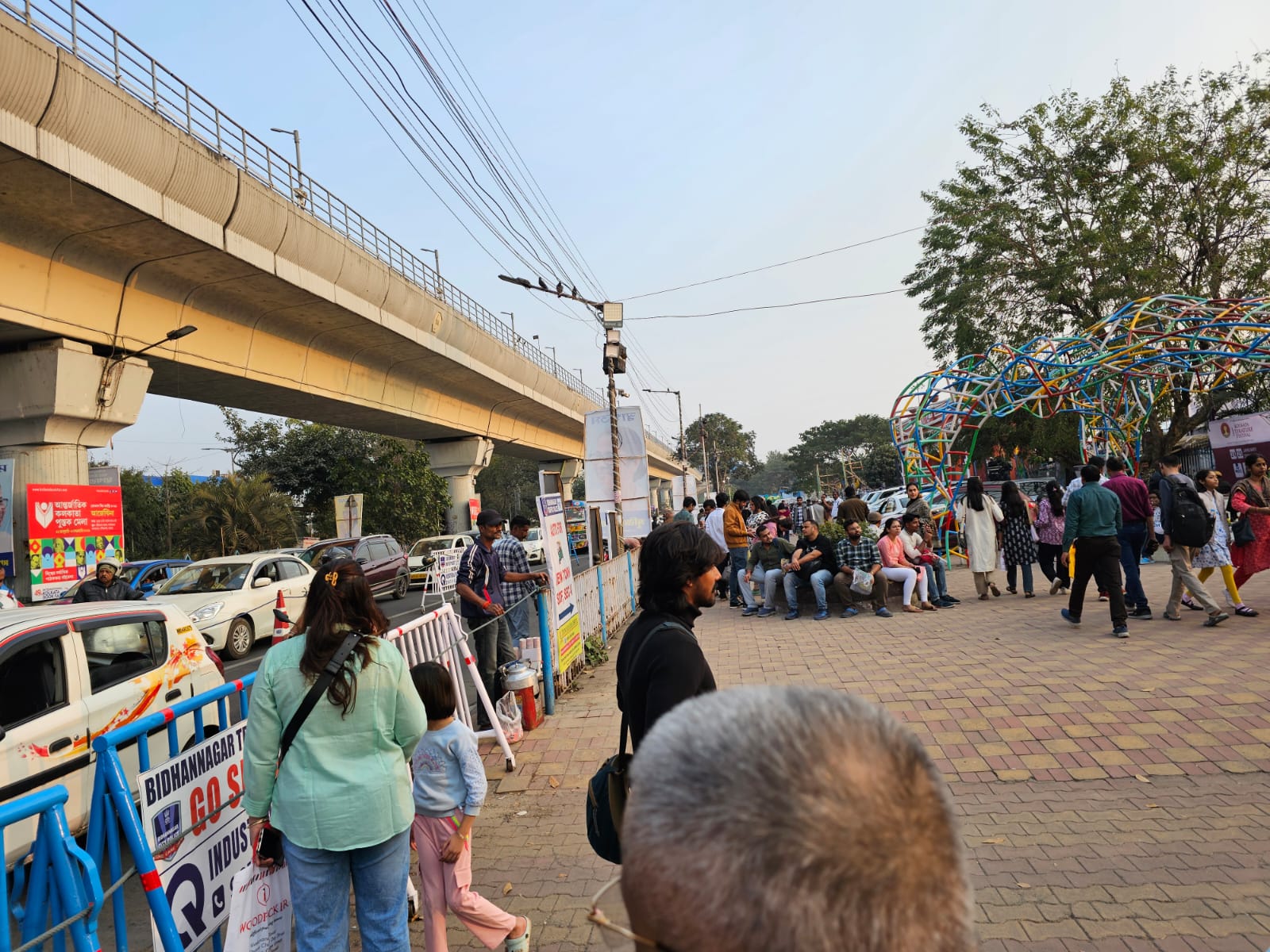
Earlier in the first week of January 2026, my first book, a collection of short stories, CALL OF THE WILD & OTHER STORIES got published. A long-cherished dream was realised. The publisher, Mr. Debashish Nandi asked me, “Have you been to Kolkata Book Fair?” then went on, “It is the biggest book fair, if not in the world, definitely in Asia and of the country, bigger than the World Book Fair of Delhi.” Honestly, I had stopped going to all kinds of “fairs” because of the unprecedented crowd and pollution. I think I last visited the World Book Fair or whatever it was called then, at least two decades ago, with my family and it was quite a challenge to navigate through the crowd who had no interest in the books but have come for an outing.

I am kind of paranoid about the crowd/ gatherings that Kolkata attracts, for example the Durga Puja. But Debashish insisted that I must visit the KBF at least once to experience the grandeur. I was in two minds, because my book is a work of fiction that I wrote over the past one year and an easy read, nothing serious that will engage the readers in conversations over a cup of tea. Frankly, I don’t expect it to create even a ripple in the publishing world. So, what’s the point of spending money for the airfare and hotel? However, my better half, Deepika too insisted that I should go.

I checked with my Kolkata friends about the location of the fairground and he suggested to look for accommodation in Salt Lake area which is very close to the venue and “able feet” can walk the distance as well. I remembered another friend from NCR had stayed somewhere there and again requested my friend, Abhijit to help find a suitable guesthouse in Salt Lake. Thereafter, I booked my air tickets and the guesthouse, Smriti Villa in GD block of Salt Lake, a mere 2 km from the venue.

I reached Kolkata on 25th morning, my dear friend Atish surprised me by coming to the airport to pick me up instead of sending the car as was discussed over video call. Atish aka Soni, hadn’t had chance to have his breakfast, so we went to kiosk at the airport to munch something and a cup of tea before going over to the guesthouse.

The guesthouse, Smriti Villa was on the first floor of a privately built house having 4 bedrooms with attached bathrooms, a lounge area and kitchen. It was more like a serviced apartment. The check-in was smooth and the manager was very polite and helpful. We had a cup of tea and left for the fairground. Soni, dropped me at the gate no.7 of the venue promising to join along with Abhijit in the evening at the guesthouse.  

The entry to the book fair was free but there was security check in place. The guard asked me, “Are you carrying cigarettes?” “No, I don’t smoke.” I replied. His next question, more like robot, baffled me. “Are you carrying lighter or matchbox?” “Why should I carry such a thing when I don’t smoke?” I retorted forgetting the advice of my friend to keep my mouth shut when confronting stupidity in Kolkata. I don’t know if the guard understood or not but waived me to enter.

I entered from the gate number 7 and realised the stall of the publisher Nandi Enterprises was at the other end near the gate number 2. I walked through the fair soaking in the sun as well as the atmosphere around me. The day was Sunday, a holiday for most and the Kolkatans, ever eager for festivities decided to throng the place in full strength. It was a family outing for them. I liked it because more people meant more sell of books. However, within next hour or so, my balloon of euphoria was punctured as I realised the majority of the crowd had no interest in the books, they simply drifted from one stall to the another, giving cursory glance to the displayed books. The only exception were the Bengali language publishers, Ananda, Mitra & Ghosh and Dey’s Publishing where there were queues to enter the stall. The only English language publishing house that attracted similar crowd was Hachette India stall.

As far as my book is concerned, it is just a collection of fictional short stories. Not a serious read but more like a book you read while waiting at airport/ railway station or on your journeys. My marketing/ sales instinct got the jolt when I saw, there was no effort on the part of the publisher to push his books, not just mine but whole bunch of his own publishing. And this was not an isolated case but across the book fair where the smaller publishing houses are simply there to announce their existence. I understand that it is not easy to campaign for your products if you are not trained in retail sales but one can perhaps hire youngsters for the duration of the fair to do the job for you, in fact, there were few stalls which were doing it. I spent almost 4 hours at the book fair and the thought dawned on me that it would have made no difference to the fate of my book if I had skipped it. Two people picked up my book while I was present inside the stall, going through the pages and left without purchasing any book!!!

In the evening, I decided to leave for my guesthouse but coming out did not see the familiar “Toto” or e-rickshaw anywhere. What I saw was the surging wave of humanity coming through aimlessly. They all wanted to be there at the Kolkata Book Fair, touted to be the biggest in the country. They were busy taking selfies and immediately posting on the social media. I opened the google map on my phone and started walking the 1.80 km to my guesthouse.

I was exhausted when I reached my room having woken up at 4 am and having been on my toes since then. I put my phone to charge and crashed out. My friends, Atish and Abhijit, as planned came around 7 pm and woke me up. It was a mini get-together of three Abs and turned out very pleasant and relaxing. Atish brought his elixir-of-life along with some Chakhna which we consumed in the space of 2.5 hours and then ordered food from Koshe Kosha, a restaurant I saw while walking back to the guesthouse from the fair ground. The food turned out to be good and tasty. During the evening, my lunch and dinner for next day was sorted out too, with Atish confirming to pick me up around 11 am and Abhijit inviting us over to his home in the evening.

Next morning, I woke up early and was ready for a cup of tea but found the guesthouse inmates including the manager were still sleeping. It was the Republic Day, a national holiday. I quietly slipped out to explore the neighborhood and find a tea vendor. Being in Kolkata, I knew there would be one not far from my location and I found one soon. A group of morning walkers, few years older to me, perhaps were enjoying their brew and vociferously talking amongst themselves, was what made me look at them and the existence of the tea stall. The “Lal Cha” or the black tea was very refreshing in the morning and I set out to explore further. I found a fruit seller at the corner from where I picked up a bunch of “Kathali Kola” or small banana, having very distinctive taste and aromatic, found only in the eastern part of the country.

Atish came around 11:30 am by which time I had my breakfast of Dosa and Medu Vada from Chennai Square having a Zomato rating of 4.4/5.0 and for a change, the ratings were right. We went to the City Centre Mall and had coffee at the Starbucks outlet. Atish reflected at the high price of the coffee there and the relatively much cheaper options available right across the road at the street-food vendor. I sipped my cappuccino and told him, “You can’t compare this coffee with that instant powder coffee, good things in life have a price.” He did not say anything but nodded his head in appreciation as he sipped his coffee.  Thereafter, we took a quick look at the mall and left for our lunch.

The Saptapadi Bengali Restaurant is a theme-based restaurant in honor of the Superstar Bengali Actors Uttam Kumar & Suchitra Sen’s movie of same name. The movie was superhit when it was released for public viewing. I haven’t seen it. In fact, I haven’t seen much of Bengali cinema beyond the masters, Satyajit Ray, Mrinal Sen and Ritwik Ghatak in my youth days. The restaurant was small having around 24-30 pax capacity but the service and food ensure regular footfalls. We found a table for two and settled down. We ordered Muger Dal, Posto Bora, Mangshor Jhol and Sada Bhaat. And rounded it off with Nolen Gur ice-cream. The main course was excellent, light and yummy, the mutton soft enough to fall out from the bones. However, the ice-cream was average, the same flavor from Amul is far more delicious. The restaurant manager took our photo and presented us with a hard copy.

We visited the book fair once again and it being a national holiday, was full of humans thronging the place with gay abandon. Like the previous day, there was no interest, no compulsion to buy books, just roaming around clicking photos and sliding in and out of the stall giving cursory look at the books. However, the food stalls were bulging with crowds and the ground around was littered with disposable plates and glasses despite the availability of wastebins. I bade goodbye and best of luck to Mr. Nandi and came out to sanity.

In the evening as we were getting ready to go to Abhijit’s home, Nandini aka Chhoti, the darling daughter of Atish called to inform that she’s in the vicinity, at a food festival with her friend. I wanted to meet her, my god-daughter, so we went to the food festival. It wasn’t crowded like the book fair, apparently because it had a entry fee. Most of the stalls were of sweets from across the state and few savory stalls as well. One of them was selling octopus (grilled, fried or curry). I checked with Atish if he would like to try but he flatly refused. Chhoti excitedly confirmed that she and her friend had already tasted and it was delicious. We moved on and saw a stall selling pickles; I wanted to check-out the stuff and requested a sample of “Chunda Mango Chutney”. Must inform here that Chunda is primarily sliced mango (or even raw papaya) and made across the country but the spices vary from region to region. Having tasted the varieties from up north to the west, I wanted to check the eastern variety. The sales person offered me a spoonful and then kept offering 5/6 other pickles/ chutneys for tasting without my asking. This was the kind of salesmanship I missed at the book fair. I ended up buying 4 different pickles/ chutneys, would have bought more but keeping in mind the limited space in my cabin luggage, I let go few of the delicious offerings.

At Abhijit’s home, they were just him and his wife, Shukla, their elder son with his wife is settled in USA while the younger one being in merchant navy was away on duty. The evening was well spent chitchatting with them. They also have a third member at home, a beautiful Cocker Spaniel. It was kept in another room and became restless, scratching the door and barking. I told Abhijit to let him out but he was hesitant, felt the dog might become aggressive and bite. “Why will he bite, unprovoked?” I asked him. “He had bitten both me and Shukla.” He replied. Still I insisted that he let Simba out to meet us. He brought him out on a leash. Simba started barking at me but his tail was swinging left to right all along… most likely he was seeking my credentials. I told Abhijit to release him from the leash and I will be responsible if anything goes wrong. The moment, the leash was removed, Simba became calm and came to me sniffing me all over the place. His next move surprised both Abhijit and Shukla, Simba put his paws on my knees and demanded petting. His bonding with me was symbol of pure heart.

Later, after dinner, Abhijit and Shukla dropped me at the guesthouse.

While I was at Abhijit’s home, my cousin bro called up to inform that he was back in Kolkata from his Rajasthan trip and he will have breakfast with me the following morning.

I was ready for my bro when he called up to inform that he was running a bit late and I should have my breakfast without waiting for him. Honestly, I had no idea about the distances in Kolkata otherwise I would have told him to send me his location and I would take a cab to his home. He was coming from Belghoria to Salt Lake to take me back there to meet my octogenarian Aunt and then to Kasba near Acropolis Mall for lunch meet with my other cousins. Looking back, I know it was quite a task which he did with a smiling face. And that’s not all, later in the evening, he dropped me at the airport too.

Lunch menu was decided much earlier, biriyani from Arsalan. The venue was my cousin sister’s home but was shifted to my niece’s home. My niece is just about a year younger to me and we were very good friends, regularly corresponded through snail mail in our younger days.

On my arrival on the day one, the number lock of my suitcase somehow got corrupt and I had to break it to open the suitcase. Thereafter, I had to buy a lock to be able to check-in the luggage but kept forgetting every time I went out. I kept my eyes on the markets we passed by but did not a see a single shop that could possibly have a small lock for the suitcase. In such a situation I fell back on the Q-Commerce sites and ordered one from the Swiggy Instamart. It was delivered in eight minutes.

I had a fabulous time with my cousins and their better halves and thoroughly enjoyed the biriyani but the icing was the Chhanar Dalna prepared by my niece, a typical Bong dish where the paneer cubes are completely caramelized crisp but the inside remains soft and white. It reminded me of my mother’s cooking. I found out how she made it and have plans to try out in the near future. Needless to mention, I presented my cousins and niece, a copy of my maiden book. Hope they’ll enjoy the stories.

My flight back home was horrible; the aircraft was old and seats rattled. On top of it the flight was delayed by 30 minutes (officially) and over 45 minutes actually. When I landed I realized it was terminal 2 instead of usual terminal 3 where AI flights normally operate. Thankfully, Guddu Kumar was on his way and I instructed him to come to T-2 instead of T-3.

I finally reached home around midnight. Besides not-so-good experience at the Kolkata Book Fair, I had a very good time with my friends and cousins.     

Banaras Diary: 2B in B

On 1st January 2024, Deepika & I, on our way to Varanasi aka Banaras, came back just before boarding the Vande Bharat Express from New Delhi Railway Station owing to a family tragedy. Ever since we have been hoping to visit the Holy City and this time our friends and long-time travel partners, Basus’ showed interest with finalising not only the itinerary but booking the train and Sugam Darshan (of Vishwanath Ji) tickets. They also shortlisted the hotels which we booked immediately. Then we were all set for exploring Varanasi or Banaras. The 2B in B (Basu’s & Bhattacharya’s in Banaras)!!

On 10th December night we embarked on the Shiv-Ganga Express from NDRS for Varanasi. The train left on time at 2005 hours with ETA Varanasi at 0600 hours. The AC first class was very nice and clean. Santanu had cautioned us that since there are no pantry car on the train, food will have to be carried with us which we did, only to find that the catering service was available right from snacks to dinner. We were five of us, so one berth was in a different cabin which I took up and slept peacefully. I was awake well before Deepika’s wake up call around 5:15 am. The train was ready to enter the station but was slowed down and finally reached the platform at 5:45 am, 15 minutes before time. The 15-days track record of the train revealed that it has been always on time or reached before time.

The driver of our pre-booked taxi was waiting for us outside the station. We were excited to have reached our coveted Holy city and took few pictures in front of the revamped Varanasi railway station. We decided to drop our luggage at the hotel but before that we stopped at a tea stall to quench our thirst with authentic Banarasi Masala Chai.

The driver, Rakesh showed us two iconic shops, Chachi ki Kachauri and Pahalwan Lassi, the latter had multiple outlets, all claiming to be the original. The uniqueness of Chachi ki Kachauri is the sitting arrangement, empty oil/ghee cannisters of 15kg are used as both seat as well as table, lined on the footpath next to the shop. A 30 rupees plate consisted of 4 kachauris with sabji and jalebi. The items were average in taste with the jalebi being a bit rancid, at least what we tasted.

Thereafter, we decided to walk to the Assi Ghat following the direction given by the hotel guard. The shop of Pahalwan Lassi was opening up, Santanu and I decided to check what’s available. The shopkeeper said that the lassi will take some time to prepare but Malai-O is ready. We readily bought two portions and gobbled it up in quick time before others could reach us. Afterall, Malai-O was on top of our culinary pilgrimage!!

When we reached Assi Ghat, we found the place sparsely crowded with yoga class happening at the adjacent ashram. Soon, the boatmen started marketing their boats for a ride. Sangeeta and Deepika had been entrusted with all negotiations and they hired a boat for an early morning ride. The boat ride was leisurely covering some of the important ghats like, Tulsi Ghat, Ganga Mahal Ghat, Hanuman Ghat, Dasashwamedh Ghat, Manikarnika Ghat Chausatti Ghat, Munshi Ghat, Nepali Ghat, Raj Ghat. It was cloudy as well as foggy so our boat kept close to the banks for us to see them clearly. Some people in other boats were throwing bird-feed attracting flocks of seagulls prompting us to take a few pictures. We spent almost two hours on the boat ride and the banks of Ganga before returning to the hotel only to find the rooms still not ready. We were directed to the third floor waiting room where we spent another hour eating Prayagraj Guava and playing cards (29).

By 1 pm we got our rooms and the first thing we did was to take bath and wear fresh clothes. Sangeeta ordered simple daal-chawal and aloo-gobi sabji for a late lunch. The daal was very tasty as was the sabji but later when we ordered the same dishes, it was average, maybe we were so hungry that our taste-buds were simply happy to get the taste.

We left for Assi Ghat around 4:30 to meet up with our boatman for the evening ride upto Namo Ghat and to watch the evening Ganga Arati at Dasashwamedh Ghat. The latter was a disaster, mainly due to our desire for the boat ride to Namo Ghat which was the farthest consuming precious time. When we reached Dasashwamedh Ghat, the place was jam-packed with boats of different size and shapes. Our boatman did his best by shoving other boats to take ours as close as possible. Still we were far off to get a real view of the spectacle of the evening arati.

We were given the first dose of commercialization of religion/ rituals here at the Dasashwamedh Ghat. At the end of the Ganga Arati, one of the apprentice pandit carried the ‘pradeep’ to the devotees/ audience placed on a big plate or thaali to take the blessings. We realised the blessing is directly proportional to the donation placed on the plate. When he came to us, Sangeeta searched her purse and could find only a hundred-rupee currency which she was compelled to place on the thaali, at the same time Deepika placed a twenty-rupee currency on the thaali. The young apprentice pandit put a ‘tika’ on the forehead of Sangeeta, seeing that Deepika expectantly asked for the ‘tika’. She was rudely rebuked by the man saying, “aap sleeper class ka ticket le ke first class mein safar karna chahate ho?” meaning, “you have paid for the second class whereas you want the luxury of first class.” This type of hypocrisy in the name of ritual is rampant across all the religious places (mandirs) in Varanasi. And the people wonder why the youngsters avoid such places.

We headed back to Assi Ghat and found it crowded with people both local as well as tourists. There was a pizzeria at the ghat where we thought we will have our dinner but the place did not have space even to stand. We came out and contemplated having our dinner at the hotel itself. Shinjini suggested, we try out the famed Banarasi Chaat. The closest one was at the Gaudulia, the famous Dina Chaat Bhandar and their signature chaat is Tamatar Chaat. The shop is located on a street which is not very wide and with parked vehicles on either side of the road, only one lane on either side is available for commuting. There were a sizeable number of customers waiting for their chaat which spilled on the road creating complete chaos. Looking at such chaos, Santanu wanted to leave immediately but was persuaded to stay put. I am sure, he mumbled a muted ‘thank you’ when he tasted the variety of chaat. Personally, I liked the aloo-tikki and the golgappas which were very different from what we get in Delhi.

Deepika and Santanu were brave enough to wake-up at 4 am and go to the Assi Ghat to witness the Morning Ganga Arati. I needed my 6 hours of sleep. We skipped breakfast to reach Kashi Vishwanath temple by 9 am at the gate no.4 for the Sugam Darshan for which we had purchased the ticket on-line. Though, we had a soft-copy of the ticket on our phones, Santanu insisted on a hard-copy (paper) and I realised the importance when we had to deposit our phones, purse (after taking out the money because otherwise how will we pay the ‘dakshina’), belt and smart-watch. The physical ticket needed to be endorsed/stamped at a location 100 metres from the entry gate. The person supposed to endorse wanted us to take the services of a designated pandit or ‘Panda’ which we refused. He tried hard to push us to ‘hire’ a panda by sending us to another person deliberately delaying process. Santanu lost his cool and gave him a sound verbal thrashing.

I do not know if the famous “Baba Vishwanth Gali” still exists in its old glory or not because the temple premises has been expanded hugely with the original temple in the middle of it. I had been to the old temple going through the gali negotiating the bulls or ‘Nandi’ of Lord Vishwanth many years ago and had the darshan of lifetime participating in “Doodhabhishek of the Lord” (milk bath). The blessings were free then. Deepika having learnt her lesson at the boat, offered a 500-rupee currency to the Mahant at the temple and received a garland as blessings. Considering the huge number of devotees visiting the temple every day, these Mahants must be earning few lakhs every month, tax-free.

A Panda had assigned himself to our group and guided us to the Gyanvapi temple within the main perimeter or parisar of the temple narrating us the story. According to the legend, the original Shivalinga was thrown in the well of the temple to save it from destruction by the army of Aurangzeb.

When the Kashi Vishwanath Mandir Parisar was created, many structures were demolished or cut-off, one such casualty is the Manikarnika Ghat, the cremation ghat believed to take the soul of the departed straight to heaven, was quite big as I remembered but now had shrunk considerably. Many terminally ill patients would come here in their last days waiting to depart and cremated hoping their soul to reach the heaven.

By the time we came out, breakfast time was over, we headed back to our hotel but decided to try out some restaurants nearby. After deliberating between an unknown brand of Banarasi Biriyani restaurant and the much known/ visited Sagar Ratna, we settled for the latter and had a hearty lunch which turned out to be the most expensive one as well. There was a Paan shop below the restaurant from where we had the flavourful Banarasi Paan, besides picking up few packs of Paan Masala.

In the evening, the girls wanted to explore the market for Banarasi sarees, Santanu and I had to go along feeling thoroughly bored. While they were busy stock-taking of the shop, Santanu and I explored the street from one end to the other which had nothing except garment shops. We came back and played few rounds of TwentyNine before going to the dining hall for dinner. We all were feeling tired and decided to call it a day. Santanu and Deepika wanted to visit Assi Ghat once more and Shinjini too showed interest in joining them. I knew it would be very difficult for Deepika to go for it twice in succession but did not discourage her. Next day, only father-daughter duo went to watch the morning arati at the Assi Ghat while we slept till late.

As we finished our breakfast, Sangeeta got a call from Rakesh our taxi driver confirming that he’s at the hotel gate. Our plan was to visit Sarnath, Buddhist religious site where Gautam Buddha gave his first sermons to his 5 disciples and Ramnagar Fort, the 18th century sandstone structure built by Maharaja Balwant Singh, the Kashi Naresh (King).

Our first destination was the Ramnagar Fort where we reached around 9:40 am and had to wait for 20-minutes as the fort gates opens only at 10 am. We bought the tickets for the museum not realising that it was the only thing that was to be experienced. Although, it is called a fort but the structure was far from being a fort and more of a palace with garages for the buggy, palanquin and cars in later period. The museum showcased the furniture, clothes and armoury of the bygone era. The most troubling part is the bad upkeep of the place, there were visible layers of dust on the artefacts, the lawns are not tended regularly as a result there are wild growths. No guides to explain the exhibits. And the Ganga River flowing below the fort is at her dirtiest. The authorities need to ramp up the place urgently and ensure proper maintenance. Salarjung Museum in Hyderabad can be their benchmark. The most memorable part our visit is the lassi we had from the 70 years old Shiv Prasad Lassi Bhandar. The thick Rabri Malai Lassi served in a Kulhad (earthen glass) was the authentic, flavourful and a must have when you visit the Kashi King’s Palace.

Rakesh suggested that we take a tour of the Banaras Hindu University (BHU) as by the time we return from Rajgir, the roads will be too crowded. The campus of BHU is huge with individual buildings and residents for both the teacher and scholars of different streams of knowledge. There is a Birla Temple in the campus attracting devotees. Interestingly, the deity in this Birla temple is different from all other Birla temple, the presiding deity here is Mahadev as opposed to the Vishnu and his consort in other Birla temples across the country viz. Delhi, Kolkata.

We took the service of a guide to explain us various sites at the Sarnath. We realised the importance of a guide while touring the historical sites in Madhya Pradesh. Surely, lot of times, the guides are not deeply aware of the history of the place but they do try to entertain you with local legends of the site. The guide’s service is “technically free” as per the govt order but they are open to receiving any amount that the tourist offers them. Anyways, our guide took us to the Buddha temple premises and showed us the “Bodhi tree” believed to be the place where Gautam Buddha gave his first sermon to his first five disciples. At the cost of being politically incorrect, I have sincere doubts that the Bodhi tree is 2500+ years old!!! We saw the temple constructed and maintained by the funding of Thai government. Then saw the tall statue of Gautam Buddha (80ft 9inches indicating the lifeline of Buddha including time spent in the womb of his mother), surrounded by a waterbody full of lotus and other flowers. The garden boasted of the replica of the Ashoka Stambh and Dharma Chakra. The Buddha statue is sculpted in line with the now destroyed statues at Bamiyan, Afghanistan. We found the size of the statue and the surroundings impressive but the sculpting is very amateurish missing finesse of the smaller one inside the temple.

The guide took us to the archaeological site from where the artifacts were excavated and now housed inside the museum but there was a huge line-up student from various schools around Varanasi who have come on discovery trip. The guide then suggested and took us to a village of craftsmen supposedly creating the famous Banarasi silk sarees and dress materials. It was a big disappointment as it turned out to be a regular shop in a village where they have a show-piece handloom only. We quickly came out and proceeded to the museum picking up few artifacts from the stalls on our way. The museum had mostly remnants of the sculptures and few utensils of the bygone era. Some of the monoliths were awe inspiring. Deepika and I have seen such artefacts and more on site at Ajanta, Ellora, Bhimbetka in the recent past and every time we felt proud of our rich heritage.

When we started for Varanasi, it was past our normal lunch time and all of us were hungry, the most popular eating places on our list were in Goudulia which was quite far from our location. Rakesh, our driver suggested we look for places in the Cantt. area which will fall on our way. Sangeeta wanted to go to the Taj property but the rest of us restrained her and found a decent eating place called Tandoor Villa right opposite the Taj property. I haven’t had my eggs for three days and when I saw they have egg-curry, I couldn’t resist, except Deepika, who opted for a vegetarian dish, all others echoed their choice for the egg-curry with rice. It was a very satisfying lunch especially as the service was prompt and the serving guys were most cordial. We left some space in the tummy for the Giani’s ice-cream and the Banarasi Paan available right next to the restaurant. We explored the street and found a shop selling Punjabi papad and pickles besides other nick-nacks and bought a few items.

On our way back, Deepika, Sangeeta and Shinjini went to a Saree shop called Taj Express close to our hotel while Santanu and I came back to rest for a while. However, in just about 15-minutes, Santanu came and suggested something that was too tempting to ignore. We came out of the hotel and headed towards the BHU. The original Pahalwal Lassi shop was close-by where we stopped to have Malai-O, the creamy, extremely light dessert only available during the winter months. Then we couldn’t resist the Malai Rabri Lassi, I am at loss of words to describe thick, rich flavourful drink that instantly uplifts your mood and energises. Next, we had the Banarasi Paan from the shop below the Sagar Ratna and bought few packs of Paan Masala as well. We walked the length of the street, almost to the gate of BHU and came back. Just as we were to go in, I found a small shop that was selling Champaran Meat. I have heard about the dish, a rich, aromatic mutton curry cooked in earthen pots. Since we were on a culinary pilgrimage, we decided to try it out. We ordered a pot of mutton curry with rice and a sabji for Deepika and told them that we will pick up after an hour or so. Our hotel was vegetarian only and we did not want to offend their sensibilities and asked him to pack it discreetly.

Traditionally, Champaran Meat is a rustic, slow-cooked mutton curry from Bihar, known for its smoky flavour, cooked in a sealed clay-pot with mustard oil, lots of onion, garlic and whole spices till the mutton is tender and juicy with its own juice. The curry is semi-dry and often taken with plain boiled rice or tandoori roti. We had it with both. The curry reminded me of the Chettinad Chicken I had in Chennai. There were fire and smoke and water oozing out from ear, nose, mouth and eyes and the tantalising, delightful taste prodded us to have more of it till the last piece. Later, Santanu and I collected the bones in the pot and dropped it at a garbage dump, ensuring the sanctity of Coco Casa.

In the morning, after breakfast, we got ready and packed our bags, ready for check-out and informed the front desk that we going out for short while and shall check-out by 12 noon as discussed and agreed when we checked-in. One of the front desk guy named Vimlesh Rawat started acting smart, telling us to vacate the room then only or latest by 11 am. So, I casually asked him, “Or else?” He was about to tell me the hotel policy, when Sangeeta pointed to him that his own Manager had agreed to the 12-noon check-out. I found this man to be unfit for hospitality industries, not because of this incident but he had been rude even when we were checking-in and never once greeted any of the resident guests.

We walked out of the hotel and headed towards the Durga Mandir, supposed to be within 500-600 metres from the hotel, turned out to be approx. a kilometre. The day being Sunday, there was rush of devotees, I decided to stay out and did Santanu. It took about 25-minutes to complete the darshan and once Deepika, Sangeeta and Shinjini came out, we headed for the Sankat Mochan Hanuman Mandir. Initially, we thought it to be close-by but it turned out to be quite far from the Durga Mandir. It seemed, lots of people have ‘sankat’ or problems in their life because the place was really crowded and unmanageable. Deepika & Shinjini went for the darshan while we waited outside.

We came back in the hotel before 12-noon and checked-out as our cab had come. Santanu announced that our train, the celebrated Vande Bharat Express is running late from Delhi and now is scheduled to depart from Varanasi an hour late around 4 pm. We had one extra hour but nowhere to go as Rakesh, our driver told us that he has another assignment from 2-pm and therefore can’t take us anywhere else. We stopped at a paan shop from where our revered PM had once had a paan. I asked for the same kind of paan that he had and it was really good, melt-in-the-mouth kind. We packed up few paan for post-dinner munching.

We were dropped off at the station around 1:45 pm and didn’t know how to pass the time but Shinjini found out an Executive Lounge where our entry became free courtesy the ICICI Bank credit cards. We had free vegetarian lunch and hot tea/coffee. The permit was for two hours and we easily passed the time playing TwentyNine. The train from Delhi finally entered the platform around 3:30 (1.5 hours late), the usual time for cleaning the train after one-leg of journey is 90-minutes but the staff entrusted with job did it in 60-minutes and the train was ready for departure around 4:30 pm. We estimated that if nothing untoward happens, we should reach Delhi around 12:30 am, it was not be… the Vande Bharat Express has a top speed of 130 kmph and it rarely reached anywhere near it, keeping the speed in the vicinity of 60-70kmph most of the time. However, on the brighter side, the seats with ample leg space in the Executive Coach, the food and the service, more than compensated the delay. We finally reached New Delhi Railway Station at 1:55 am. The station at that hour looked quite different, devoid of normal hullaballoo of the day time, the quietness and the low lights made it eerie. We came out looking for a pre-paid cab but none was available, finally Deepika negotiated with private cab driver and we took it to reach home around 2:40 am. We slept around 3 am, about the time, Basu’s reached their Gurugram home.    

Healthy Eating Bong Way

Bengalis have been doing “healthy eating” long before it became an Instagram trend.

Our detox starts with নিম-বেগুন and উচ্ছে ভাজা, শুক্তু and not green juice or green tea.
Our multivitamin is লাল শাক, পুঁই শাক, কুমড়ো শাক, পালং শাক, হেলঞ্চা শাক, মেথি শাক and can name a few more but not kale .
Our protein comes from ডাল আর ডালের বড়ি, not powder shakes.
Our omega-3 and vitamin d are from মাছের ঝোল, not capsules.

And talk of Sundays – the sacred day of খাসির মাংস! It’s not a meal; it’s a festival — a ritual of togetherness, love and laughter, and that inevitable দু-পিস আলু that reigns supreme in every gravy. Because আলু isn’t just an ingredient; it’s an emotion for a বাঙালি soul . A Bengali curry without আলু is an unforgivable sin.

Our চাটনি is not only sweet it has ingredients like nuts and dry fruits and is nothing less than any digestive aids.

Our মিষ্টি দই, is a probiotic desert, of course served with love.

So yes, our food has it all — তেতো দিয়ে পরিষ্কার, শাক দিয়ে পুষ্টি, ডাল দিয়ে শক্তি, মাছ দিয়ে গ্লো, মাংস দিয়ে এনার্জি, চাটনি দিয়ে হজম, আর দই দিয়ে আরোগ্য।

In truth, বাঙালির রান্না মানেই balanced diet with added emotion — a little তেতো for wisdom, a little মিষ্টি for hope, and a lot of সর্ষের তেল for attitude! 😀😀

The sad part is that we have traded it all for avocado toasts and coffee shop culture. The once-thoughtful, home-cooked বাঙালি খাবার is now lost in the maze of oily বিরিয়ানি and wrap menus. The mighty শুক্ত has been replaced by nuggets, and মাছের তেল has surrendered to burger grease.

(collected)

Howdy Buddy

Howdy Buddy?

Am Good.

Ever since I have come of age, “Am good” has been my standard response to “Howdy buddy”. Even when I am in pain or distress. I was trained to hide my discomfort not by anybody but the circumstances and environment around my growing up years. The only person to whom I could confide about my physical and/or mental distress was my mother and she’s long gone, forever.

The festival season in India begins with the arrival of Lord Ganesh… Shree Ganesh Chaturthi till the English New Year. Then of course there is Sankranti followed by Saraswati Puja culminating in the festival of colours, Holi. Over six months of celebrations.

There’s an interesting story narrated by my mother… Lord Ganesh was upset when his human head had to be replaced with an elephant head, he felt, no one will respect or pray to him as he was deformed. His father, Lord Shiva arranged for a race between him and his brother Kartikeya to circumnavigate the universe and whoever wins the race will be have the honour of being Pratham Pujya or the first to be worshipped. Lord Kartikeya started off on his Peacock and took an early lead but Lord Ganesh stayed back and simply circled around his parents Lord Shiva and Goddess Parvati. He declared, “My parents are my universe.” Impressed by his wisdom, Lord Shiva granted him the boon of being the Pratham Pujya. He further declared him to be the Vighnaharta, the remover of all obstacles which is why Lord Ganesh is invoked before starting anything new. Jai Ganesh. Jai Vighnaharta.

The festival season is supposed to be of merriment and joyous occasion; however, I invariably get emotionally charged and depressed during this time. As I am not a person to confide my thoughts to others including my partner, I tried to figure out the reason.

The emotional blackout resulting in deep depression stems from my childhood. I was the seventh child and that too accidental, totally unplanned. My other siblings were born in quick succession with max gap of four years whereas I have a clear difference of at least seven years from my elder sibling. And my birth did not bring any joy to the family instead it brought discomfort and misery. My father lost his job at the bank and had to settle for a job at one-fourth the salary, finding it difficult to feed so many mouths. Overnight we slipped into poverty from being affluent.

I remember going to the “ration shop” with my father and brothers to get our staples of rice, pulses and wheat which used to be sub-standard, full of pebbles and sand. My mother and elder sisters would painstakingly clean them before use. We lived in a forty-square-feet, two room house where one corner of the first room doubled up as kitchen. Cooking used to be on coal fired angithee or oven which made my mother an asthma patient in later years. The word or concept of luxury was not in our dictionary; we survived on a day-to-day basis. We were not supposed to get unwell as that would mean spending scarce resources on medicine. But as fate would have it, my father became very sick with stomach ulcers that caused him extreme pain and discomfort not to mention the high cost of medications. He suffered for almost ten long years before getting relief from Unani medicines from the senior Hakim of Hamdard.

In such an environment, the festival of Durga Puja brought gloom over the family, not joy. The friends or the peer group would flaunt their new clothes… one new outfit for each day of puja when we could barely have one set for the entire duration. As I grew up, I became conscious about our predicament and I would become depressed with emotional outbursts. Today, affordability is not a concern but the pain is different, missing the ones that were dear to the heart. This depression is chronic without relief.   

The situation improved partially when my eldest sister and brother started working after their college and two other sisters got married to their boyfriends. My parents grudgingly accepted but I have a suspicion that they sighed with relief as well.   

I particularly remember one afternoon, when at the lunch, mother informed there is only dal-chawal and no sabji. I started crying. My mother went to a neighbour to borrow a potato to make some fries for me. Whenever I think about that afternoon, I am drowned in utter shame.

Another instance that makes me feel ashamed of myself happened years later in my teenage years. Most of my friends in school would go to Kolkata (then Calcutta) during the summer break to their relatives. We too had relatives from both parent’s side but the cost of making such a journey deterred us. Anyways, it was the summer break after the class-10 exams when a close friend was going alone to Calcutta and he urged me to go along with him. He was not privy to my financial constraints and kept prodding me. Unable to resist I demanded my parents to provide the funds for the trip. My friend’s parent insisted on traveling by Rajdhani Express with just three in-between stoppages of less than 5 minutes, a safer journey but much more expensive compared to the other trains. My father provided the funds which I did not ask from where or how then but much later, when he had left this world, I suspected was it was borrowed from some source. I did not mean to embarrass him but inadvertently by my stubbornness and immaturity, I did. And worst of it I never said sorry to him.

It is not that I did not have fun, joyous moments growing up, there were a quite a few occasions that brought happiness in our life but they were few and far between. We used to have great times whenever my maternal uncle visited us. Also, I had memorable time when I first met my (maternal) grandparents. In their own way they spoilt me throughout my stay with them. Happy memories.

I being the youngest of the lot, had the privilege of observing the elders, both their wisdom and follies. As an individual, I have strived to use their wisdom and shun their follies from my life. As a struggling family, there wasn’t much thoughts about higher education or career development. The living thought was to complete the college degree and find a job, any job. Only the collective money could improve our lifestyle. That was the thought of the time. There was no one to guide or show a path to the youths to go for higher education or even attempt to become a govt/ bank officer. All my siblings started working at the lowest rung in private organisations taking years to climb up the ladder. I was no exception. I did try to become a Chartered Accountant (CA) and appeared for the entrance exam failing in one subject by two marks. There was no one to push or encourage to try again.

However, I was lucky to have two excellent teachers or as I call them Gurus, who poured their knowledge onto me and taught me the fundamentals of marketing and management in real world. Their teachings surpassed the teachings of the management institute where I got my post-grad diploma in management. The diploma has remained a piece of paper only to add a line on my resume.

My friends and family are blessed with one advantage – faith in something or someone superior in whatever manifestation. Whenever they are in distress or otherwise, they pray to that power. They feel inner peace. I do not recall when I last prayed. I simply cannot bring myself to ask any favour or boon from something or someone who’s existence, I find questionable. I do not pray; I do penance for living in this world by accident. I strongly feel, I don’t deserve to be here.

Why am I telling you all these things?

Because, year after year during the festive time, my inner demon haunts me with these thoughts. I have grown intellectually as well as materialistically to know that there’s no point in pondering over the past. But on a rainy evening, when it gets dark, I experience inexplicable panic. I don’t share my fear. I don’t share my thoughts. I don’t speak out. I understand in this world filled with noise and chaos, silence is golden. Less I speak, it brings peace around me now. And that’s how I shall drift away.

But then you ask me, “Howdy Buddy?”

I reply with a feeble smile, “Am Good.”  

Threat to the City

The month of August in Delhi has been acting peculiarly, it’s nice and breezy when it is raining but the moment the rain stops it is unbearably humid prompting Sravani to switch on the air conditioner. Rudro has come home after almost 3 months training at a undisclosed location. He is looking fitter than when he was transferred back from Kolkata to the Special Task Force of National Security Agency. They were sitting in their new 3-bedroom apartment on the 10th floor, a govt accommodation in Netaji Nagar, heart of New Delhi.

“Since you are here for 2-weeks furlough, let’s go somewhere to chill out. I have heard, Goa is particularly beautiful after the monsoon.” Sravani spoke while snuggling up to Rudro.

“Good idea, let’s get Aniket and Sunanda along as well. But I will have to get the clearance from my office for leaving the station.”  Rudro responded gently combing the hair of Sravani with his finger.

“Can’t we go on our own?” Sravani sounded a bit annoyed.

“We can but going out with friends will be more joyous.” Rudro replied.

Before Sravani could say anything, Rudro’s phone rang and he got up answering the call.

“Hello, Rudro speaking.”

As he listened to the caller on the other side, Rudro’s jaws tightened. Finally, he told the caller, “I will see in 30 minutes.” Then he called up someone and asked the person to meet him at the Safdarjung Tomb and quickly changed into a pair of jeans and t-shirt. He kissed Sravani and told her, “I will be late, don’t wait for me, have your dinner.” He drove off in his XUV 700 and reached the Safdarjung Tomb stopping on the service lane while waiting for his contact to show up. The weather of New Delhi hung heavy with the promise of rain, but for DCP Rudro, it felt like the suffocating silence before a thunderstorm.

ACP Ananya Singh, knocked on the window of Rudro. She had reached completely unnoticed by Rudro and he liked it. Rudro unlocked the car and she climbed in; to outsiders, it may have looked like a man meeting his girlfriend as they talked animatedly inside the car. Rudro took out a small chit and handed over to Ananya who looked at it in confusion, the chit had only three words written on it, “Mustafa, Tiger, 72 hours”.

“What does this mean?” Ananya asked.

“Mustafa is the code name for the terror outfit across the border, Tiger is likely the Home Minister and 72 hours is obviously the ticking clock. But I don’t know when this message was intercepted and how much time has already elapsed.”

Rudro started the engine and said, “We are going to find out soon.”  

It took him twenty minutes of fast driving to reach the dingy hotel in Paharganj. He asked Ananya to wait in the car while he went inside. He knew the room he wanted to visit and went straight to the second floor and knocked on the door. The door opened about 6 inches and was stopped by the chain. He looked at Rudro and smiled opening the door fully for him to enter.

“I am glad I could reach out to you.”

“Well, in our trade luck do play a role, you were lucky that I was home otherwise my phone would have switched off. But tell me how did you come across this news.”

“Sir, with due respect, a good agent never reveals his source. But I can tell you that it came from deep inside the organization. The person risked his life to pass on this to me. If he is caught he will face a torturous death. We have now 70 hours left to stop the incident.”

Rudro’s gut, honed by years of sniffing out trouble in the capital’s underbelly, screamed at him. This wasn’t a routine threat. “Mustafa” was a known terror outfit, infamous for its meticulous planning and brutal efficiency. “Tiger” was an internal codename for a major target—something big, something public. The “72 hours” was a ticking clock.

He thanked the man and asked him to dig further to find out the target and the place.

“The information is confirmed. We have to find out the engagement details of the top brasses in the govt for next three days immediately.” He told Ananya.

“I will get on the job now.” Ananya assured him and went to her car which had followed them earlier and waiting at a distance.

Rudro called up Col. Diwakar Pandey and informed him of the situation. After about 15 minutes discussion Rudro was able to convince Col that the matter is serious enough for the STF to get involved rather than leaving it to the local police to handle. Colonel asked him assemble his team but instructed him to be in the background and let the senior member of the team to front the operation. ACP Ananya Singh, a sharp analyst with a photographic memory, and Sub-Inspector Akash Verma, a tech-savvy whiz, were his right and left hands. They worked through the night, cross-referencing intel, monitoring digital chatter, and analyzing the cryptic message.

Ananya’s breakthrough came at 3 AM. “Sir, there’s a G-20 summit day after tomorrow with many state heads attending. The keynote address will be delivered by the Prime Minister of Italy, a known voice against the terror organization. Both our PM and HM will be attending the session.”

“Where?” Rudro asked, his voice low and intense.

“She’s scheduled to address a public gathering at the Bharat Mandapam.”

The pieces started to fit together. A large public gathering, a high-profile target, and a terror group that specialized in spectacular, high-impact attacks. The attack would be brazened, designed to cause maximum chaos and destabilize international relations.

Akash, meanwhile, had found a digital ghost. A single, encrypted photo uploaded to a dead-end server. It was a picture of a crowded market, unremarkable at first glance, but his software detected anomalies. A small, seemingly random collection of people in the background, all wearing similar hats, their faces obscured. Their movements were synchronized, their gazes fixed.

“That’s not Bharat Mandapam, sir,” Akash said, zooming in on a street sign. “This is a photo from Sarojini Nagar market. It was taken this morning.”

A cold dread washed over Rudro. The G-20 summit was a feint. The actual target was a soft one, a place where people felt safe. Sarojini Nagar, a bustling hub of life and commerce, was a perfect place for mass casualties. The terror group was planning a secondary, more devastating attack to cause panic while the authorities were focused elsewhere.

With the clock ticking down, Rudro split the team. One unit headed to Sarojini Nagar, the other to secure the Bharat Mandapam area. Rudro himself led the charge into the crowded market. Navigating the labyrinth of stalls and shoppers, he used the image as a guide. They spotted them—three men, their eyes darting, their hands clutched around backpacks that looked unusually rigid.

“Alpha team, proceed with extreme caution,” Rudro’s voice crackled over the radio. “Suspects sighted near Gate 1. Move to intercept. No shots fired unless absolutely necessary.”

The operation was a whirlwind of controlled chaos. Rudro’s team, disguised in plain clothes, moved in with practiced precision. They closed in on the three men, who realized they were cornered. The older man of the group dropped his backpack on the ground and pulled out a gun and pointed it towards the policeman near to him. Rudro tried to aim his gun on the man but the policeman came between them. Taking advantage of the situation, one of the other two made a break for it, but Rudro grounded him with a single shot on his leg and then sprinted across to the fallen man finding the hidden detonator in the man’s palm before he could detonate the bomb. Meanwhile, the older man shot the policeman before quick bursts from Ananya Singh’s gun killed both terrorists. There was a flash of red light pulsed ominously from the fallen backpack of the third terrorist. Rudro’s heart stopped for a moment and jaws hardened. Ananya Singh went over to the fallen man and relieved him of the detonator. The bomb squad, which has been waiting at a distance, came in and defused all three bombs. The bombs had more than enough fire power to bring down half the market.

“Don’t. Move,” Rudro hissed, his knee on the man’s chest as the downed man tried to sneak away.

A tense silence descended, broken only by the distant cries of street vendors and the blaring siren of the ambulance. The three bodies were transferred to the hospital while the forensic team came and cordoned off the area to collect valuable clue. Unknown to Rudro, Colonel Diwakar Pandey had a chat with Ananya Singh and given her a two-word instruction, “No prisoners.”

Ananya Singh gestured Rudro to come and look at the other two dead terrorists. Rudro, put the handcuffs on the man before going to the fallen men. As soon as Rudro reached the spot, the man got up and tried to run but Ananya took an aim shot him on the head, killing him on the spot. A wave of confusion turning into a collective sigh of relief as the truth slowly dawned on the public.

“Why did you do that? The guy was injured and couldn’t have gone far. We could easily have captured him.” Rudro was angry and demanded an answer from Ananya.

“What was the point of arresting such scums? He was a low order operative only, would have been of no use to us. I am sure he wouldn’t have any information beyond this op. Whereas, we have ensured the safety of the city.” Ananya Singh defended not revealing the instructions of Colonel Diwakar Pandey.

Yes, the city was safe. The G-20 summit went off without a hitch. The news hailed the ATS team of Delhi Police lead by ACP Ananya Singh and SI Akash Verma as heroes, their faces plastered on the front pages. But Rudro knew the real victory wasn’t in the headlines. It was in the silence of a market that didn’t explode, in the laughter of people who were still alive, and in the quiet satisfaction of a job well done. He looked out at the city from his 10th floor balcony, a sprawling, chaotic, and beautiful beast. A single tear of relief rolled down his cheek, a testament to the price of peace. The storm had passed, but he knew another one was always on the horizon. He’d be ready.

Discovering the Gems of India -2

DAY THREE: Going Back to the Abode of our Forefathers

After concluding the first leg our journey, we were ready for the next, the first of which was a 100 km journey to Bhimbetka Rock Shelters, arguably the first settlement of humans in the subcontinent. And from thereon to the cleanest city of the country, Indore.

We had asked for our breakfast to be ready by 7:30 am but the hotel staff and the chef came in only after 7:30 to prepare our food, incidentally, we were the only guests at that time. We had our breakfast as quickly as possible and embarked on a journey of 2 hours 10 minutes, crossing the town of Sanchi. Initially, we drove through the two-lane state highway (Udaigiri Road-Ucher Road-Gulgaon Road) leading us to 4-lane NH 146 (Sagar-Bhopal Highway), then to NH46 till we reached the serpentine road leading to Bhimbetka Rock Shelters. The recent heavy downpour across the country has done extensive damage to the roads, not sparing even the National Highways. We were lucky that the day begun as dry and continued till we reached our destination.

The Bhimbetka Rock Shelters are an important archaeological site that spans the Paleolithic and Mesolithic periods, as well as the historic period. It exhibits the earliest traces of human life in India and evidence of the Stone Age starting at the site in Acheulean times.  It is a UNESCO World Heritage Site that consists of seven hills and over 750 rock shelters distributed over 10 km. with evidence that at least some of the shelters were inhabited more than 100,000 years ago.

The rock shelters and caves provide evidence of human settlement and the cultural evolution from hunter-gatherers to agriculture, and expressions of prehistoric spirituality. Some of the Bhimbetka rock shelters feature prehistoric cave paintings and the earliest are dated to 10,000 BCE, corresponding to the Indian Mesolithic period. These cave paintings show themes such as animals, early evidence of dance and hunting from the Stone Age as well as of warriors on horseback from a later time (perhaps the Bronze Age). The Bhimbetka site has the oldest-known rock art in India, as well as is one of the largest prehistoric complexes. The Rock Shelters of Bhimbetka are 45 kilometres south-east of Bhopal, Madhya Pradesh at the southern edge of the Vindhya Range. South of these rock shelters are successive ranges of the Satpura hills. It is inside the Ratapani Wildlife Sanctuary, embedded in sandstone rocks, in the foothills of the Vindhya Range.

Bhimbetka meaning “Bhima’s resting place” or “Bhima’s lounge”, is compound word made of Bhima (second brother among the five Pandavas of Mahabharata) and Baithaka (seat or lounge). According to the native belief, Bhima during his exile used to rest here to interact with the locals. Bhima Worshiped Mata Vaishavi at this location and was blessed for concurring the forthcoming war. There is a famous Mata Vaishavi Temple existing at this place since long.

It was only in the 1970s that the scale and true significance of the Bhimbetka rock shelters was discovered and reported. Since then, more than 750 rock shelters have been identified. The Bhimbetka group contains 243 of these, while the Lakha Juar group nearby has 178 shelters. According to Archaeological Survey of India, the evidence suggests that there has been a continuous human settlement here from the Stone Age through the late Acheulian to the late Mesolithic until the 2nd century BCE in these caves. This information is based on the findings from the excavation of the site, the unearthed artifacts and goods, pigments present in deposits, as well as the rock paintings. The site contains the world’s oldest stone walls and floors. The origin of the raw materials utilized in certain monoliths uncovered at Bhimbetka has been traced back to Barkheda.

The site consisting of 1,892 hectares was declared as protected under Indian laws and came under the management of the Archaeological Survey of India in 1990. It was declared as a World Heritage Site by UNESCO in 2003.

The rock shelters and caves of Bhimbetka have a large number of paintings. Some of the oldest paintings are dated to 10,000 BCE, but some of the geometric figures date to as recently as the medieval period. The drawings and paintings can be classified under seven different periods and dating back to the earliest paintings to have belonged to the upper Palaeolithic to be as early as 40,000 years ago. The colours used are vegetable colours which have endured through time because the drawings were generally made deep inside a niche or on inner walls.

One rock, popularly referred to as “Zoo Rock”, depicts elephants, barasingha (swamp deer), bison and deer. Paintings on another rock show a peacock, a snake, a deer and the sun. On another rock, two elephants with tusks are painted. Hunting scenes with hunters carrying bows, arrows, swords, and shields also find their place in the community of these pre-historic paintings. In one of the caves, a bison is shown in pursuit of a hunter while his two companions appear to stand helplessly nearby; in another, some horsemen are seen, along with archers. In one painting, a large wild bovine (possibly a gaur or bison) is seen. Some of the animals identified are sloth bear, wolf, hyaena, rhinoceros, wild cattle, deer, antelopes, hare, monkeys, anteater, rats, fish, turtle, peafowl, some birds without any details among the wild animals and a domesticated dog. Deer and antelope are amongst the most numerous of the wild animals depicted. The pictures include groups of hunters; one such group is depicted as running away from a rhinoceros. Other groups are engaged in hunting deer, antelopes and other prey. Spear and bow and arrow are the main weapons of hunt; fish and turtle are being caught in a net, and rats are being driven out of their burrows to be caught. The paintings are classified largely in two groups, one as depictions of hunters and food gatherers, and in others as fighters, riding on horses and elephant carrying metal weapons. The first group of paintings date to prehistoric times while second one dates to historic times (around 5th to 3rd Century BCE). Most of the paintings from the historic period depict battles with use of swords, spears, bows and arrows.

Mitali knew someone in the Archaeological Survey of India (ASI) and we were directed to a knowledgeable Guide, Bimal Roy (or Rai). He suggested that we visit the most important 15 caves instead of wandering through the wildness. Given the limited time we had, the suggestion was welcomed and we followed him from cave no. 1 on an amazing journey of bygone era. Here, I would like emphasise the importance of a guide at such tourist interests, we would have wandered through the place often following crowds who would have been as clueless as we were and missed out seeing the wonders that Bimal showed us with explanation. The basic difference between rock shelters and caves is that the first one is a natural formation over a long period of time whereas the second one is manmade using tools. The Bhimbetka mountains were submerged in water (ocean) billions of years ago and emerged on the surface due to tectonic movements millions of years ago. The weather played its part in creation of these natural rock shelters over a period of time. The experience is beyond words and one must visit Bhimbetka with ample time to do complete exploration. The added attraction is the jungle safari of Ratapani Tiger Reserve which is expected to start soon after the monsoon break. It took us about 2+ hours to complete the tour of the rock shelters. We were hungry.

At the point where the Bhimbetka Road meets the highway, there’s a Midway Treat of MP Tourism where we stopped for lunch as well as the rain which started as soon as we reached there. The place wasn’t too big but clean and we were their first customer for lunch. The joyful news to the members of our group was that they served non-veg as well. We still had over 400 km to cover, so decided to go light on stomach and ordered simple egg-curry with rice, besides green salad and papad. While we were enjoying our meal, it rained heavily and stopped just in time for us to proceed to Indore.

Our journey through NH46 took us through Bhopal (could have taken the bypass but it would have increased the time significantly) and Dewas. There was a point where we could see a bridge over the river but it was barricaded forcing the traffic to go below it through the flowing river. I can now legitimately claim that I have driven my Jeep Compass through a river. It would have been a different story to tell if the current of the river was strong, the heavier vehicles could have made it to the other side but the smaller cars would have gone under. When we were approaching Dewas, it started raining again, the visibility became bad with fading lights forcing us to stop at a midway treat for tea n snacks.

We got into a huge traffic snarl when we were about 20-22 km away from Indore. The under-construction flyover was the cause; the service road was inundated with water and mud as also the invisible potholes due to waterlogging as well as darkness of the night. We treaded the path with utmost caution, driving at 20kmph or less taking over 45 minutes to cross the stretch of 2km. On the positive side, I can say that my Jeep Compass glided over the slush with ease.

Deepika having seen the reviews of our hotel in Indore was very apprehensive and the situation did not ease when both Tapas and I said that we haven’t checked the reviews before booking just two days before our trip. However, reaching there we realised it wasn’t as bad as the reviews made it look. The property, Hotel Kanchan Tilak has 50 guest rooms and situated next door to the famous 56 Dukan of Indore with ample parking space. As far as the condition of the property is concerned, it requires immediate and urgent renovations. On the last night of our stay, a portion of the false-ceiling of the bathroom in one of the rooms came crashing down. Fortunately, it happened in the dead of night when no one was using the facility. The quality of food was at best average. I will never revisit.

DAY FOUR: Visiting the Archeological Splendor

In the morning, after breakfast, we left for Mandu (Mandav) Fort also known as Jahaz Mahal, 100 km from Indore taking 2.5 hours. Our vehicles having been through the slush had become dual colour, the bottom half being brown and the parking attendant at the hotel did a wonderful job of cleaning them to their original glory.

We reached Mandu Fort around 11 am and it took some ingenuity to park our vehicles in the designated parking lot; the place was in complete chaos with nincompoops parking their vehicles rampantly disregarding the convenience of others, blocking the thoroughfare as if they own it. Anyways, we walked down to the fort and connected with our guide Raj Kumar, courtesy the contact of Mitali. He turned out to be extremely knowledgeable about the history of the fort and delighted us through his narration besides taking us to every nook n corner of the vast fort.

Mandu or Mandavgarh is an ancient city in the present-day Mandav area of the Dhar district located in the Malwa and Nimar region of western Madhya Pradesh, 35 km from Dhar city. In the 11th century, Mandu was the sub division of the Tarangagarh or Taranga kingdom. This fortress town on a rocky outcrop about 100 km from Indore is celebrated for its architecture.

Mandu gained prominence in 10th and 11th century under the Paramaras. The town of Mandu, situated at an elevation of 633 metres is perched on the Vindhya Range extending for 13 km while overlooking the plateau of Malwa to the north and the valley of the Narmada River to the south which acted as natural defences for the fort-capital of the Paramaras. As “Mandapa-Durga”, Mandu is mentioned as the royal residence in the inscriptions of the Paramara kings starting from Jayavarman II. In all probability, Jayavarman or his predecessor Jaitugi moved from the traditional Paramara capital Dhara to Mandu, because of attacks from the neighbouring kingdoms. Balban, the general of the Delhi’s Sultan Nasir-ud-din, was in the verge of capturing Paramara territory when the Paramaras also faced attacks from the Yadava emperor Krishna of Devgiri and the Vaghela king Visaladeva of Gujarat. Compared to Dhara, which is located in the plains, the hilly area of Mandu offered a better defensive position.

In 1305, the Muslim Sultan of Delhi Alauddin Khalji captured Malwa, the Paramara territory. Ayn al-Mulk Multani, the newly appointed Governor of Malwa, was sent to expel the Paramara king Mahalakadeva from Mandu and cleanse that place from “the odour of infidelity”. With the help of a traitor, Multani’s forces found a way to enter the fort secretly. Mahalakadeva was killed while attempting to flee, on 24 November 1305. When Timur captured Delhi in 1401, the Afghan Dilawar Khan, governor of Malwa, set up his own little kingdom and the Ghuri dynasty was established. His son, Hoshang Shah, shifted the capital from Dhar to Mandu and raised it to its greatest splendour.

Mohammed Khalji established the Khalji dynasty of Malwa (1436-1531) and went on to rule for the next 33 years. It was under his reign that the Malwa Sultanate reached its greatest height. He was succeeded by his son, Ghiyas-ud-din, in 1469 and ruled for the next 31 years. He had a large harem and built the Jahaz Mahal for housing the women, numbering thousands. Ghiyas-ud-din was poisoned at the age of 80, by Nasir-ud-din, his son. Thereafter, the history is mired with conspiracy, assassinations and betrayal for the next few centuries till the reign of Akbar, the Mughal Emperor.

One of the rulers was Baz Bahadur who was not only a connoisseur of music but an accomplished singer himself. Legend says that once he happened to listen to the melodious voice of Rani Roopmati and was so enamoured that he brought her to Mandu and settle her at the Rani Roopmati Pavilion, originally built as an army observation post. It offered a complete view of the fort area besides the Narmada River. When the news of the defeat of Baz Bahadur reached her, she committed suicide by swallowing a diamond ring to avoid capture by the marauding army.

The Mandu Fort is perhaps the largest fort in India if not of the world with interesting spots to explore.

Roopmati’s Pavilion A large sandstone structure originally built as an army observation post it is known today as Roopmati’s Pavilion. Rani Roopmati – the love interest of Baaz Bahadur lived here and is said to have gazed at the Baz Bahadur’s Palace – situated below and also at Narmada River, flowing through the Nimar plains far below, a river which the queen revered.

Baz Bahadur’s Palace Built by Baz Bahadur, this 16th-century structure is famous for its large courtyards encompassed by large halls and high terraces. It is situated below Roopmati’s Pavilion and can be seen from the pavilion.

Rewa Kund A reservoir constructed by Baz Bahadur for the purpose of supplying water to Rani Roopmati’s Pavilion. The reservoir is situated below the pavilion and hence is considered an architectural marvel because of its complex maze-like corridors for escaping any attack.

Darya Khan’s Tomb complex Darya Khan was a minister in the court of Mahmud Khalji II, and his tomb lies in a walled complex along with another tomb, a mosque, a pond, and an inn. At the centre of the complex is the massive sandstone tomb of Darya Khan.

Shri Mandavagadh Teerth temple is dedicated to Lord Suparshvanatha, belongs to Shwetambar sect of Jainism and has been attractively constructed with exquisite looks. It underwent expansion in 14th century. The 3 feet high idol of Lord Suparshvanath seated in padmansana is believed to be much older. Ruins of many other temples and idols can be seen here giving rise to the belief that the Islamic invaders took the short-cut of constructing their forts, palaces and mosques over already existing temples of Hindu, Buddhist and Jains.

Jami Masjid Inspired by the great mosque of Damascus, this enormous structure is striking in both its simplicity and architectural style-with large courtyards and grand entrances. At the front of Jaami Mosque, there are ruins of Asharfi Palace. There is a seven-story winning memorial at the north-east of the palace, now in ruins with only two floors visible.

Hoshang Shah’s Tomb India’s first marble structure, it is one of the most refined examples of Afghan architecture. Its unique features include the beautifully proportioned dome, intricate marble lattice work and porticoed courts and towers. It served as a template for the construction of Taj Mahal.

Jahaz Mahal/Ship Palace Situated between two artificial lakes, this two-storied architectural marvel is so named as it appears as a ship floating in water. Built by Sultan Ghiyas-ud-din-Khalji, it served as a harem for the sultan. Apart from the enthralling architecture, Jahaz Mahal is also a significant venue for the vibrant colours of the Mandu festival. With a series of adventure activities, music shows, lights, and balloon festivals that happen every year in the winter season. The sound and light show at the Jahaz Mahal is another interesting event that holds the eyes of every tourist.

Hindola Mahal Hindola Mahal – meaning Swing palace is so named due to its sloping side walls. The Hindola Mahal might have been constructed during the reign of Hoshang Shah about 1425 C.E. but may date to the end of the 15th century during the reign of Ghiyas al-Din. It is one of a set building making up the royal palace complex at Mandu, which consists of the Jahaz Mahal, the Hindola Mahal, the Taveli Mahal, and the Nahar Jharokha. The Hindola Mahal may have been used as a chamber to plan military expeditions with the top commanders.

The Darwazas (Gates) The wall encompassing Mandu has 12 major darwazas or gates. The present road, through which Mandu is reached passes through many of these.

At the end of the tour of Mandu Fort lasting 5.5 hours, we were exhausted and hungry as well. The contact person (Mr. Patankar) was at the gate to meet us and took us to the guest house to freshen up and then lead us to Sri Sai Baba Guest House Restaurant serving local (Malwa) cuisine, for lunch. Always enthused in trying out local delicacies, we ordered Kadhi Pakodi, Dal Paniye and Dal Bafley served with plain boiled rice. I can tolerate reasonably spicy food but the Paniye and Bafley were on a different level altogether and it got multiplied when I accidentally bit a very hot green chilli. Water flowed from my eyes and nose while fire came out from my ears and mouth. Amalda’s sister-in-law, Shraboni suggested to put a pinch of salt in the mouth to subdue the spiciness. Oh boy, it worked and I became normal in a jiffy. Great learning.

Reaching back to the parking lot, we found a Maruti Alto parked very irresponsibly blocking Topshe’s car and it had the parking brake applied. I used my previously used technique and asked Topshe to place the pillows that he had in his car, at the point of contact while I gently drove his car hitting the illegally parked car to create a gap large enough to take the car out.  

It took us little over 2 hours to reach back in Indore. Deepika, Sumita and Sudipta went out to shopping at the insistence of Sumita and I predicted that while the other two will end up buying, Sumita won’t find anything worthwhile to buy. On the lighter side, it was her way of helping the shopkeepers do their stock-taking, once in a while. Topshe and I went in search for some dry savouries of Indore to take back home along with some sweets.

We ordered food and miscalculated the quantity, ending up with extra food on the table. The quality wasn’t that good to call for a doggy bag. After dinner, we played few rounds of TwentyNine and this time Topshe & I comprehensively beat Amalda-Manojit. I packed up our bags before hitting the bed.

We left for Delhi (Home) after breakfast passing through Ujjain, Kota and bypassing Sawai Madhopur and Jaipur. We wanted to visit Mahakaleshwar Jyotirlinga Temple in Ujjain on our way back but was advised to drop the plan as it was a festive weekend with thousands of people visiting would have been very crowded and would have delayed us significantly.

We stopped at roadside restaurant called Shri Krishna Restaurant and had one of the worst foods of the entire trip causing health issue with Sumita and Deepika.

As we bring closure to this amazing journey, the next one is eagerly awaited. Jai Hind.        

Discovering the Gems of India-1

This year (2025) Independence Day (15 August) offered a long weekend of 3 days and if one could add 2 more days, it became a fabulous 5-day break. We couldn’t have missed this chance. Together with Topshe and Gora, a road trip was planned in the hills, Shangarh and Sissu, both in Himachal Pradesh, are quaint non-commercialized urban villages offering breathtaking view of the mountains besides doable treks. Everything was fine and going as per plan till the nature decided to open up the skies to wash and cleanse the mountains, every day, news of cloudburst and landslides blocking the roads floated in and we were forced to focus on Plan-B, Madhya Pradesh. The sites closer home viz Khajuraho was already covered by us separately, earlier. I have heard of Bhim Betka Rock Shelters and its rock paintings dating back to 30000 to 10000 years, beginning of human race, and proposed it to Topshe. He in turn made a grand plan of not just Bhim Betka but included Udaigiri Caves, Sanchi Stupa (3rd Century BCE) and Mandu (Jahaj Mahal) Fort in the itinerary. We also thought of visiting Mahakaleshwar Jyotir Linga Temple in Ujjain, if time permitted. The proposed tour spanning 5 days started on 13th and culminated on the late evening of 17th August 2025 and was planned in two days’ time.

The tour party comprised of Tapas & Sudipta, Manojit, Amalda, Mitali & Shraboni (sister-in-law of Amalda), Sumita (Deepika’s friend), Deepika & I. Traveling in Kia Carens and Jeep Compass.

With so much content, I decided to do it in two parts… the account of first part is here.

Day One: The Day of Travel

We started from my home around 5:45 am, a clear 30 minutes delay from the proposed time and caught up with Topshe & others at the Mahamaya Flyover at 6:05 am. After a brief chat we began our journey. The first break came at Jewar Toll Plaza where we stopped for tea and bathroom break. And I realized in the hurried departure from home, I had forgotten to carry my black coffee flask.

We had our proper breakfast at the Chambal Spice restodhaba, Dholpur, where I had visited 3 years ago while traveling to Bengaluru by road with my son Ayush. At that time, we were informed that the place had started operation only a week ago; in three years, it had lost its shine both in ambiance as well as the quality of food and service.

The journey from thereon was a long one through NH44 and we were greeted with light showers on and off. Right after Morena, we took the NH46 towards Gwalior-Shivpuri. Unlike the NH44, this National Highway, a 2-lane road took us inside the towns and villages with local traffic pouring on it, maneuvering through such condition affected our time and consumption of fuel. After crossing Guna, we found some reprieve with lesser local traffic but rain and narrow 2-lane road did not allow us to speed up beyond 60-70 kmph. Since we had a heavy breakfast, we did not stop for the lunch but halted at a BP fuel station to freshen up. Unfortunately, the toilet at this place was extremely dirty prompting us to abandon the idea till we found the IO fuel station 100 meters away with a clean one. I was carrying boiled egg while Mitali had some homemade delicious cake which were devoured in quick time standing under the open skies ready to open up and it did.

As soon as we started for the final leg of our journey, we were greeted with light to heavy rains most of way to Udaigiri but the advantage was practically empty road allowing us zip through whenever the visibility improved. We reached our destination, Village Deck Resort around 7 pm, a good 13 hours journey. The lowest point in our travel from Delhi to Udaigiri was the abandoned cattle on the road, any distraction or slight mistake could have been fatal.

The Village Deck Resort can hardly be classified as a resort. It was spread over 3000 sq mtr with habitable rooms, a swimming pool, a water body with a flock of swans besides open grassland kept for future development. In their website the name was prefixed with “MPT” denoting “Madhya Pradesh Tourism”, a govt owned property but it was a misnomer…the place is privately owned and managed property. We were allotted 3 rooms in the main block and 2 rooms on the other side of the water body, supposed to be cottages. The wild smell around it suggested they were less frequently occupied. The rooms were of decent size with functional air conditions that quickly cooled down the temperature and evaporated the wild smell. We settled down and gathered at Sumita’s room to play a few rounds of Tambola that I had carried with us. Later, we had dinner at their dining hall, the food, we were told will be vegetarian throughout our stay as the property followed a strict vegetarian only principle.

Day Two: Exploring the Bygone Era

All of us were tired from the day-long road journey and therefore needed good sleep and rest for the day trip exploring the Sanchi Stupa and Udaigiri Caves, very close to our place of residence.

Sanchi Stupa is a Buddhist complex, famous for its Great Stupa, on a hilltop at Sanchi Town, district Raisen, Madhya Pradesh, India. It is located, about 23 kilometres from Raisen town and 46 kilometres north-east of Bhopal, capital of Madhya Pradesh.

The Great Stupa at Sanchi is one of the oldest stone structures in India, and an important monument to the historical architecture of India. The Sanchi Stupa was originally commissioned by the Mauryan emperor Ashoka in the 3rd century BCE. Its nucleus was a simple hemispherical brick structure built over the relics (bones) of the Buddha. It was crowned by the chhatra, a parasol-like structure symbolising high rank, which was intended to honour and shelter the relics. The original construction work of this stupa was overseen by Ashoka, whose wife Devi was the daughter of a merchant of Vidisha who was born in Sanchi which incidentally happened to be the venue their wedding. In the 1st century BCE, four elaborately carved toranas (ornamental gateways) and a balustrade encircling the entire structure were added. The stupa at Sanchi built during the Mauryan period was made of bricks which over the centuries and dynasties were overlayed with stones to stand in its current form. There are numerous stupas around Sanchi including the Relics of Sariputra and Mahamoggallana, now enshrined in the new Vihara. Sanchi Stupa is depicted on the reverse side of the Indian currency note of ₹200 to signify its importance to Indian cultural heritage.

During the later rule of the Shunga, the stupa no.1 (popularly called the Great Sanchi Stupa) was expanded with stone slabs to almost twice its original size. The dome was flattened near the top and crowned by three superimposed parasols within a square railing signifying the symbol of the dharma, the Wheel of the Law. The dome was set on a high circular drum meant for circumambulation, which could be accessed via a double staircase. A second stone pathway at ground level was enclosed by a stone balustrade. The railings around Stupa 1 do not have artistic reliefs, these are only slabs, with some dedicatory inscriptions. These elements are dated to circa 175–125 BCE. Although the railings are made up of stone, they resemble wooden fence, the joints between the coping stones have been cut at a slant, as wood is naturally cut, and not vertically as stone should be cut. There are short records of the donors inscribed on the railings as well as stone slabs in Brahmi script. 

The decorations of Stupa No. 2 are probably the oldest extensive stupa decoration in existence and this Stupa is considered as the birthplace of Jataka illustrations. The reliefs at Stupa No.2 bear mason marks in Kharoshthi, as opposed to the local Brahmi script. This seems to imply that foreign workers from the north-west (from Gandhara, where Kharoshthi was the script in use) were responsible for the motifs and figures that can be found on the railings of the stupa. For the first time, clearly Buddhist themes are represented, particularly the four events in the life of the Buddha that are: the Nativity, the Enlightenment, the First Sermon and the Death.

Stupa No. 3 was built during the time of the Shungas, who also built the railing around it as well as the staircase. The Relics (bones) of Sariputra and Mahamoggallana, the disciples of the Buddha are said to have been placed in Stupa No. 3, these relics boxes were excavated in 1950’s and are kept in the vault of the nearby museum. Every year, they are taken out and displayed for public viewing on the last Sunday of the month of November coinciding the inauguration of the museum by Pandit J L Nehru, the first Prime Minister.

We had commissioned the services of an ASI certified guide, Rakesh, a very knowledgeable person, who took us through the site explaining each facet of the monument often interspersing with local folklore, e.g. the 40ft high Ashoka Pillar was cut into pieces and the lion head was taken by a local zamindar or land owner to adorn his home. We saw the black stone pieces of the pillar on site, the top portion with lion heads is now on display at the Bhopal Museum.

We did not realise that we spent more than 3.5 hours touring the Grand Stupa and the surroundings. There were groups of Buddhist devotees from Sri Lanka wearing a kind of uniform of similar T-Shirts with badges and caps for easy identification, were seen offering prayers at the site and doing parikrama or circumambulation of the Great Stupa. Some of us bought a few souvenirs from the vendors at the parking lot before leaving for our next destination, Udaigiri Caves.

The Udayagiri Caves are twenty rock-cut caves near Vidisha, Madhya Pradesh primarily denoted to the Hindu gods Vishnu and Shiva from the early years of the 3rd century CE to 5th century CE. They contain some of the oldest surviving Hindu temples and iconography in India. They are the only site that can be verifiably associated with a Gupta period monarch from its inscriptions. One of India’s most important archaeological sites, the Udayagiri hills and its caves are protected monuments managed by the Archaeological Survey of India.

Udayagiri caves contain iconography of Hinduism and Jainism. They are notable for the ancient monumental relief sculpture of Vishnu in his incarnation as the man-boar Varaha, rescuing the earth symbolically represented by Bhudevi clinging to the boar’s tusk as described in Hindu mythology. The site has important inscriptions of the Gupta dynasty belonging to the reigns of Chandragupta II (c. 375-415) and Kumaragupta I (c. 415-55). In addition to these, Udayagiri has a series of rock-shelters and petroglyphs, ruined buildings, inscriptions, water systems, fortifications and habitation mounds, all of which remain a subject of continuing archaeological studies. The Udayagiri Caves complex consists of twenty caves, of which one is dedicated to Jainism and all others to Hinduism. 

The Udaigiri Caves was on our way back from Sanchi towards our hotel. We were told that only a portion on the ground level is open to public as a Leopard family with 4 cubs have taken shelter in one of the upper caves and it would not be wise to disturb them. The caves at the ground level were all gated and locked without any source of light inside, so we had to be satisfied with the inscriptions outside each cave. At the cave number 13, we could see the rock-cut image of reclining (sheshshayi) Lord Vishnu on the coil of primeval snake, Sheshnag with his head resting on one of his four hands. It is one of the earliest and largest single-rock sculpture of reclining Vishnu. In another cave, visible clearly was the image of Lord Vishnu in Varaha Avatar rescuing the earth depicted as Bhudevi.

I had a mild hope of seeing the leopard family in the wild but it remained unfulfilled. We came back to the Village Deck Resort, very hungry, just in time as the skies opened up for the next one hour with torrential rain. We enjoyed our food and the rains from the safety of the dining hall.

We rested for couple of hours and then played tambola through the evening before dinner time. Later, I teamed up with Topshe while Amalda partnered Manojit for few hands of TwentyNine to end the first leg of our journey.

To be continued…