Sunil was walking through the jungle track. He had checked in the small hotel almost adjacent to the jungle of Sariska, Rajasthan. Once upon a time this used to be a thick sprawling jungle full of flora n fauna but now humans have taken upon the jungle land for agriculture and residential and commercial use pushing the animals back into the deeper part of the jungle.
He was looking for the ancient temple of Bhairav, the manager at the hotel had given him the direction which he followed to reach at the temple but found it in ruins and abandoned. He was told that the place is serene and has a calming effect on those who visit. He looked around the place which was much greener than the rest of the jungle that he had come through, he could hear the sound of flowing water at a distance, other than that there was pin-drop silence. He liked it. He thought, I will come again in the morning and explore further, maybe go and check the water source as well. Sunil is city bred, grown up and living in the busy Karol Bagh of Delhi where it is always noisy and full of people, he liked the jungle for the lack of those very thing. He really enjoyed the serenity of the place. “What a beautiful place, wonder who built this temple in the middle of the jungle?” he spoke to himself.
“Yes, indeed this is a beautiful place”. Someone spoke from his behind startling Sunil. He turned back to find his long-lost friend Vikas… “Is that you, Vikas?” he shouted in excitement.
The guy named Vikas is of the same age as Sunil but exceptionally slim and had a serious demeanour, he spoke slowly, “Yes, I am the forest officer here.”
“Where did you vanish after the college? I kept looking for you and got know that your family has moved away from Karol Bagh without any forwarding address.” Sunil asked.
“Well, my father, the only earning member, passed away suddenly, my maternal uncle took us to his home in Burdwan. He sent me to Guwahati, Assam to work at the company of his friend. The pay was very low, so I sat for the exams to get into a govt job and was selected to be the forest officer here.” Vikas told him again in a slow monotonous voice.
“So, how long are you here?” enquired Sunil.
“A little over a year now…” before Vikas could continue there were sounds of people approaching, probably a group of students in excursion or trek. Vikas became little agitated with the approaching noise, “I will go now, but come tomorrow, I will meet you here again. I have something to share with you” saying this Vikas walked into the thick foliage and vanished. Sunil waited for some time to see the group of teenagers walk by talking animatedly. Sunil thought, Vikas was his best friend in the college, quite upright, always standing up against any kind of atrocity, helping the weak in their fight for justice. He used to be quite sturdy, muscled and strong. What happened to him, he looks like skeleton now, maybe the life in the jungle has taken a toll on his health. Sunil followed the path taken by the teenagers to reach back to his hotel.
Just as he was entering his hotel, he saw there was a forest office on the opposite side. He hesitated a bit before approaching it. There were two forest officials sitting in the office, he asked one of them, “Do you know where I can find Vikas, about 30 years old, I believe he is a forest office here. I met him in the jungle few minutes back but he was in a hurry and left before I could take down his address.” The officers looked at each other and then at Sunil, anxiety mixed with fear was writ on their faces, the other officer in a cracked voice asked, “What name you said?”
“Vikas Dutta.” Sunil told him.
“Look, it’s a vast jungle with many forest offices and numerous officers and staff, it is not possible to know every individual. You may check at other camp offices.” The officer replied as a matter fact.
Sunil could sense, something was amiss, the officers were hiding information from him, but why? He couldn’t figure out but decided not to peruse further. He decided to go back to the temple and check if Vikas is still around there.
Sunil had a nap after lunch and woke up around 4 pm, got ready and left for the Bhairav temple. As he entered the jungle path leading to the temple, the weather changed, the air became still and heavy, there was absolute silence all around. Sunil was in a trance as he rapidly walked towards the temple. He reached the temple and shouted, “Vikas, Vikas, where are you”? there was no response, he walked up the broken steps of the temple, the door was closed. It has been closed for many years now with mud accumulating at the base making it difficult to open. He tried to push but failed.
Sunil wondered if Vikas would still be around in this part of the jungle? He was questioning himself, why did he come here in this darkening evening. Surely, Vikas have to be present at other locations of the jungle as well and he wouldn’t be waiting for him here. He decided to return to the hotel.
As he turned from the temple, he was surprised to see Vikas standing at a distance from him wearing the same uniform of the forest officer that he was wearing in the morning, though his hair was in disarray. “Where did you vanish in the morning and why? I went to enquire about you at the forest office but they couldn’t tell me anything about you”. Sunil spoke with mild irritation in his voice.
“I knew you will come; I was waiting for you since morning” Vikas spoke, again slowly in the same monotonous voice.
“But did you run away? Why are you scared of the people?” Sunil asked angrily.
He could sense visible fear on his friend’s face, he looked terrified of some unknown fear. Vikas looked around and then spoke, almost whispering, “They are looking for me, if they catch me…” before he could finish, a voice came through, “Hey, hey, hey…” a shepherd boy trying to control his flock of sheep and making the sound. Sunil watched them go past and turned towards Vikas only to find that he has vanished again.
“Hey, Vikas, where are you?” he shouted. “I need to talk to you, come out.”
Vikas came out from behind the temple. “What’s wrong with you? Why do you hide as soon as other people appear? What are you afraid of? I am a journalist with ANI, I can surely help, you just have to ask…I know lot of senior officers in the govt and police department, I can talk to them” Sunil said.
The eyes of Vikas lighted up for a moment, then he said, “Forget about me, it’s getting dark in the jungle, you better leave now. The jungle is not a safe place after dark.”
“Okay fine, but you walk with me to my hotel, we can talk there… let’s have dinner together. We are meeting after such a…” Sunil couldn’t finish, sound of a motorcycle approaching could be heard. He looked at Vikas but he was nowhere to be seen. Sunil jumped on the temple parapet and hid behind a pillar. The motorcycle came into view, two forest officers with rifles were riding, they stopped at the temple and one of them went to the temple door to check. He shouted back, “All is okay.” Then they rode on to the forest path. Sunil came out in the open, so did Vikas. “Come here in the morning, I will tell you my story” saying this Vikas walked into the dense forest and vanished.
Sunil couldn’t sleep well throughout the night and kept thinking about Vikas… what he’s afraid of and what story he wants to tell me… he finally slept in the wee hours of the morning.
He had a quick breakfast and left for the Bhairav Temple. He has only this morning to find out the mystery of Vikas, tomorrow, he must join office .
He reached the temple premises half expecting to find Vikas but there was no one in the vicinity, the air is still and kind of heavy. He decided to wait for some time, since he has come, no point turning back without knowing the story of Vikas. He waited for almost half hour and still no signs of Vikas, he thought, probably, Vikas has nothing to say, I am wasting time…
“I am here” hearing the faint voice of Vikas, he turned around.
Vikas was standing near the temple door, he hand signaled Sunil to come close. Vikas pushed the door and it opened with crackling noise. He went inside and asked Sunil to follow.
Sunil stopped on his track, as a rotten, putrid smell emanated from inside the temple. He took out his handkerchief to mask his nose from the foul smell before entering the temple.
The idol inside temple looked terrifying with vermillion pasted on the upper portion of the face, the temple was dark except the light coming through the open door. Sunil switched on his phone light. The idol was broken at many places looking even more grotesque. Vikas was at the back of the idol and asked Sunil to come there.
Vikas pointed at the corner of the platform of the idol. Sunil could make out that the brick there is loose as if it was taken out and placed again. “Look under it.” Vikas whispered.
Sunil lifted the brick to find a packet in the hollow under the brick. “What’s inside the packet?” he asked but there was no response. He looked where Vikas was standing but an emptiness looked back to him. Suddenly, he started shivering, he called out, “Vikas, where are you?” only his voice echoed back. He was perspiring now; with great effort he came out running and did not stop till he reached the safety of his hotel room.
Once he had calmed down, he opened the packet. A pen-drive fell out of it; also, a notebook and an unsealed envelope addressed to Vikas’s mother. Against his principles, he decided to read the letter…
“Dear Maa,
I am in grave danger here in the forest camp. There are three forest officers in connivance with a poacher is doing great harm to the forest. They are killing the animals for their skin and other body parts and selling them at high prices. I have photographed them in action and recorded them in the pen-drive. These people have come to know that I know about their illegal operation. They came to my home few days back but fortunately I wasn’t at home then. Since then, I am hiding from them…don’t know how long I can evade these people…they are many… a gang. They have been threatening me to hand over the pictures or else they will kill me. I am not scared to die but I am going to expose these evil people. Don’t worry for me.
Your loving son,
Vikas”
Sunil sat with the letter for some time thinking about next course of action. The letter was dated four months ago and the envelope had an address. He wondered with whom he had been interacting in the jungle! He made up his mind. He packed up, paid the hotel bill and drove back to Delhi.
Sunil remained busy with office work all through the week but on the weekend drove down to Noida at the address mentioned on the envelope. Vikas’s mother told him that about three months back, the forest department informed her that Vikas is missing after he went for the evening round of the forest and they fear that he may have become a victim of tiger attack deep inside the jungle.
Sunil could figure out the entire story, his friend has been murdered in cold blood. He set up a meeting with the Secretary in the Ministry of Environment, Forest and Climate Change (MoEFCC) with all the evidence which Vikas had documented in the pen-drive. He also showed his last letter to his mother and photographs taken by Vikas before his brutal murder.
Next, he published the complete story as a syndicated news which was carried by all the leading news publishing houses. The news channels on television picked up the story and flashed it on their prime time. The social media carried it further to create a pressure on the administration to act on it. The police arrested the culprits who admitted to the killing; the skeleton of Vikas was dug out from behind the temple, his mother identified it through the gold ring still hanging on his finger.
Sunil attended the cremation of Vikas and carried his ashes to Haridwar to immerse in the Ganges.
I was in full concentration writing the second chapter of my ambitious project, a thriller spanning three continents when Deepika announced that she is going to Ranchi for a day to address the students of SAIL Management Institute. I instantly said, “Okay, I will come along and spend the day with Indrobodon. He recently had a cataract surgery; I will boost his morale.”
“But there will be others going with me, wouldn’t it look odd if you pile on?” Deepika protested.
“I am only taking the flight with you, that too separately, just tell me which flights you are taking, I will book accordingly,” I said calming her.
I informed Indro about my plan and asked him to book me a single occupancy room at the Royal Retreat Hotel, just a walking distance from his home. He protested and said, “Why don’t you stay with us, it’s a matter of one night only?”
“That’s the problem, my dear, it is the night that I am worried about because of the medical issues. In any case, I will be spending the whole evening and the morning with you guys. In fact, you will get tired of my relentless badgering.” I countered and prevailed upon him. I told him that I will share the flight details once booked and he will pick me up from the airport.
The Indigo flight took off after a 40 minutes delay but managed to cover up 20 minutes and landed at Birsa Munda Airport around 8:30 pm. The runway being short, the pilot had to apply a hard break to bring the aircraft to stop at the precise point of disembarkation. I had only cabin baggage and so did Deepika and her colleagues, we came out in double quick time. There was an uniformed chauffeur standing with a placard for Deepika & party, I too saw Indro and Tania at a distance, so we bade goodbyes and moved on for our respective destinations. Indro due to his cataract surgery was not driving and Judha, his son was at the hospital attending to patients, so Tania was driving. She drove quite well, even though she’s just learnt driving and still to get her permanent license. I asked them to drop me at the hotel to freshen up promising to join them at their home ASAP.
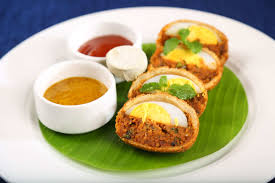
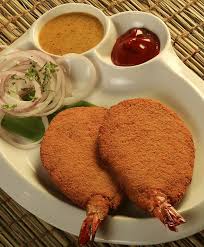
I reached almost simultaneously as Judha and we took the elevator to their home on the 8th floor. The Roychoudhury’s had made elaborate arrangements to entertain me, Jagrata had made Taal er Bora (Palm Fritters) and Prawn Balls as snacks with the drinks. I had, once told Indro that in my home, the food preparation is always “fusion food” or an amalgamation of Bong-Panju cuisine making it a cosmopolitan affair. Therefore, I sometimes crave for typical Bengali cuisine, he had conveyed this info to Jagrata, who took it upon herself to feed me with Bong dishes.
The dinner was served as Thaali, with many items in bowls resting on it… the ones I recognised immediately are Shukto (some people call it Sukhtoni), a mildly bitter mixed veggie curry, Kumro Chhechki, fried pumpkin, Sona Muger Dal, Aloo-Kopir Dalna, Sorshe-Posto Chingri, Katla Maachher Kaliya. The last item though looked delicious; I declined as I am not a fish eater. There was plain basmati rice to go with these as also Tomato-Date Chutney to end the feast. Unfortunately, we got so enticed by the culinary display that none of thought of taking a single picture of the spread!!!
After dinner, we sat in the balcony taking in the night view of the city horizon and seeping Oolong Tea. The pet turtle of RoyChoudhury family has grown big, from about 4 inches in 2021 to about 7 inches now and quite agile… They have added two more little turtles in the family I offered it some cabbage leaf which it consumed quickly looking for more…
Later, Indro and Judha walked me back to the hotel but before that Jagrata told me not fill my tummy with hotel food and have breakfast with them at their home. She had soaked the dal and prepared other ingredients for Dhuska with Aloo+Chana in the morning.
The Manager at the Royal Retreat recognised me, having stayed there in 2021 for couple of days when I had come for Judha’s engagement ceremony. He insisted that I must try their breakfast platter consisting of the flavour of Jharkhand, interestingly, they too had Dhuska with Aloo-Chana sabji besides Lithi-Chokha. Out of curiosity, I tried both in small quantities, must admit, both were quite tasty enticing me to grab more but I resisted as the home-cooked Dhuska is waiting for me. I checked out of the hotel and proceeded for Indro’s residence.
The home-cooked Dhuska with Aloo-Chana is any day far superior to the restaurant variety and I ended filling up right upto my neck.
I wanted to see the famed Patratu Valley, especially driving on the serpentine road leading to the valley and dam. The distance is less than 50 km and takes just over an hour to reach. Judha suggested we take his Bullet 500 motorcycle and asked me, “Uncle, can you drive the motorcycle?” I used to drive a Yamaha RX100 long ago, in fact I haven’t driven a 2-wheeler for more than 2 decades, I told him so… “You try it out and get acclimatized with the machine within the complex, if are comfortable, then you must ride it to Patratu Valley, it’s an altogether different experience”, Judha insisted. So, we went down to check out the bike, these days, most of the bikes come with button start instead of kick start, a great thing for old people like me. After a bit of hesitation, getting used to the gear shift and breaking distance, I drove the bike inside the complex easily.
Patratu Valley offers a picturesque escape for travellers seeking off-the-beaten-path experiences. Just 40 kilometres from the bustling capital of Ranchi, this once-forested area has transformed into a popular tourist destination. Our half-day excursion from Ranchi to Patratu was a scenic delight. The drive along the ghat roads was exhilarating, with stunning S-curves, hairpin bends, and panoramic views of the Pithoria-Patratu valley. We couldn’t resist stopping at a viewpoint to enjoy the breathtaking scenery and indulge in local golgappas. Indro had told me that we would be crossing the Tropic of Cancer on our way to Patratu Valley, on reaching the spot, we stopped to see the scenic surroundings and took a snap as well.
The Patratu Lake Resort, developed by the Jharkhand government, is a major attraction in the area. Located near the Patratu dam, the resort offers a range of water sports, including jet skiing, motorboating, parasailing, and thrilling adventure activities like wall climbing and bungee jumping. While we explored the resort’s facilities, the lake’s serene beauty captivated us.The thrill of driving up the valley through the winding roads and the desire to experience authentic Adivasi cuisine led us back to Ranchi, leaving us eager to return to Patratu for a more extended stay.
Indro introduced me to Ajam Emba, an authentic Oraon tribal-food eatery tucked away in Ranchi. The name, meaning “great taste and healthy food” in Kurukh, is a testament to the restaurant’s commitment to preserving indigenous culinary traditions.
Stepping into Ajam Emba felt like entering another world. The rustic decor and murals depicting local life created an authentic atmosphere. The menu, rooted in Oraon traditions and the biodiversity of Jharkhand, featured dishes cooked in earthen pots and served on Sal leaves.
Indro expertly guided me through the menu, recommending Marua Chilka (finger millet crepe), Sanai Phool (Jute flowers), Bodi Sandhana, a curry made from bamboo shoots. and Beng Saag chutney. Each dish was a revelation, showcasing the unique flavours and ingredients of the region. Indro explained that Beng Saag is a versatile medicinal plant whose name is inspired by baeng (the Bengali word for frog), for the chorus of frogs announcing the rains coincides with the appearance of this saag. Our lunch ended with stewed desi chicken, sourced from rural markets.
After our culinary adventure, we headed to Tagore Hill, an iconic landmark in Ranchi. Named after Jyotirindranath Tagore, the hill is a treasure trove of history and culture. We explored Shantidham, his former residence, and admired the intricate reliefs on the boundary walls.
Brahma Sthal, a serene spot on the hill, offered a moment of peace and reflection. We watched the sunset from the hilltop, taking in the breathtaking views.
Returning home, we enjoyed a delicious barbecue prepared by Judha. We enjoyed whiskey with lovely juicy grilled chicken pieces while the Bengali feast was prepared by Jagrata and Tania. The early dinner was simple and light as per my desire. I had posto bata, mochar kalia and Pabda machher jhol. And then Indro and Judha dropped me at the airport where I joined Deepika and together we came back to Delhi and home. It was a whirlwind trip to Ranchi simply on a whim but thoroughly enjoyable.
Deepika and I decided to explore the natural scenic beauty of the Jharkhand at a more leisurely and opportune time in the near future, maybe I will be able to persuade few more Langotias to join.
Both of us had a hearty laugh and then on a more serious note he said, “Tomorrow is Saturday, how about meeting for lunch?” The idea suited me as Deepika will be out attending some conference at Taj Palace Hotel. “Let’s add the other two as well and decide the venue.” I told him though I knew the response of Gora and Pulki, both are most adjustable souls and would agree to whatever is decided.
Anyways, both came online and much deliberations, we decided to meet at the gate number 2 of Malviya Nagar Metro Station and visit 6, Ballygaunge Place, a newly opened fine dining restaurant specialising in Bengali cuisine.
Once I got the confirmation from Gora that all three of them are together and their metro just crossed AIIMS, I called up the restaurant and booked a table for four. It was a Saturday lunch time, knowing the appetite of Delhiites, it would be full, I guessed and I was right.
I walked down the 1.2 km stretch from my home to the metro station and joined the other three and went to the next door Eldeco Centre, a business hub with a variety of restaurants at the ground floor level viz. Indy, The Piano Man, The Mission Bay besides 6 Ballygaunge Place.
There was a sizeable crowd waiting to be seated, having booked our table, we were ushered in and offered a table that could sit six but did not complain. The ambiance is quite relaxing with décor of vintage Bengal. The spacing of the table is sufficient to make you relax and talk to your fellow diners without any bother. The menu was quite exhaustive, the main course is divided in sections as per the main ingredient such as Prawns, Ilish, Bhetki, Chitol, Chicken, Mangsho, Rice Prep. It also had Starter, Sweets and Beverages. From the starter section, we ordered one portion each of Prawn cutlet,Hansher Dimer Devil and Chhana Motorshutir Chop. We also asked for Fresh Lime Soda which the restaurant has named as Noti Binodini, after the famous actress of the Bengali theatre of the 19th/ early 20th century. As we were waiting for our food and beverage, a gentleman in casual clothing approached us and introduced himself as Angshuman Dutta, helping out his friend (the Chef) with PR/ Marketing for the restaurant. He further stated that he is from Delhi but now settled in Kolkata and his school happened to be our Alma Mater, Raisina Bengali School, Mandir Marg, New Delhi. He is a 1990 batch, a clear ten years junior to us. He was delighted to have 4 of his seniors in the restaurant and we were immediately marked for special treatment… the beverages were made complimentary, a thousand bucks discount on the bill !!
The starters arrived in one go and was served by the steward… we dived into our plates as all of us were hungry and the aroma from the food was too enticing. The prawn cutlets, the devil and chhanar chop, all were crisp on the outside but soft inside and melted in the mouth. They had the hint of spices but not sharp, easily digestible.
We asked for the menu to decide on the main course… this section was quite large divided into sub-sections based on the main ingredients. We placed order for Posto-Narkel Bora, Chholar Dal and Dhokar Dalna, with Loochi, all vegetarian dishes because Bengali vegetarian dishes are as exquisite as are the no-veg items. Then we asked for Bhetki & Ilish Paturi, Chitol Machher Muitha and Dhakai Kalo Bhuna Mangsho with Basanti Pulao and Chingri Pulao.
My cosmopolitan palate (taste), found the curried items a bit on the sweeter side but overall very tasty and the quantities were sufficient to fill our tummy. Amongst the main course we ordered, I was particularly interested in the Chitol Machher Muitha having heard about it so much from my friends and relatives living in Kolkata. The preparation of this item is quite tedious and only a seasoned chef can bring out the flavours correctly. The one we had was excellent and calls for another visit to relish it again. I had opted for the Bhetki Paturi even though the Ilish Paturi was boneless as well but smelly for my liking. I had it with Chingri Pulao but it would have tasted better with plain boiled rice. The Dhakai Kalo Bhuna Mangsho is quite similar to the Bhuna Mutton with more caramelisation of the meat making it almost black but it tasted awesome with Basanti Pulao.
We were done with food having filled ourselves upto the neck when the steward brought 4 portions of the Nolen Gurer Ice Cream and said that it was complementary from the management. Who are we to protest such generosity, in no time, the ice cream was gone… in our tummy.
The bill came along with a bowl of Kolkata Dry Paan. As per our norm, Gora paid the bill and we transferred our individual share to him through Google Pay once we were out.
I hung the carrot of TwentyNine (a card game) in front of the three which they could not refuse and we all walked back to my home. Topshe and Gora became partners while Pulki joined me as partner. We played for about 2 hours with neither side winning conclusively.
They left after I had served them Kashmiri Kahwa Tea that I had bought from Palampur Tea Estate, with Cake Rusk from Defence Bakery, Delhi.
Chandraketugarh, located in the Ganges Delta, are a cluster of villages in the 24 Parganas district of West Bengal, about 35 kilometres north-east of Kolkata. The name Chandraketugarh comes from a local legend of a medieval king of this name. This civilization can perhaps be identified with the Gangaridai of Graeco-Roman accounts. In early historic times, Chandraketugarh was connected to the Ganga by the Bidyadhari River and must have been an important centre of trade and possibly also a political centre.
The Asutosh Museum of Indian Art conducted an excavation between 1957 and 1968, which revealed relics of several historical periods, although the chronological classification of the relics remains incomplete. Many of the Chandraketugarh items and terracottas are now in collections of museums in India and abroad; many of them are a part of private collections.
Chandraketugarh is thought to be a part of the ancient kingdom Gangaridai that was first described by Ptolemy in his famous work Geographica (150 CE). A recent archaeological study being conducted by a team from IIT Kharagpur, believes that King Sandrocottus (mentioned by Greek explorer Megasthenes) was Chandraketu, whose fort Megasthenes visited in the third century BCE, after Alexander’s invasion of India, and gives a detailed account of what he saw in Indica. He mentions King Sandrocottus as one of the most powerful kings of Gangaridai, the Gangetic delta that spread over the five mouths of the river and was a continuum of a landmass comprising Anga, Banga and Kalinga. The history of Chandraketugarh dates back to almost the 3rd century BCE, during the pre-Mauryan era. Artifacts suggest that the site was continuously inhabited and flourished through the Shunga-Kushana period, onwards through the Gupta period and finally into the Pala-Sena period. Archaeological studies suggest that Chandraketugarh was an important town and a port city. It had a high encircling wall complete with a rampart and moat. The residents were involved in various crafts and mercantile activities. Although the religious inclinations of the people are unclear, hints of the beginning of some future cults can be seen in the artefacts. Some of the potteries carry inscriptions in Kharoshthi and Brahmi scripts.
I came across Chandraketugarh courtesy of my friend Indrajit’s blog and it immediately aroused my curiosity. I checked with him if he had already visited this place to which he said, “No, but would like to visit especially as it is in the backyard of Kolkata where I have been to numerous times.” Well, that was enough for me to plan a tour. I checked with few likeminded souls and all agreed. I had a long chat with Topshe aka Tapas who is perhaps more reliable than google!! He checked the ticket price and availability of both flight as well as train while talking to me, the latter was not available on the dates that suited us while the airfare was too high prompting us to become adventurer and commit to a road trip!!! Contrary to my expectations, my co-travellers were thrilled when I told them that after my discussions with Topshe, it has been decided to take the road.
The four of us, Topshe, Gora, Pulki and I decided to travel lean taking absolute basic minimum luggage that can easily be fitted into the boot of Jeep Compass. The route we took is Delhi-Varanasi-Ranchi-Kolkata. A total of 10days +/-2 days tour. Ranchi was added to pick-up Indro to complete the gang.
DAY ONE
I picked up the three of them, Topshe, Gora and Pulki from the Mahamaya Flyover around 5:45 am, when the horizon showed glimpse of the rising Sun. Gora and Pulki stayed overnight at Topshe’s place and they were dropped by Soubhik, Topshe’s son. We started our long journey as Google indicated 9 hours 50 minutes to the destination. We estimated about 10-12 hours with breaks. Gora had used his contacts to book us two rooms at the Annapurna Hotel, Godowlia with parking facility. We decided to drive in shifts between myself, Topshe and Pulki while Gora said he is out of touch with 4-wheeler driving but would give it try if the roads are clear of traffic.
We stopped at the “truck/ bus lay-by” for breakfast just before hitting the Agra Outer Ring Road and devoured the Aloo Paratha made by Deepika early in the morning along with Puri-Aloo made by Sudipta (Topshe’s better half) and downed it with Coke Zero. From there on, Pulki took the wheels and I retreated to the back seat to take nap and get refreshed for lunch. It was decided to refill the tank as soon as it reaches the 25% mark to avoid last drop panic. I woke up as Pulki pulled-up at the Indian Oil station just before Lucknow. We had decided that I will take care of the petrol bills, while Gora will manage the hotel and food bills… at the end of the day, the accounting will be done for that day.
Topshe took the wheel once we had filled up the tank and now would drive till the destination unless he’s fatigued…Gora moved to the passenger seat and Pulki joined me at the back. We were quite tempted to enter Lucknow and have Rahim’s Nihari-Kulcha & Biriyani for lunch but resisted as that would have delayed us massively. Instead, we took the Lucknow Outer Ring Road (By-pass) and stopped at Gangotri Dhaba on the Saidpur-Khajirhat Road, the Purvanchal Expressway starting point. The food was vegetarian affair… Yellow Dal tarka, Aloo-Matar Sabji with Tandoori Roti splashed with butter to make it soft. They had Malai Lassi but we avoided the indulgence as lassi is a great sleep inducer and we needed to stay awake for the final leg of this journey.
Topshe really enjoyed driving the Jeep and speeded up on the thinly populated Purvanchal Expressway and we were soon we exited the expressway to take the NH330 towards Sultanpur. The Sultanpur Bypass took us to NH731 towards Varanasi bypassing Badlapur and Jaunpur and we reached the vicinity of Varanasi. Topshe stopped on the side near a dhaba and we had tea-samosa while stretching our legs. Topshe told me to take the wheels thereon, his logic was simple…soon we will be negotiating city traffic and narrow crowded roads and he wasn’t comfortable driving a not-so-familiar vehicle through those areas. It suited me because I was getting a bit restless sitting at the back. We left for Varanasi after finishing our tea and Gora having his urge for a smoke satiated. We did not encounter much traffic on the way except when we left the Lucknow-Varanasi highway and entered the Teliabagh Road and Lahurabir Road leading us to our destination. We reached Hotel Annapurna around 5:45 pm courtesy the no-holds-bar driving of Topshe, majority of the distance… Pulki and I have been driving very conservatively keeping within the speed limit.
We checked into the Hotel Annapurna whose owner is a Probasi Bengali living in Varanasi for over 3 generations; Shri Pralaynath Banerjee lived in another house in the vicinity with his family… this was his ancestral house which he had converted into a boutique hotel. The hotel had a large courtyard which is being used as a car parking, a large hall as you enter, a small part duly partitioned functions as reception area while the larger section has become dining area with relaxing furniture. In the ground floor they had 4 rooms with attached bathroom and on the first floor there were 6 rooms with attached bath and a dormitory with 8 single beds. We were allotted 2 rooms on the first floor from which one could get a glimpse of the Ganges during daytime… the rooms were quite large with high ceilings and comfortable beds, clean bathrooms with geysers and modern amenities. Topshe and Gora took one room while Pulki and I took the other.
We quickly freshened up and left to explore the nearby places on foot, taking the car out was ruled out because of the crowded roads/ lanes and parking woes. The receptionist, Ms. Shailaja suggested we go to Pagal Sardar Milk Shop, popular snacks shop nearby towards the Dasaswamedh Ghat. We took the advice and headed there soaking in the evening flavours of Kashi, perhaps the oldest continuously lived-in city of the world.
There was a sizeable crowd waiting to be served when we reached but the service was quite prompt and nobody has to wait for more than 5-7 minutes. We ordered 2 portions each of Dahi-Bhalla and Aloo-Tikki-Chaat along with 4 glasses of Malai-Lassi. While devouring the items we realised why the place is full of customers… the portions are quite generous and the taste is out-of-this-world… non of the dishes were spicy but full of authentic flavours and the lassi was delightful. Our tummies were full and bursting…we needed to digest fast because Pralaynath Babu had promised us authentic Bengali non-veg Thali for dinner!! We headed towards the ghat to take look at the Maa Ganga. I must say that Varanasi has had a 360 degree makeover in the last 10 years, it has become quite clean with dedicated walkways leading to the ghats and even the ghat area is quite clean where one can sit for hours together and enjoy the soft music of the waves of the Ganga colliding at the banks while enjoying cool breeze wafting over the river. We walked along the river taking-in the mystic charm of the different ghats where people were busy with ritualistic fervours.
We returned to the hotel around 10 pm ready to dig into the offerings of Pralaynath Babu and his Chef. We were the only ones at the dining hall as other residents had already taken their dinner and gone. The authentic Bengali Thali had at least 10-15 items and many of them are first time for me; notable among them are bhetki-paturi, dab-chingri, shorshe-ilish, dakbunglow-chicken and kosha-mangsho. I passed my portion of shorshe-ilish to Pulki as I can’t have ilish due to its strong smell and numerable bones. The banquette was truly memorable and, in the process, we over ate but the Chef Ajay had a surprise concoction for us made of Gondhoraj Lebu and some secrete spices…he promised that everything will be digested within an hour and we would be hungry again!!!
DAY TWO
We were ready for the darshan of Mahadev by 6 am, Pralaynath Babu had assigned a person to take us through a “VIP Enclosure” for serene moment with the Mahakal-Neelkanth-Vishwanth, you call him in any name but at the end it is ONE, the Maha Vishnu, Madhav who exist in many manifestations. We had a peaceful darshan and offered unadulterated milk and sweets besides flower on the lingam receiving His blessings through the Purohit. On the way back we visited the Gyanvapi Mandir as well as Annapurna Mandir. It is believed that Shiv and Parvati came to Kashi to live a domesticated life as Mahadev/ Vishwanath and Annapurna providing domestic bliss to the humans on earth.
Religious activities were done by 8 am and we headed to the famed Kashi Chaat Bhandar. We ordered for their hot selling Tamatar Chaat, Aloo-Tikki Chaat and Hara-Matar Chaat with Masal Chai. It was one of the most satisfying breakfasts I had in many days.
Coming back to the hotel, we packed up and settled our dues with Pralaynath Babu with a promise to visit again. Since we already had our breakfast, he packed us some sandwiches and boiled eggs and fruits for the road. We headed for Ranchi to meet and pick-up Indro on way to Chandraketugarh.
The route was pretty much straight using the NH19 (AH1), approx. 400km taking 8 hours non-stop. Topshe drove the first three hours then we stopped for the restroom at a petrol station, filled up the tank as well and the Pulki took the wheel for next two hours and stopped by a Line Hotel (Dhaba) where we had tea and finished the sandwiches and eggs. Then I drove the rest of the distance, on a newly laid beautiful road prompting me to exceed the speed limit. We reached the outskirts of Ranchi around 4:30 pm and guessed that in another hour we will reach Indro’s home. Gora called him up and informed accordingly. He had booked us at the Royal Retreat Hotel, very close to his home at Global Lavanya Residential Complex. We stopped at the Brother’s Bakery to pick-up some pastries and cookies for the kids, Judha and Tania, who’s engagement ceremony I had attended but could not join the wedding festivities due to covid infection just before I was to take the flight for Ranchi.
We reached Indro’s home on the dot of 5:30 pm, he had instructed the security at the gate, so, we had unencumbered entry inside the complex and parked at the visitor’s parking. Indro along with Jagrata and Tania gave us a tumultuous welcome as if we are coming after winning a war!!
After we had washed up our grimes, we were offered tea and specially made Dhushka with Aloo-Chana Sabji… I had requested Indro to arrange this as one meal… I had fallen in love with Dhuska since the time I first tasted it during my first visit. After chitchatting for some time, we took out our nightwear and toiletries bag to check-in at the hotel… 2-minute walk down the lane. We purposely left the car at his complex and he asked the chowkidar to arrange for it to be washed and cleaned.
Dr. Judhajit, a very able doctor, came home around 9 pm and enquired about our health and wellbeing. Both, Gora and I had consulted him over phone and his diagnosis had always been accurate. I simply adore him for his amiable nature. Indro opened a bottle of Single Malt from his collection and poured for everyone, I declined as I was still on my self-imposed alcohol ban. Instead, I joined the toast with Lemon Ice-Tea. The dinner was simple Bengali fare yet fulfilling… Shukto, Chholar Dal, Aloo Bhaja, Beguni, Pabda Jhaal and Chicken Curry with Rice followed by Raw Papaya Chaatni and Papad. There were Mishti Doi and Nolen Gurer Sandesh which I couldn’t resist despite being a diabetic… the expensive medicines will have to work harder, I told myself. We spent some more at Indro’s home before retiring for the day. We agreed to start our journey towards Kolkata around 8/8:30 am… we needed a good sleep to get ourselves rejuvenated.
DAY THREE
We left for our last leg of the journey after having sumptuous breakfast of stuffed paratha with creamy dahi and soft rosogolla sharp at 8:30 am. Additionally, I had a fluffy masala omelette prepared by Tania… Indro knew about my weakness of eggs so he asked her to make it for all but except Indro and I, others declined. Indro, sat with me at the front, others nicely fitted in the rear seat.
There are three routes to Kolkata from Ranchi, the shortest one is via Jamshedpur – Dalma wildlife sanctuary, a very scenic route mostly through green patches. We were tempted to stop by at Dalma wildlife sanctuary but decided against it and simply soaking in the nature with zero pollution. We stopped at the Garden Inn Restaurant, Kharagpur, situated on the highway for lunch thereby avoiding getting into the city. We opted for vegetarian dishes and kept it light. Since we were ahead of time, having made it 4.5 hours instead of 5.5 hours, we relaxed in the adjoining garden where we had lemon tea and cookies before departing to complete our journey.
Topshe took the wheels and I moved to his seat. The drive was mostly uneventful except that this route being the oldest amongst the three, the roads are not wide, mostly 4 lane and at some places becomes 2-lane without the divider. In such stretch, the speed, sometimes becomes rolling and then near any town or village, a sizeable road space is occupied by the hawkers and rickshaws creating unnecessary road jams. Anyways, Topshe, expertly navigated such irritants and soon we were cruising towards Howrah crossing the Kolaghat, famous for its thermal power station. Once, we reached Howrah, our driving got restricted to the speed of the traffic ahead. Moreover, here the highway has bursting population on either side, both residential and commercial with rampant encroachment of the road space. It was still early evening, so the crowd was not very high but we lost the earlier advantage of beating the google timeline, it now was showing 6 pm to our final destination… Nizam Palace on Acharya JC Bose Road, only consolation being a Saturday evening, the traffic inside central Kolkata might be lighter than usual with most offices either on holiday or getting over when we reach.
Nizam Palace is a CPWD Guesthouse for the government officials, both serving as well as retired, the tariff is very reasonable…rather cheap compared to the private accommodations with decent clean room, nothing fancy though. Topshe, Gora and Pulki, all retired Central Govt officials, used their channels to book 3 double-bed rooms on the first floor of B-Block. The best part of the place is that it is very centrally located with numerous options for eating out as well as sightseeing. The online reviews of the place suggested to visit the dining hall instead of room service as it is very lax and at times the food/ tea is cold by the time it reaches your room. So, after freshening up, we went to the dining hall to have tea and snacks… surprisingly, they had options of Darjeeling tea which Indro & I opted for and ordered a large pot while others asked for Masala Chai along with assorted pakoras including Devilled Egg, we were hungry but wanted keep space for the dinner at Peter Cat, Park Street where we have booked a table for five at 9:30 pm.
All of us wanted a quick n short nap, especially after the snacks which were excellent, crisp on the outside and melt in your mouth and the Darjeeling tea was very well brewed. Setting the alarm for 8 pm, I hit the pillow and dozed off immediately. Mine and Pulki’s alarm buzzed simultaneously stirring us up forcefully. We got ready, so were the others and we booked Uber cab to take to the Park Street which is notorious for parking woes. The cab dropped us right in front of the restaurant. Indro and Gora wanted to have a smoke, so we strolled along the road which was getting crowded by minute with hungry diners, it was a prudent call to book our table in advance.
If you are in Peter Cat, you must try their famous Chello Kebab served on a bed of buttered rice with tandoori kebabs and topped with fried egg. We had the prawn cocktail as starter followed by chello kebab, also ordered virgin mojito to go with the food. Though, the restaurant is quite old, they have maintained the quality and taste but their service needs much improvement. The restaurant was full to capacity with customers waiting outside; in such a scenario, the restaurants, typically in the north and south of the country, speeds up their service so that the customers can finish their food quickly and allow others to enjoy the fare as well. But, here in Kolkata, there was no hurry and food arrived at its own pace. By the time we finished, it was almost 11 pm and getting a cab was a task in itself. I tried to book through Uber but it was showing minimum 15-20 minutes waiting due to heavy rush. I checked the distance to our hotel; it was just over 2 km and walk through the Camac Street would take similar time (22 minutes) as waiting for the cab. I convinced others to walk as would help us digest the Chello Kebab as well besides experiencing the night life of Kolkata.
With the guidance of google maps, we reached Nizam Palace in half an hour, completely exhausted and decided to call it a day. Tomorrow we shall venture out to see Chandraketugarh.
DAY FOUR
We were ready to go to Chandraketugarh by 8:30 am after having a South Indian breakfast of dosa-idli-vada at the dining hall itself. Its about 50 km from our place, driving time two hours passing by the New Town, Salt Lake City towards Barasat on the Kolkata-Bashirhat Road. Indro’s ancestral home is in Bashirhat where some of his relatives still lives but he said he has no intentions of visiting them in this trip… in fact none of us have told any of our relatives or friends about this trip, we wanted to keep it within this small group only. It took us two hours to reach Berchanpa after checking with the locals we reached the archaeological site.
What is most intriguing about Chandraketugarh is that very little has been excavated and what lies beneath the ground is best left to guesswork.
The region of Bengal where it meets the bay is an active delta which due to silt and sedimentation, geographically changes its character. The delta is one hand slowly increasing in length while global warming now has done the reverse with increasing sea level. The location of Chandraketugarh has a deep historical presence and was once set to be the capital of Bengal Gangetic plains that had active trade links with Europe especially with the Greeks. The Greeks referred to this region as “Gangaridai” and have been mentioned in several Graeco-Roman texts.
Bidyadhari River, now extinct, was then much bigger and greater in size and was easily accessible to trading ships coming in from the Bay of Bengal.
The mounds were first located around 1905 – 1906 by a local doctor named Taraknath Ghosh and this information was passed on to the Archaeological Survey of India (ASI). A.H. Longhurst from ASI – Eastern Circle visited this site for inspection which led to the discovery of ancient pots and bricks.
It is also to be noted that eminent archaeologist Rakhaldas Bandyopadhyay had also visited this site around 1909. However, nothing much happened till as recently as 1955 that a small level of excavation work was carried on by the Ashutosh Museum of Indian Art.
The excavation resulted in the discovery of pottery, beads from the various era which can be classified as:
Period-1 which might be pre-Mauryan and can be characterized by Red Ware typical of this era
Period-2 which might be the Maurya-Sunga era was marked by Northern Black Polished Ware
Period-3 is post-Sunga with redware, stone beads, cast copper coins, etc.
Period-4 which is the Kushan era with terracotta figurines
Period-5 Gupta era with burnt bricks and other relics
The further detailed excavation was planned but never executed till date, the excavated mounds were covered up and waiting to be dug again.
As the name suggests “Chandraketugarh” can be roughly translated as the region ruled by a person named Chandraketu. Very less is known about him and some references put him as one of the greatest rulers of the Gangetic delta region. It is strongly believed that Sandrocottus mentioned by the famous Greek explorer Megasthenes is in reference to King Chandraketu, the most powerful king of Gangaridai, the people of the Gangetic plains of Bengal as referred to by the Greeks. It is believed that Alexander met Chandraketu putting his tenure to be in the 5-4 century BCE.
Khana-Mihirer Dhipi – This is well marked and the excavations are still visible. The excavated sections have been cleaned up and various structures can be easily made out. The excavation carried out in 1957on a mound revealed temple-like structures which are of multiple dynasties, likely because of rebuilding over existing temple sites over and over again. The majority of the excavated pottery belonged to the Sunga-Kushana style.
During the excavation of this section various pottery, terracotta plaques, etc. were also excavated. The nature of pottery clearly shows the attributes from various periods of rules in this part of the world.
Various objects that were excavated from this site included terracotta figures, cooking pots, coins, beads, long neck jars, etc. Some interesting find around this excavation site were terracotta plaques of human, animal, and bird markings.
After entering our names in the register, we took the well-marked walking path to explore site. You are not allowed to climb on top of the excavated structures and need to walk only on the designated pathway. Visually what you get to see are huge foundation sections of various sections within the excavated area which only comprises terracotta bricks. No visual figures are present, the ones excavated from this site have been shifted to the nearby Chandraketugarh Museum.
Chandraketugarh Museum, is a new museum under the state government which was built to store the excavated artifacts from site. Previously these were stored at the house of two local enthusiasts while some were kept at the local school museum. Photography is not allowed inside the museum. It is highly recommended to visit the museum because it’s only here one gets to see the vast artifacts that were excavated from this region of Bengal. However, more detailed and beautiful figurines excavated in the early 20th century have gone out of the country, mostly illegally through smuggling.
We spent over three hours exploring all sites including the museum grasping a part of Indian history that has never found it’s way into the school text books.
EPILOGUE
We spent another three days in Kolkata on a Foodie Delight Tour, besides meeting our local friends and having camaraderie but that’s another story to told at some other time.
Indro decided to stay back for Jagrata along with Judha and Tania to join him for medical check-up and also spend some time with their relatives. The four of us left for home after a very satisfying and fulfilling road trip.
We have a WhatsApp group of 20+ classmates from Batch of 1980 RBS who meet up for a G2G (get-together) but unfortunately this happens only “once in a while”. Every time we meet, we make promises to meet every month but somehow that never happens. Basically, there’s a inertia that works which prevents us to take quick call on a proposal to meet on a certain date at a certain venue. Therefore, most of the time it is only less than half the strength showing up for the G2G. So, I decided to call up only those, who I knew would be willing to join at the shortest notice for a FoodAventure (food adventure)… going to a eatery at random for its signature item.
Last Saturday, 31st August ’24, the four of us (Pulak, Tapas, Manojit and I) decided to meet at such a place called INDIE BBQ located at Noida Sector 75 (as per the Google). The decision fructified on Friday late evening and it was decided that I will pick up Tapas on the way and the others will reach on their own. We reached the address given in the web-page only to find it locked and the condition suggested that it has been locked for quite some time. There hung a banner with a mobile number. I just took a chance and called that number…
“Hello, is this Indie BBQ?” I enquired.
“Yes, Sir.” Came the reply.
“Well, I have come a long way from Delhi to taste your Grilled Pomfret and you have closed down.”
“Sorry Sir, actually we have relocated to Greater Noida West, I am sending you the location right away.” The owner responded.
True to his words, he sent the location detail with complete address and landmark, it was about 9 km from the original location (32 km from my home).
It was a food-court of a local shopping centre adjacent to a housing complex. The seating is on the open courtyard with each outlet having their own specified arrangements unlike a food-court in the malls. Officially the outlet is open for business from 1400 hours till about midnight but in reality their business starts more towards the evening (winter months may see a reversal of this trend).
We were clear about our first course, grilled pomfret and added the crispy fried octopus on the recommendation of the server. Also ordered fresh lime soda to quench the thirst. We were having street food experience sitting on the extended pavement, it reminded me of the days in Karol Bagh when we could only afford the street food at the Gaffar Market eatery. I must mention that, the place is quite clean and the staff very polite and eager to serve you to the best of their ability.
The size of the pomfret wasn’t too big, just about 6 inches but it was quite fresh and grilled to near perfection, well cooked and the spices were tempered well unlike the usual spicy fare of the street food. The crispy fried octopus was truly crispy on the outside and juicy inside. I feared that it would be rubbery if not cooked well but the chef showed his skill in making it highly palatable.
We wanted to sample the dum ki biriyani but it wasn’t readily available, so we ordered Champaran Mutton Curry with butter naan, and it turned out to be a wise call, just good enough quantity and excellent in taste. Tapas and Manojit got Mutton dum biriyani (Kolkata style) packed for home and I believe, the kids enjoyed it thoroughly.
The four of us have, thus decided to do this FoodAdventure, every month on a Saturday, convenient to all at a very short notice. We have also decided to welcome any of our likeminded batchmates to join us at such short notices at such odd places and enjoy not just the food but the camaraderie as well. You are welcome to tell us about such places that serve mouthwatering dishes. We have identified one at the Sarvapriya Vihar Market serving non-veg cuisine from the north Indian states for our future meet.
Address of Indie BBQ:
Aastha Green Food Court, Greater Noida West, Sector-4, Opposite Eco Village-2 and SUPERTECH market. Feel free to call at 9958359295 for further assistance.
Nikunj Niyogi sat on the cot inside the dilapidated home of Begum Hasina Wahid and wondered how long he will survive. He knew the aggressors are closing in and will barge through the door soon. He checked his gun; fully loaded Heckler & Koch with an extra magazine… he knew it is not a deterrent but would hold them back for a while…he might take few of them down especially in a closed space combat. But it did not matter if he lived or become a martyred for Maa Bharati… having established the coordinates of the terrorist camp he felt relieved. Begum Hasina Wahid, the septuagenarian had taken the small chit to the Army camp some 20 km east of her modest village with express instruction to hand over the same to Col. Debabrat Das. Nikunj and Debabrat were batchmates at the NDA, Khadagvasla, while Debabrat continued with regular army, Nikunj was recruited by the army intelligence and special ops. Both were of the rank of Colonel but in case of Nikunj, the title is seldom used.
The kaleidoscope of his life played on as Nikunj waited for the inevitable. He had to kill those two lowly terrorists because they had seen him and sounded alarm through their satellite phones. Nikunj belonged to a large family, he was the youngest of nine children and there was a gap of seven years between him and his immediate elder brother. In the younger days in school and academy, he used to joke that he was a perfect example of an accident. His father owned a small grocery shop in the congested locality of Paharganj, New Delhi. The residence, if one can call it such, was the 2.5 rooms atop the shop. His father would open the shop around 8 am and close at 9 pm, every single day as even one day closure meant less food on the plates of eleven hungry souls besides loss in the business. When Nikunj joined Raisina Bengali School in Class-I along with a bunch of bubbling kids, his eldest brother cleared Civil Services exam and was poised to join the Foreign Service while his second brother completed his Master’s program and hoped to join his elder sibling into the civil services the next year.
Nikunj liked his school, it allowed him abundant space to run around and make friends and learn new things every day. He became particularly pally with a kid named Rudro Prashad Chatterjee aka Rudro. They became inseparable as the years passed, sharing the same bench at the back of the class. Rudro belonged to a well-to-do illustrious Bengali family, his uncle was a famous character actor in both Bengali and Hindi film industry, but he was very down to earth person and took care of Nikunj, bringing extra lunch everyday to feed him knowing the economic conditions of Niyogi family.
One day, when Nikunj was in the 8th grade, he got a call from the principal’s office, visibly shaken, he went there to find his second brother Bikash Niyogi, who was now an IPS officer, sitting with the principal discussing something somberly. The principal, instead of admonishing him, put his hand on Nikunj’s head in a manner of blessings and told him to gather his school bag and go home with his brother. Later he got to know that his father while managing the shop had a massive cardiac stroke and succumbed before any medical help could reach him. During the 10-day mourning period, Rudro would drop in every day after school bringing food for the entire family. Nikunj found an anchor in Rudro to overcome the irreversible loss of father.
Graduating from school, Rudro joined St. Stephen’s College where he met Aniket Mathur while Nikunj was selected for National Defence Academy where he met Debabrat Das… both found new best friend but Rudro and Nikunj remained in touch through regular communication. In time both sets of friends graduated with flying colors. Rudro went on to become an IPS Officer while Aniket continued with his master’s program followed by a PhD in Economics & Current Affairs. Debabrat showed all round prowess both academic as well as on field, particularly as a marksman. Nikunj, though was not as perfect as Debabrat on field activities, he was far ahead in academics especially in mathematics and coding. Another god gifted talent of Nikunj was his ability to grasp languages, he was already fluent in Punjabi, Urdu, all 4 south Indian languages besides English, Hindi and his mother tongue Bengali. He had picked up the southern languages from his fellow cadets, Punjabi and Urdu from the streets of Paharganj becoming a multilingual at a very young age.
After the graduation from NDA, Nikunj was asked to report at the Army HQ in New Delhi and seek out certain Colonel Diwakar Pandey. The Army HQ was huge with hundreds of people working in the building, both uniformed and in civilian dress. It took some effort to locate Col. Pandey but one look at him and you can’t miss the “fauji” written on his face with a handlebar moustache adorning the large face and it matched his booming voice as well.
Col. Pandey asked Nikunj to follow him and they ended up in a room or rather a hall full of electronic gadgets and computers, the temperature of the room was closed to freezing point, at least that’s what Nikunj felt entering it. Col took him to a console and asked him to sit before moving on to another person at the corner. Nikunj was startled as the computer screen came alive and a south Indian gentleman started asking him questions about him. After a bit of initial hesitation, Nikunj spoke fluently in Malayalam first and as the interviewer changed languages he followed him with Tamil, Telugu and Kannada. After almost 45 minutes, the person on the screen seemed satisfied and bade him goodbye. The process wasn’t over, a Sardarji came on the screen and spoke to him Punjabi followed by a Maulvi in Urdu. Both seemed satisfied with his prowess of the languages.
Meanwhile, Col. Pandey has been observing the facial reactions of Nikunj on a large screen along with psychiatrist Dr. Geetika Sharma and both were very impressed with Nikunj who showed no discomfort while rapidly switching languages as if they were his mother tongue.
The next day, Nikunj joined a special school of languages to learn Arabic including all variations spoken through the middle-east followed by Russian, French and German. At the end of the year, he was fluent in all four and expressed his desire to learn Mandarin as well. His request was neither turned down nor accepted but he was put through a fast-track course in Spanish. At the end of the language school, Col. Diwakar Pandey reappeared and told Nikunj that he has earned a well-deserved furlough of three days to meet his family but he must report at Col’s home at Delhi Cantt. at 6 am the following Monday for a visit to the countryside.
Sharp at 6 am, Colonel, Nikunj and Sergent Bakshi set out for the countryside trip. After driving for almost 3.5 hours through the villages and mufassil towns of Haryana, Colonel stopped his Maruti Gypsy in front of an abandoned warehouse near the Punjab border. He honked thrice and couple of sepoys opened the huge gate of the warehouse and saluted… he drove inside the compound. The place had a spooky feeling with abandoned rusted machineries, delivery trucks in dilapidated conditions lying on the foreground. They went inside the building which could collapse any time, but the Col moved confidently ahead followed by his Sergent and Nikunj. He stopped in front of a sliding door and scanned a card which resembled an ATM card, in fact it worked as an ATM card as well. The doors slid open to reveal an elevator on the other side… it took them down to the basement, Nikunj had a quick look at the buttons when they illuminated as Colonel used his card to scan and press the button, it showed 4 floors below the ground level. As the elevator door opened, they were greeted by a person who looked like twin brother of Colonel Diwakar Pandey. In fact, Colonel Sudhakar Pandey was the twin brother of Colonel Diwakar Pandey but excelled in a rarified field of counter intelligence. After the pleasantries, Col. Diwakar formally handed over Lieutenant Nikunj Niyogi to his brother to train him in counter intelligence. It would take at least a year for him to master the craft, the brothers assumed. They were mistaken, in three months’ time, Nikunj could easily dodge and escape his tails and one occasion caught an agent unaware. By the end of the month six, he had become a pro and an excellent marksman. Colonel Sudhakar Pandey or EssPee as he was affectionately called, was very happy and informed his brother that their asset is ready for commissioning.
Nikunj was brought back to reality with gunshot sounds, he readied himself for the inevitable. He looked through the tiny hole of the window and selected his prey.
It took Begum Hasina almost the whole day to walk through the valley and hillocks avoiding the main serpentine road to reach the army camp. It took a long chat with the sentry at the gate with her broken Pashtu-Urdu mixed Hindi to explain her urgent need to meet the colonel. Unfortunately, Col. Das had gone to meet the Lt. General at the local HQ and is expected to reach by sundown. The sentry allowed Hasina Begum to sit inside the hutment and offered water and biscuits.
The Colonel came back to the camp just before the sunset and was informed of the old lady waiting for him. He immediately sent for her and ushered her inside his office. He called a soldier who knew Pashtu to interpret her narration. Col. Debabrat Das asked Major Ramprasad and Lt. Joginder to form a small troupe of 4 soldiers each and go with the lady to the village while he consulted with the Lt. General to plan out the strike at the terror camp as per the coordinates sent by Nikunj Niyogi.
The team of Major Ramprasad and Lt. Joginder along with Hasina Begum reached the hamlet in about an hour’s time when the dusk was settling in the hills… in the faint light, they witnessed a horrifying scene. The entire hamlet was completely flattened and bodies were strewn all over the small clearing. On closer look, there were at least six bodies which were clearly that of the terrorists still holding their AK-47 guns and a headless body. Hasina begum was inconsolable but still identified the bodies of the villagers and from the attire of the headless body she identified it to be of Nikunj Niyogi. The body did not have any identity papers except a bundle of cash and firmly held Heckler & Koch handgun. There were bullet marks on the body which indicated he must have died before the ghastly beheading happened.
Major Ramprasad called the camp through radio and was instructed to stay put at the hamlet and be vigilant as the extremists are likely to return to retrieve the bodies of their fallen brethren’s. The Colonel assured that reinforcement will reach early in the morning.
The next day, two things happened; first the dead bodies were buried with full religious customs and Begum Hasina Wahid was taken to a safe house in the city under the care of the army. She had no relatives…her only son had died in the Kargil War. The second instance happened after sundown; a squadron of Sukhoi flew in and flattened the extremist training camp hidden in the jungles. A squadron of highly trained commandos took care of the fleeing terrorists. No prisoners were taken in because that was their instructions.
Later intelligence report confirmed over 100 dead terrorists but their leader Mukhtar Abbas Pathan had escaped the camp along with few of his close aids long before the commando operation started.
Recently I watched a short video clip on environment by a Bangladeshi scholar who echoed my thoughts and more… And at that moment (around 1:30 am) I decided to pen down my take on the subject.
WE ARE CURRENTLY WITNESSING SIXTH MASS EXTINCTION ON EARTH AND ARE NOT DOING ANYTHING TO STOP OR REVERSE IT. VERY SOON IT WILL BE OUR TURN!!!
The approx. age of Mother Earth is 4.5 billion years and, in this period, it has already witnessed mass extinction of living beings 5 times. Mass Extinction happens when 75% of the living beings are wiped out from the face of the earth. The last mass extinction happened some 65-66 million when dinosaurs, mammoth and few thousand other living organism went extinct, apparently due to asteroid collision.
According to many scientists in the field, we are experiencing 6th mass extinction. It is quite natural that few species would vanish from the face of earth due to atmospheric reason but right now, in the last 30-50 years, the process of extinction of species is happening at an exaggerated pace of 100x or 1000x times. Why and how?
Let me explain… if you think that the mother earth belongs to the humans alone, then you are fundamentally wrong. The earth belongs to all right from the micro organisms at the bottom of ocean to the whales, dolphins, millions of fishes to the land animals, birds and insects besides humans. Even the green plants in your house pots to the big trees in the jungle, all have equal share of mother earth. However, we humans have cornered almost 70% of land and potable water for our own use leaving the 30% for the rest of the creatures. This started sometime in the Seventies and has continued unabated… as per research and studies, based on the available natural resources on the earth, approx. 3.5 billion humans can be comfortably accommodated without disbalancing the equilibrium of the nature. In the early 70’s, the earth had recorded human population to be around 3.5 billion or the threshold level. In 1968, Prof. Paul Aldrich of Stanford University published a book called Population Bomb wherein he predicted few dooms day events in case the human population exceed beyond 3.5 billion… few of those have come true and we circumvented the others. Coming back to the point, with the unprecedented increase in human numbers, unhindered growth of the cultivated land, massive scale of urbanization, industrial growth, vehicular traffic etc. have robbed the other species of their rightful existence. Some hundred years ago, we were close to the nature, living in villages with accommodation sufficient to our needs and not wants, cohabiting with birds, animals and insects, and surviving together, but somehow the need got replaced with the wants and we the humans started expanding our living quarters exponentially throwing out the rest of the species.
Today, in circa 2024, the world human population exceeds 8 billion and still growing while the other species are shrinking. The human population has more than doubled in the last 50 years, which is much faster than the growth over the previous thousands of years put together. We have pushed the other species to the brink of extinction silently… the animals in the jungle or the living beings in the ocean can’t speak and doesn’t know how to protest but we humans can but we have chosen to maintain silence on the issue. Why? Because it is convenient for us, humans… more the numbers… more business opportunities and profits. We are the greediest species on the earth. We think we are the smartest and therefore the earth belongs to us… to expand we have done massive deforestation, created and used weapons of mass destructions without thinking about the future. What have we achieved? Nothing really, all superficial… we have ensured drastic change in the weather patterns due to global warming… the glaciers that used to be the lifeline for all the living things on earth have shrunk greatly and it is a matter of few hundred years that they will be gone completely ensuring the hastening of the 6th Mass Extinction on the earth. It has not sunk in yet, that with our so-called super intelligence, without potable water and clean breathable air, we will meet the same fate as the other species, we too shall perish, gone forever.
I am particularly worried about my country, India… we have become the most populous country in the world. I do not find it to be a proud achievement… as a matter of fact, we have limited land, potable water and other resources which probably is good for 0.8 billion people and just sufficient for 1 billion people but we have grown to 1.44 billion as of 2024 and still growing. In the last 10 years we have grown at 11% and 35% since the beginning of this century. There’s an urgent need to address this population explosion cutting across the politics, religion, caste lines.
I am in the last cycle of life, my generation or the generation next have not taken significant steps to reverse or stop this mayhem but I have hope in the youngsters around the world to listen to the screams of the less fortunate species and extend their hands to help them. I also have immense faith in MOTHER NATURE and her sense of fairness in maintaining equilibrium.
QUICKER WE REALISE, THE BETTER, THAT WE HAVE ONLY THIS PLANET EARTH TO CALL HOME NOT JUST OURS BUT THAT OF MILLIONS OF OTHER LIVING THINGS… WE MUST LEARN TO COHABIT PEACEFULLY. BEING A SUPERIOR SPECIE, IT IS OUR RESPONSIBILTY TO STOP THE DESTRUCTION.
Ayush and Rajashree were going to attend a wedding of their friend at Jaipur, Deepika and I decided to tag along to have their company through the journey, a road trip I have been looking forward for many months. They came over the weekend for our journey slated for the Monday 8th July.
We left for Jaipur around 6/6:15 am, filled up the tank on the way but couldn’t check the tyre pressure which is a norm I follow for all long drives. In good time we crossed Gurugram and reached Delhi-Mumbai Expressway. It’s a boon for the commuters from Delhi+NCR to Jaipur as the original NH8 (NH148) takes over 6 hours to reach Jaipur due to narrow and heavy vehicular traffic. Around 9 am we stopped for breakfast at a “Rest & Recreation” somewhere after crossing over to Rajasthan between Alwar and Dausa. The food was below average, we had better stuff at another such stopover, which happened to be the next one as we drove towards Dausa. The driving on expressway can become monotonous making the driver drowsy, especially after meals and I started feeling sleepy but managed to stay awake and reached the old highway which is the connector from Dausa to Jaipur. I stopped and asked Ayush to take the wheels. He drove nicely as I slept soundly.
My sis-in-law, Bina Sapra lives in Jaipur and was the reason Deepika & I decided to visit the city. We reached her spacious home around 11 am and was welcomed with tea and sweets. Her husband had stayed back to meet us all. She had made lunch for all of us… Ayush and Rajashree were to join the wedding celebrations of their friend, so they had an early lunch and left for the Mariott hotel with their cousin Rishabh. Deepika and I took it easy and chatted with Bina over a leisurely lunch before leaving for our hotel Hyatt Place, Malviya Nagar, Jaipur, a 5-7 minutes’ drive from their home. Bina had suggested Hotel Lalit but the online reviews of the hotel did not inspire us. Normally, the room sizes in Hyatt are small (Delhi, Hyderabad) but here we got a decent size of room with usual star hotel amenities… made us happy with our choice.
In the evening, after a good nap, fully rejuvenated, Deepika went out with her sister Bina for shopping while I went to meet my friend and school buddy, Colonel Abhijit Das. His home is at a place called Nirman Nagar, Jaipur. In all my previous trips to the city, it had been centered around the older part like Johri Bazar, Bani Park areas. I have never been to this part of the city, so I trusted Google Map to take me to my destination (my friend had sent me his location). It took me about 30-35 minutes in peak evening traffic but I reached. It was exhilarating experience meeting my friend after 44 years… none of us have changed much except putting on a bit of meat and having aged gracefully. He had set up a nice cozy home where he lives with his better half Sapna, a teacher by profession and aged father. His only daughter is married and settled in Luxembourg with her husband. We chatted for over an hour, talking about school days, professional life and the present over a cup of tea and savories.
Deepika called up to inform that a dinner has been planned at the Shikhaar Bagh situated inside the Hotel Narain Niwas. It was a 30 minutes’ drive from Nirman Nagar so I took leave of my friend, Colonel Sahib promising each other to meet again.
While going to Narain Niwas, Google Map suggested an alternate route while showing congestion ahead. I took it and reached the Ajmer Road from where I was to take a right turn but Jaipur Police had put up temporary barriers preventing right turns. I took left and following the map came back to the same spot!!! Luckily, the congestion had cleared by now and I drove on the original route to reach my destination within permissible delayed time. Sandeep & others had ordered soup and nachos as starter. I ordered a sweetcorn chicken soup, the sisters wanted to share a pizza and the husbands decided to share a chilly garlic chicken noodle without egg (Sandeep is allergic to eggs). I found the pizza to be little dry but my soup was edible. Despite clear instruction, the noodles came with egg toppings and was asked to be replaced. The food was average but portions were quite generous.
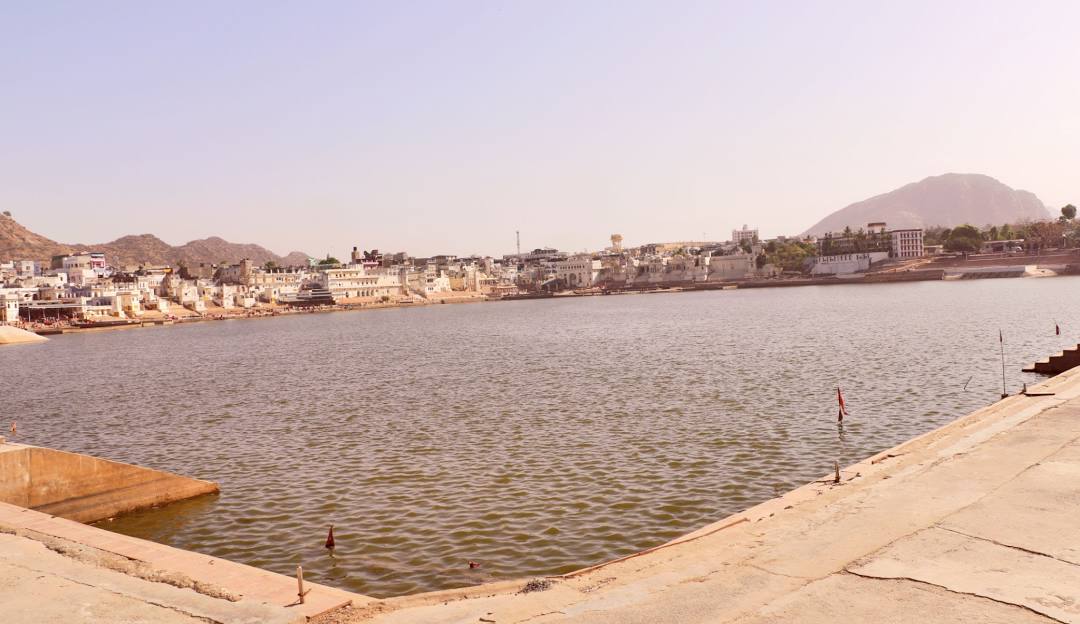
Following morning, we went to Pushkar to see the famous Brahma Temple next to the Pushkar Lake.
Brahma Temple, Pushkar (also known as Jagatpita Brahma Mandir) is a Hindu temple situated at Pushkar in the Indian state of Rajasthan, close to the sacred Pushkar Lake to which its legend has an indelible link. The temple is one of very few existing temples dedicated to the Hindu creator-god Brahma in India and remains the most prominent among them. The temple structure dates to the 14th century CE, with later partial rebuilding. The temple is made of marble and stone slabs. It has a distinct red pinnacle (shikhara) and a hamsa bird motif. The temple sanctum sanctorum holds the image of four-headed Brahma and his consort Gayatri (goddess of Vedas). The temple is governed by the Sanyasi (ascetic) sect priesthood. On Kartik Poornima, a festival dedicated to Brahma is held when large numbers of pilgrims visit the temple, after bathing in the sacred Pushkar lake.
The temple is said to have been built by the sage Vishwamitra after Brahma’s yagna (ritual). It is also believed that Brahma himself chose the location for his temple. The 8th century Hindu philosopher Adi Shankara renovated this temple, while the current medieval structure dates to Maharaja Jawat Raj of Ratlam, who made additions and repairs, though the original temple design is retained. Pushkar is often described in the scriptures as the only Brahma temple in the world, as a result of the curse of Savitri (Saraswati), and as the “King of the sacred places of the Hindus”. Although the Pushkar temple is no longer the only temple to Brahma, it is still one of very few existing temples dedicated to Brahma in India and is the most prominent among them. The Pushkar Lake and the Brahma temple were identified as one of the 10 most religious sites in the world and one of the five sacred pilgrimage places for Hindus in India.
The temple is open for worship between 6:30 am and 8:30 pm during winter and 6:00 am and 9:00 pm during summer, with an interval in the afternoon between 1:30 pm and 3:00 pm when the temple is closed. Three artis are held in the temple: Sandhya arti in the evening about 40 minutes after sunset, Ratri Shayan arti (night-sleep arti) about 5 hours past sunset and Mangala arti in the morning, about 2 hours before sunrise. The priests at the Brahma temple adhere to a strict pattern of religious practice. House-holders (married men) are not allowed to enter the sanctum sanctorum to worship the deity; only ascetics (sanyasis) can do this. Hence, all offerings by pilgrims are given, from the outer hall of the temple. The priests of the temple in Pushkar, generally belong to the Parashar gotra (lineage).
Once a year, on Kartik Poornima, the full moon night of the Hindu lunar month of Kartik (October – November), a religious festival is held in Brahma’s honour. Thousands of pilgrims come to bathe in the holy Pushkar Lake adjacent to the temple. Various rites are also held at the temple during the fair. The day also marks the famous Pushkar Camel Fair, held nearby. Special rites are performed on all poornimas (full moon days) and amavasyas (new moon days).
When we reached at the mandir, it was closed for afternoon siesta, so we went see the lake. Bina and Deepika went down to the banks of the lake which was quite dirty but people revered the spot. Before that we needed to use a rest room, so stopped by a restaurant whose signage displayed “AC Restaurant” and we felt that the place would be clean. It was not but usable. We also had to endure the onslaught of the self-styled guides cum priests proclaiming to be brahmins and offered to do puja on our behalf. We firmly shunned them.
While coming back from the lake, I noticed a guy sculpting figurines from black stone… quite modern depiction of the Ganesha and others. We checked the price and he quoted a price that was too high to even consider, so we countered with our offer which he initially rejected but later agreed. I picked up three Ganesha sculptures for Bina, Ayush and ourself.
We had a very peaceful and exclusive darshan of Brahmaji and left for Jaipur stopping once to eat the puri-sabji that Bina had packed for lunch. In Jaipur, we made a stop at MGF Mall where Deepika bought few Jaipuri tops and then at World Trade Park to buy a gift for Rishabh. Unlike Delhi, the malls in Jaipur are much less crowded and Bina confirmed that locals usually don’t visit malls much except to watch a movie or dining. Later, at her home, we had a simple but very tasty dinner, bade our goodbyes and was dropped at our hotel by Rishabh and Bina.
In the morning, we had sumptuous breakfast at the hotel and waited for Rajashree & Ayush to confirm pick-up time. The wedding reception had continued till late night and they went to bed in the wee hours of morning. As confirmed by Ayush, we picked them up from the Mariott around 11:30 am and headed for home, stopping on the highway for Rajashree and Ayush to eat something as they had missed the breakfast at the hotel. We reached home around 7 pm having stopped to buy a sunglass for Rajashree (a Birthday Gift) from a newly discovered shop in DLF Phase-I market (courtesy Sangeeta Basu)… Overall, it was a nice break for all of us from otherwise regimented life.
We are in the middle of the Circa 2024 and it certainly shall be remembered for the extreme weather conditions. In January we saw extended period of cold days (temperatures going below 5 degrees centigrade and now we are experiencing extended heat wave conditions (temperatures hovering around 45 degrees centigrade) since the month of May across northern part of the country. The time was ripe to go away to cooler chimes but most of the popular hill stations were crowded with people from the plains of Punjab, Chandigarh and Delhi besides Gujarat and West Bengal. We discussed with our decade long traveling partners and dear friends, the Basus and after much deliberations decided on Palampur in Himachal Pradesh, 485 km from Delhi for a quiet holiday, choosing an appropriate hotel called The Seclude, Palampur starting June 3 to 7, 2024.
DAY ONE
The alarm rang at 4 am but both Deepika and I were already awake. We got ready in 45 minutes flat then brewed our favourite tea’s and while sipping on it, called up to check status of Basu’s, who confirmed they have just started from Gurugram with ETA of 5:15 am. As we loaded our luggage in the Jeep, Santanu & Sangeeta arrived in a Blue Smart. We left at 5:35 am for our first destination Zhil Mil Dhaba at Karnal… google map indicated ETA at 8:32 am.
Once we left Delhi, traffic reduced and I could cruise at a sedate speed of 80-90 kmph, occasionally crossing the 100kmph barrier. The NH 44 is now a smooth driving paradise with elevated sections avoiding the city traffic and we soon reached our first destination – Zhil Mil Dhaba at 8:20 am beating GM by 12 minutes!!
We ordered for a mix of parathas with butter, curd and pickles and followed it up with tea, coffee and Limca as individual choices. The curd was excellent and I regretted not ordering lassi instead of black coffee but on hindsight, it was the correct decision as I had to drive another 300+ km.
The drive on NH44 was smooth and uneventful and we soon reached near about Zirakpur from where Google Map guided us to the left on a State Highway. The road soon became narrow passing through villages which reminded me of my numerous trips to my son’s university beyond Greater Noida zig zagging through the village roads. After about 25-30 km, we reached the national highway avoiding the chaos of construction on the NH44 at Zirakpur. The road NH 205A was through Ropar where we had gone few years ago but so much had changed since that we couldn’t recognise where exactly we had been to… we carried on at a steady speed never going above the speed limit, soon we crossed over to Himachal Pradesh and the road became serpentine climbing at a comfortable inclination. We entered Kainchi Mod Tunnel (1.8 km) which seemed never ending and wondered what would be feeling of driving inside Atal Tunnel (9+ km)!!
We crossed two more tunnels but they were much shorter in length and was soon on a beautiful scenic serpentine road that tempts you to press on the gas paddle but my dear friend Topshe had warned me of the numerous speedcams installed on the stretch and advised to be below 50kmph at all times. We were so engrossed in the scenic beauty and dodging the speedcams (slowing down just in time) that we missed our exit towards Hamirpur and had to endure a detour of 30 km. The road here onwards was through the towns (cities) often getting stuck at traffic jams. We needed a break to freshen up and stopped at resto-bar hoping to get sandwich and coffee. It was more of a bar than restaurant, offering only snacks like peanut masala and pakoras, thankfully they served coffee which I badly needed to stay awake at my siesta time (3-5 pm). This part of HP is mainly valleys so the climbs are never too steep and as the traffic was light, we could cover the distance in quick time. Getting closer to our destination, dark clouds could be seen in the distance over the mountains. The temperature dropped to 30 degrees and I switched off the air-condition and slide down the windows to let fresh air come through. I quietly accelerated realising that if the downpour starts, it will become a difficult drive in this hilly terrain.
We reached Seclude, Palampur, nestled in a quiet village with ample greens all around and the Dhauladhar range seemed to be close enough to touch. They have very aptly named the place. The (assistant) Manager, Mr. Bajinder Singh came out to receive us and took the luggage out of the car. I parked the car at the designated area and stretched my legs before going inside the hotel. There was another family occupying a family room besides us with two kids below the age of 10yrs and I dreaded the cacophony and ruckus they will unleash, but fortunately, they too wanted solitude and shifted to the newer property of Seclude down the road (25 meters) and we had the entire first floor to us. The food (dinner) was average to good but their breakfast was excellent and we thoroughly enjoyed. The rooms were of decent size and clean with breathtaking view of the Dhauladhar range.
oplus_1179682
The nicely brewed tea rejuvenated us and we went for walk along the road but had to cut short as it started getting dark and the clouds that have been hovering over the mountains descended to the valley threatening to break into a downpour which they did as soon as we were in the safety of the hotel. We settled down to play cards, needless to say it was the game of TwentyNine. The dinner was served in the room around 9:30 pm after which called it a day, a gruelling day for me having driven almost 500 km, half of which had been through serpentine hilly terrain.
DAY TWO
In the morning, after breakfast, we decided to explore Palampur and hired a cab to avoid the parking hassles and also to give me a break from driving. Our first visit was to Saurabh Van Vihar, a park created in memory of Kargil Martyred Captain Saurabh Kalia…
Saurabh Van Vihar is a very popular tourist place located at Palampur town of District Kangra in Himachal Pradesh, built in memory of Kargil hero, the late Captain Saurabh Kalia. The Vihar is built and managed by the Forest Department of HP. Saurabh Van Vihar is a nature park lying in the lap of snow-clad Dhauladhar Mountains, surrounded by lush green forest. Today, the park serves as the memory of many fearless soldiers, who sacrificed their lives for the security and pride of the country. The park offers many medicinal plants, a long trail of forest, an aquarium, small water body for boating, an open-air amphitheatre as well as a Tiger Hill Bridge besides the snow fed Neugel Khad river flowing through it. A great place for families, children and tourists to hangout and enjoy the natural beauty.
It takes about 2-3 hours to cover the park… we spent about 30 minutes exploring the aquarium, the river front, Kargil Bridge and the boating lake… it was too hot to go for boat ride, although few enthusiastic ones could be seen paddling.
Next, we visited the famous Baijnath Temple dedicated to Lord Shiva.
Baijnath Temple is one of the most popular temples in Himachal Pradesh, and here, Lord Shiva is worshipped as the ‘God of Healing’. Baijnath or Vaidyanath is an avatar of the great Lord Shiva, and in this avatar, the great lord rids his devotees of all miseries and pain. As a result, this temple holds ultimate significance to all Lord Shiva devotees and is considered to be extremely sacred.
Baijnath temple was built in 1204 A.D by two native merchants, Ahuka and Manyuka, who were doting devotees of Lord Shiva. Situated at a distance of only 16 kms from Palampur, this time-honoured temple is a place where one can attain sterling peace and untainted tranquillity in the gentle caress of God. It is one of the unique temples in India where both, Lord Shiva and Demon King Ravan are worshipped.
According to the ancient scriptures of Hindu tradition, Lord Shiva established 12 jyotirlingas and one of these 12 jyotirlingas rests inside the famous Baijnath Temple. The ancient but magnificent temple is set in the backdrop of the Dhauladhar Himalayan Range, an ancient rustic temple standing gloriously in front of majestic white mountains! The view of the peaks in the Himalayan Range covered in ghost grey mist as they pierce the sky gives a feeling of both, marvel and satisfaction.
Deepika, Sangeeta and Santanu went inside to pay obedience to Lord Neelkanth aka Baijnath while I got busy in my favourite pastime of observing people besides standing guard to their footwear. They came out quite quickly and we headed for our next destination Bir Biling, a place for paragliding enthusiasts, Santanu & I stepped out to take few snaps. In the hot weather conditions, there were quite a few who were merrily paragliding high up in the sky. It’s a sport for the youngsters definitely. We moved on for Andretta Pottery. Honest confession… the place is unnecessarily hyped up; we did not find anything that can be termed as irresistible or even beautiful… the items on sale were exorbitantly priced as well. One can easily find much attractive pieces in Delhi’s numerous Banjara Shops (on Press Enclave Road, Delhi Haat etc) at much reasonable prices.
Before, the Andretta Pottery hub, we paid a visit to the Sardar Sobha Singh Art Gallery & Museum. Sardar Sobha Singh was born on 29 November 1901 in a Sikh family in Sri Hargobindpur, Gurdaspur district of Punjab. His father, Deva Singh, was in the Indian cavalry. Sobha Singh joined British Indian Army as a draughtsman in 1919 and served at Iraq till 1923 when he resigned from the Army and opened his own studio at Amritsar in 1923. He moved to Lahore, Delhi, and Bombay before finally settling down in Andretta in 1947 as he was forced to leave Lahore due to the partition of India. Andretta (near Palampur), was a remote and then little-known hamlet in the Kangra Valley on the foothills of the Himalayas but Sobha Singh brought this tiny village on international art map by his various classic works. Sobha Singh is fondly remembered as Darji and his daughter Bibi Gurcharan Kaur, assisted by her son Dr. Hirday Paul Singh, has converted Andretta into an ever-popular tourist destination not only for art enthusiasts but for all who admire his work. His most famous artworks are that of the Sikh Gurus and other eminent public figure viz. Mahatma Gandhi, Saheed Bhagat Singh, Lal Bahadur Shastri, Prithviraj Kapoor and Amrita Preetam. The art gallery and the museum are very well preserved and provide insight into the lifestyle and work of Sardar Sobha Singh.
After Andretta, we visited Wah Tea Estate which had a eatery as well where we had a leisurely lunch and spent some time in the tea plantation. We also picked up some exotic tea for home. We returned to the hotel and after some relaxation settled down to playing TwentyNine.
It also happened to be the declaration of results for Indian Parliamentary Elections. I am labelled as the most political amongst my friends with right-wing inclination but it was Santanu, Sangeeta and Deepika who were most interested in the results. This time around, the ruling dispensation (last 2 terms) had coined the tagline Ab ki bar 400 par. Any rational person can understand that this slogan was to pep-up the cadre to do well in the absence of any perceptible issue. In the post independent India, no party has ever managed to win 3 consecutive terms except our first PM, Jawahar Lal Nehru but the situation at that time was very different and unique. I knew that the current govt will return to power but with a lower or similar mandate than the previous 2 terms, so I played cool and killed the joys of the others by not reacting to their provocations.
At dinner time, the manager of the resort, Mr. Chain Singh served us a preparation of Himachali Sabji made by his wife. It was very tasty and delectable which we tasted for the first time. We asked him about the ingredients which is locally available only and can’t be replicated at home. He promised to treat us with a special daal-saag of Himachali origin and kept his promise on the last evening. I thought the saag might be palak or spinach but it was some local foliage that’s native to this part of the state.
DAY THREE
Technically, the second day, we decided to visit Dharamshala and McLeod Ganj even though we have warned by multiple sources that it will be mighty crowded. We left for Dharamshala after breakfast and on the way stopped by at the Chamunda Mandir on the Palampur-Dharamshala Road. In the Kangra district of Himachal Pradesh, around 10 kilometres (6.2 mi) west of Palampur, is the renowned Chamunda Devi Temple which depicts scenes from the Devi Mahamaya, the Ramayana and the Mahabharata. The goddess’s image is flanked by the images of Hanuman and Bhairava. There’s another temple of Shiva just below it inside a cave. It was relatively uncrowded when we visited and we had a nice, peaceful darshan of the deities.
oplus_1179682
As we started for the Dharamshala, the driver announced that there’s a Dalai Lama (Tibetan) temple in the close proximity. Our first reaction was “Oh no, not a temple again”!! But he persuaded us to check it out and frankly, Norbulingka Institute, a centre for Tibetan culture, did not disappoint us rather it is a must visit if you are in the vicinity. Norbulingka Institute is built in traditional Tibetan architectural style and follows a ground plan based on the proportions of the deity of compassion and patron Bodhisattva of Tibet, Thousand-armed Avalokiteshvara. Norbulingka is about keeping alive centuries old Tibetan tradition in content, form and process by providing apprenticeship in traditional Tibetan art forms and making Tibetan experience accessible for contemporary lifestyle. The atmosphere of the compound was tranquil and peaceful. The life-like statue of Dalai Lama is fantastic. However, their tac shop was exorbitantly priced, one could get similar items in the shops of McLeod Ganj at the half price. The cafeteria on the premises needs complete overhaul not just the menu but the manpower as well. Once a sizeable number of customers visit, the staff gets overwhelmed and confused, service becomes pathetic.
oplus_1179682oplus_1179682
We all have seen the Dharamshala Cricket Stadium (highest stadium) on the television screen during the IPL matches, Deepika insisted that we visit the place even though we were not sure if we would be allowed inside the stadium. As it turned out, the HPCA had opened one gate to allow the visitors to take look inside the stadium at a modestly priced ticket of Rs.20/- per person. It is perhaps the most beautiful scenic stadium in the world with the Dhauladhar range of Himalayas at the backdrop. The stadium is small but has so far provided some of the most entertaining cricket matches, both international and IPL.
On our way to McLeod Ganj, we made a brief visit to Naddi which is basically a high viewing point from where one can get a panoramic view of the valley. It took us about 30-40 minutes to reach McLeod Ganj from Dharamshala with the detour of Naddi as the traffic was not too heavy… the driver dropped us the market square. Ten years back when we came to Dharamshala, many a times we had come here to pick-up food and our favourite spot used to be Tibet Kitchen for its authentic oriental cuisine. Without much thought we went in there, the place has been renovated and we got to know that ownership had changed thrice over the ten-year period. The ambience was nice and clean. We ordered very standard Chinese dishes… soups, starters and main course. The soups arrived, Thupka for Santanu, Manchow for Deepika and Talumein for Sangeeta and me. Honestly, we couldn’t make out any difference in the soups, all looked similar and tasted same too, but it was too late to cancel the rest of the orders. The main course was pathetic, the hakka noodle was all gooey, the pork pieces leathery and the chicken was bland; the sauted veggies had magically become very sour (vinegary) Manchurian. We called for the Chef and after much persuasion, a young chap came forward who was definitely not a chef by any measure, at best a helper/ errand boy, he mumbled his apologies but not just our lunch but our appetite was ruined too. We left the restaurant to do shopping; I would have liked to pickup a Tibetan brass statue but Deepika had warned me that there’s no space for such a thing back home. However, I was allowed to buy a Tibetan Tongue Drum, a musical instrument for meditation, while she and Sangeeta bought some stone jewellery for gifting.
It started raining as we came out from the shop and quickly intensified, we called the driver but he informed that there’s a long traffic jam and it may take up to 30 minutes to reach us from the parking area. While waiting for our cab, we had “Softy Icecream”, a must have if you are in any hill station. Forty minutes later, half drenched we got into the cab and headed for Seclude… the rain kept pace with us till Dharamshala but we knew it will soon reach Palampur too, maybe with less intensity.
Back in the hotel, we freshened up to play TwentyNine, the team Santanu-Deepika and Sangeeta-myself were tied to One-All… Santanu started playing aggressively winning every hand that he called. Sangeeta, my partner too showed her prowess and started bidding aggressively, we were chasing them closely, when Santanu played Single Hand to win a set. However, his triumph was short-lived as two games on, I got a handful of Hearts and two high cards of Diamond, prompting me to play and win Single Handedly, equaling the game with a set. We realized it was past 9 pm when we got a call for dinner… we had asked for boiled potato, rice with lots of butter which we converted into a Bong soul food (Ghee-Bhaat, Aloo-Seddo). It was one the most delicious and relishing dinner especially after our horrible lunch experience at McLeod Ganj.
DAY FOUR
The day was earmarked for relaxation, we got up early and went for a stroll through the village road followed by breakfast. Sangeeta suggested that we visit the (upmarket) resort, Storii by ITC Group. She called up to find if they allow walk-in guests at their restaurant which they affirmed and booked us for around 1:30 pm. The Storii by ITC is located off the Palampur-Dharamshala Road and one has to go through the Palampur Cantonment. The well laid and maintained clean road took us to the beautiful property with lush green lawns and large swimming pool, well appointed large rooms with a tariff to match the opulence. New blocks were under construction which they are promoting as time-share units; we were given a brochure of the units on sale which looked nice and attractive but the asking price was too high for us to even contemplate.
I have been off alcohol since the beginning of this year and it has affected our dining… Santanu had to let go of a chilled beer in the absence of a partner and settled for a virgin Mojito, for the main course we decided to go local and ordered two portions of Himachali Dhaam. The Dhaam in Himachal differs from region to region, it is essentially a mid-day meal (lunch) consisting of boiled rice, sweet rice, daal, sabji, roti/puri cooked in Himachali tradition and offers an opportunity to get acquainted with the delectable local taste. Originally, Dhaam used to be only cooked by Botis, a particular caste of Brahmins who are hereditary chefs but nowadays, there’s no such restrictions. Our platter had boiled rice, sweet rice, puri, chhole-aloo, paneer curry/ mutton and daal. The Dhaam feast as it is primarily a vegetarian fare but here at the Storii by ITC, they had made an exception for the non-vegetarians like us with the inclusion of Mutton curry. This was one of the best cuisine we had in Himachal even though we had visited the state numerous times.
After lunch, we relaxed within the resort and even played few rounds of TwentyNine after acquiring a pack of cards from the front desk of the hotel. Thereafter, we indulged in a leisurely coffee with cookies before returning to our hotel.
DAY FIVE
While coming to Palampur from Delhi, it had taken us almost 12 hours, but with moderate traffic. The return journey wouldn’t be like that especially once we are closer to Delhi in the evening… we were bound to encounter heavy traffic and consequent jams. Therefore, we decided to break our journey and stay overnight at Chandigarh (Panchkula/ Mohali/ Jirakpur) and booked two rooms at Bella Vista by ITC Welcom Group.
After our visit to the Storii by ITC, our expectations were high about Bella Vista, however, we were met with complete disappointments. The hotel is old, run down business hotel within the complex of a commercial mall which itself is in bad shape of disrepair and abandonment, probably affected by the Covid lockdown. The only grace was the quality food but marred by below par service… when we reached there in the afternoon, we were parched and hungry, so we ordered for chilled beer and Nachos with salsa to start with followed by tandoori chicken and naan for 3 of us and a veggie roll for Deepika. The beer was served with peanuts and followed with the main course, however, we kept waiting for the Nachos with salsa and eventually cancelled it. We have great regard for the ITC Welcom Group hotels and resorts and felt that this particular unit is probably forgotten and not in the radar of the management.
We had planned to go to Chandigarh in the evening but the unbearably hot weather made us stay back in the air-conditioned cool confines of the hotel room and play TwentyNine till dinner time.
DAY SIX
In the morning, we had a sumptuous buffet breakfast in the hotel and left for Delhi around 9:30 am, initially thinking that we would stop at the famous Puran Singh da Dhaba (Original) at Ambala Cantt and pack our lunch but Google Map took us through a different route altogether bypassing Ambala. We connected to NH44 just after Ambala and stopped only once for a break at the Haveli Resort. We reached the outskirts of Delhi around 12:30 pm and encountered heavy traffic… it took us another 1.5 hours to finally reach home, where Shinjini (daughter of Sangeeta-Santanu) along with Chewbacca the Princess, was waiting to pick-up her (their) parents.
It was not an ideal holiday that we would have preferred, primarily because of the unusual and extended heatwave conditions throughout the northern parts of the country including the hill stations but it had been a thoroughly enjoyable road trip after a long time.
Why am I writing this after almost 6 months… My Son’s Wedding Story?
Well, this was the second biggest event of our life after the birth of our son. And personally, the last before I depart for the Baikunthadham. More importantly, I witnessed the event unfold from the sidelines, most of the times if not at all times. The mother-son duo managed and did all the external interactions and I watched them doing wonderfully well. Why so? Because I was told to keep my thoughts to myself only and not speak out bluntly which I do most of the times. I have always been like that… blunt, rude, truthful and on your face kind of attitude… now it’s too late to change, so keeping my traps shut was the best for all concerned. And I can tell you the story as it happened truthfully adding few of my special masala to spice it up subtly.
THE BEGINNING
Sometime around September 2022, our only child Ayush announced that he’s ready for marriage and introduced us to his would-be life partner Rajashree, a nice, beautiful young girl. Initially she was nervous meeting us (would be mom n dad) for the first time but as the conversation happened, we put her at ease and she opened up with us. We were overjoyed with the prospect of them getting married but as per Indian customs, the parents must meet n greet and agree to the match. So, it was decided to meet Rajashree’s parents at a restaurant in Connaught Place.
We wanted to have an engagement ceremony in end December when Ayush would come for Christmas holidays, but my sister pointed out that it being the Bengali month of “Poush” it is considered an inauspicious month to celebrate any happy occasion. The formal engagement ceremony was pushed to March 2023 while Ayush arranged for a private party for the two of them where he formally proposed to her and she accepted. We got to see the pictures only!!
We arranged for a small gathering at the Panchsheel Club for the engagement ceremony on 4th March ’23, attended mainly by the relatives of both sides and friends of Ayush and Rajashree and few family friends. Before that, Mr. Guha, arranged for a ceremony called Patipatra, it is the first ritual of Bengali Hindu marriage. It is also known as Lagnapatra or Mangalacharan. Patipatra ritual is basically a preliminary discussion in the presence of Purohit Moshai, finalizing the date and venue of the marriage. It is through this ritual that other rituals of marriage begin… In earlier days, the Patipatra also included the “joutuks & pronamis”, the gifts from both sides that would be exchanged. However, ours was simple which mentioned that both parties agree to the alliance and a date/venue to be decided soon.
After discussing with our Purohit (Pandit Ji), and in consultation with Mr. Guha, we finalized November 27th & 28th 2023 for the marriage of Ayush-Rajashree. It is going to be the biggest event of our life so needed prep starting immediately… but before that our home needed a makeover…
THE PREPARATION
We envisaged the whole operation of home renovation to be of 12-14 weeks though the trusted contractor, Mr. Sheetla Prasad assured finishing by 12 weeks. Both were wrong, it took almost 17 weeks to complete and while it was on Deepika & I was confined to one room only for most of the weeks. At the end however, we now have a brand-new home to live and enjoy for a long time to come.
While the home was getting renovated, we did the wedding shopping mostly giveaways ensuring value for money for each item bought. Deepika and I went to Kolkata to do shopping and bought sarees, dhoti-kurta and ritualistic items for the marriage ceremony (see Shopping dot Kolkata at Aranyascope).
Ayush staying in a bachelor pad with two other friends decided to move into a family accommodation after marriage and started looking around for a lease. Most of the organization which went into WFH mode had recalled their employees thus sending the rentals up north. The 2BHK apartments were costlier than his current lease of 3BHK which anyway were skyrocketing. We advised him to look for an apartment to buy instead of rent… the logic being that he would pay the EMI instead of the rent and acquire a property which would appreciate in value over the years. Initially, like all youngsters he was hesitant… “I don’t know if I will be in the country five years down the line, what will I do with the apartment then?” But eventually he agreed and started house hunting with a renewed zeal. He shortlisted couple of places but wanted us to have a look and confirm. Deepika decided to go and take a call and utilized the visit to meet few of her clients in the city. On the second day of her there in Bengaluru, she called me and declared that I was needed there to break the impasse as what she likes, Ayush doesn’t and vice versa. The following evening, I reached Bengaluru and was told that what Deepika likes is little further from Ayush’s office increasing his commute time substantially while the one Ayush was keen is in a unusual surrounding… the property was developed by one of the top notch developer of the city, Brigade Group, it was primarily developed for a hotel chain as “Suites” in the floors 4 to 6 with floor 1 to 3 as co-working space and the ground floor as food court. However, due to Covid pandemic the deal fell through and they were selling the space as individual units. The unit itself was large (1800 sqft) 2.5 BHK, ideal for a couple… but the issue was the surrounding; the location of the property was on a busy main road next to an office building. The security was an issue as well because of the food court and co-working space in the same building. Also, there was no greenery or walking space, it lacked the feeling of living a residential building.
Anyways, I went to check the places with an open mind after fixing appointments with the respective agents. Our first visit was to Whitefield where Deepika liked the apartment. It was gated community and the unit was on the 6th floor, quite airy and lighted consisting of 3 bedrooms and decent sized living cum dining room. We liked it despite the increased commuting time for Ayush as well Rajashree. However, while we were at the other property, the agent called up to inform that the unit has been sold and he can show us some other units in a few days time.
Having rejected the second property, we were back to square one and I was feeling that my visit was a total waste time and money. On Monday evening, Ayush called and said that one of the agents he was interacting will be able to show us an apartment at Shobha Royal Pavilion, Sarjapur Road. It was a delightful news because Shobha Developers are one the top five and reliable builders. Their properties get sold as soon as they announce the project.
The following day we reached the site and met Deepak, the agent who took us inside the complex. The property layout reminded me of our stay in NCC Urban, Hyderabad. Three towers were completed, and two more towers are in the finishing stages for handover. The concerned apartment was on the 18th floor of tower 4 where final finishing touches were underway. The elevators were working, and we went up to the 18th floor… only 4 apartments per floor which was a good sign. We liked the apartment as soon as we entered… some places give you a positive vibe immediately. It was well lighted and airy with space enough for the couple as they start their marital life. Both, Ayush and Rajashree were in their respective offices, but we needed them to see the place and take the call. They agreed to reach within an hour. We told Deepak that we liked the apartment, and he should hold on to it till the kids see it and confirm. Promising to meet us again in one hours time at the site, he went to have his lunch while we had our coffee while waited for the arrival of Ayush and Rajashree.
The abode of Ayush & Rajashree
Ayush and Rajashree both liked the apartment, and the deal was sealed. It was decided that Deepak would speak to the owners Deepali and Amaresh and work out the formalities. The whole process was estimated to be done in 60days, but Madhav had other ideas, it took 4 months to complete the deal in mid-January 2024. However, the owners had given the keys to Ayush on receipt of the initial payment, so he could start the interior decoration while formalities and paperwork was going on. Following evening I came back home but Deepika stayed back to attend to business meetings.
The month of October came and went away along with the festivities of Durga Puja and our annual Laxmi Puja at home. We were in the wedding month before we could realize. Ayush came home 2 days before the Diwali, and we celebrated it in the usual way. However, there was no time for the Diwali card parties…we were bracing for the grand party on 27th and 28th of the month.
A week before the D-day, Sangeeta & Santanu came over to guide and help us pack the Gaye Holuder Tatva. The packing of Gaye Holuder Tatva is quite intricate, imaginative and requires not just creativity but some level of expertise in the concept of packaging. The items are non-standardize both in shape, size and material. Sangeeta having done it for her daughter Shinjini’s wedding knew it at heart. We had bought the trays (specially made for this purpose) and cellophane sheets besides ribbons and assorted items. She and Deepika made the trays while Santanu and I packed them at our best abilities. Some of the items like the Lehenga posed a challenge because not only it was voluminous but quite heavy. Then there were glass and silver items which needed to be firmly placed on the tray before wrapping. It took more than 5 hours to do the packing between 4 of us. We purposely avoided making fancy packages (the usual norm e.g. creating a cone or boat shape using a saree) as these were to be transported twice, once from our home to the hotel and then to Rajashree’s parental home. I had few big cartons in which I placed these trays duly numbered and noted to make a list for the bride’s side to tally. Later, I got to know that even this list is usually made very fancy with poems and drawings describing each item!!! A few perishable items were left to be procured and packed on the day of Gaye Holud. I entrusted the job of procurement and packing to friends staying close to the venue of wedding.
Ayush had a Sherwani with open front stitched at Bengaluru nicely embroidered but extremely ill fitting. We went to Manyavar in Southex hoping to find a tailor to correct it or find something alternate. They said they don’t do alteration for garments made by others; also, their largest size was a bit smaller for Ayush’s physic. However, one of the salesmen provided an address in Lajpat Nagar who do alterations. It was a small shop specializing in wedding attires at a reasonable price. The owner said he can make it better fitting provided there was enough margin (cloth) to play. He promised delivery within 4-5 days. We bought a matching Safa & Stollfrom him and waited for the renewed sherwani.
As promised, we got the sherwani duly altered without any difference to the fittings. We were in a panic mode with only 4 days remaining before the event. Ayush had spent a lot on the sherwani and was not keen to spend more, however, after lot of persuasion agreed to check-out nearby designers who can do it within the short time we had. Designer Vikas Makhija was one from whom he had got a “Modi Jacket” made few months ago which fitted him perfectly. We went to his outlet at Shivalik, Basant Kaur Marg but he did not have anything readily available that fitted Ayush. When we narrated our predicament, he agreed to do it and deliver on Monday evening, the day we were to move to the hotel in the morning. We kept our fingers crossed.
THE EVENTS
My eldest sister and nephew came from Germany on 25th and the wedding celebrations were kicked off on 26th November 2023 with the ceremony called NANDI MUKH, a Bengali ceremony for all happy occasions, this ceremony is performed at the bride and the groom’s home by their respective families, a day before the wedding. The significance of Nandi Mukh is to pay tributes to the deceased ancestors of both sides and seek their blessings. An elaborate pooja is performed under the guidance of a pundit or some elder member of the family. Holy spirits are invoked to shower their blessings on the bride and groom. After the pooja, a fun factor comes into play. A bachelor lunch billed as the last bachelor lunch for the groom and the bride (known as ‘Aaiburobhaat’), is organized where friends and family members make the bride and groom eat to their fullest. A special effort is made to cook several dishes, including their favorite ones. The Nandimukh ceremony can prolong for 5 hours plus but I told the Panditji to make it concise as much as possible and he did his best to complete the rituals within 4 hours. All the ritualistic items like the Kulo, Khuri, Pradeep, gamchha, dhuti, saree etc. were bought from Kolkata except the perishables like fruits, veggies and sweets which I bought locally except banana which my cousin brought from Kolkata, because a whole un-cut bunch (hand) of small bananas known as Yelakki or Elaichi was needed but we don’t get them here in Delhi (one can place an advance order with some vendors in C R Park but no guarantee that it will be delivered as required on time).
We had arranged for lunch for the invitees at the rooftop of our residence (the owner of that space had kindly consented to our request and were away to Mumbai giving us complete freedom to deck-up the place). The caterer was a young chap called Dipakar Acharya (Dipu), with whom I got connected through my dear friend Ashishh. Before confirming I tasted the food at an event in CR Park and liked it. The food spread was completely Bengali cuisine starting with Narkel diye Chholar Dal, Jhurjhure Aloo Bhaja, Beguni, Aloo-Kopir Torkari, Chhanar Dalna, Katla Maachher Kaalia, Chicken Rezala, Gobindobhog Bhaat, Papor Bhaja, Pineapple Chaatni, Mishti Doi and Sandesh. Needless to say, the event went off very well with the guest relishing and enjoying food and the warmth of the late-November Sun.
Later in the evening, on persistent demand of the nieces, a Mehendi team was arranged along with the customary street food that goes with it… Gol-gappa, Bhalla-paapri, Aloo Tikki, Samosa and Dhokla. We did not expect many people to join as it was decided just two days before and invitations had gone late. However, to our surprise, those who had come for the Nandimukh, stayed back and others joined later in the evening. Deepika’s friends, Mala, Sumita, Radhika and Madhavi who had been instrumental in making our wedding a real dashing affair 32.5 years ago, made the evening come alive with their never diminishing energy through singing and dancing. We requested Kartik, hubby of Arushi to arrange for the music appropriate for the occasion and he delivered with high level of professionalism. The music made everyone dance to the tune including yours truly and my octogenarian sister from Germany. The event which was supposed to be for just between 4 to 7 pm went on till about 9pm and we were simply exhausted by then and needed a good nightly sleep to recuperate for the grand events to follow.
Deepika and her friends, instrumental for a happening Mehendi Function
Oh, I forgot to mention that on 25th November evening, Rajashree’s parents and some family members came over to our home to bless Ayush. The ceremony of AASHIRWAAD itself is supposed to be elaborate but in view of the upcoming events, we decided to keep it simple and limited to immediate family members. Aashirwaad, similar to Sagai in North India’s marriages, is a common ceremony observed by the bride’s and groom’s families. It usually takes place much before the wedding. However, Bengalis are flexible in their approach. Keeping the convenience of their guests in mind, they sometimes organise the Aashirwaad just prior to the wedding ceremony. The objective is to ensure that all the elders in the family, and among friends too, bless the couple. With some dhaan (rice grains) and durba (three-pronged grass blade) and sweets, the bride and the groom are blessed. As an expression of blessings, gifts or money are also given. However, unlike the North Indian’ marriages, ring exchange is optional.
The morning of 27th started with a busy note, my cousins (sisters) coming from Kolkata had to be picked up from the T-2 IGIA in the morning. Deepika’s Bhabi and niece were reaching Nizamuddin Railway Station around 7 am… she went with Guddu to pick them up while I picked up my cousin brother from La Paz hotel on the way to the airport. These pickups couldn’t be outsourced like I did for my friend Abhijit Bose coming from Kolkata by Rajdhani who was picked-up by my dear friend Gora. Ayush had instructed his outstation friends & colleagues to avail Ola/ Uber and reach the hotel on their own.
We had lot of stuff to transfer to hotel from home…some very delicate like the Shree which Shinjini aka Jhukku made with help from her granny. It had come out beautiful and everyone who saw, appreciated it immensely. Then there were the ghot and Kulo decked up with items and blessings of the ancestors which needed to be carried as it is and with care. We had two vehicles to ferry the material and humans but that wasn’t enough, so I called my friends Tapas and Robin with their cars. In two trips, most of the stuff were transferred and only the most personal items were held back to be taken personally with us. By the time everything was done, it was well past 3 pm and time to go for the trial of Ayush’s sherwani. The sherwani was ready for fitting and it took less than 15 minutes to assess the points that needed refinement. The delivery was scheduled for 8 pm same evening. We paid up and introduced Guddu who would pick it up and bring to the hotel.
We reached the hotel around 4:15 pm and the extended lunch hour was almost over… we quickly went grab some food at the Kylin Restaurant of the Holiday Inn, Mayur Vihar. Just as I was about to dig into the Chicken Leg piece, my friends Abhijit aka Bhnodor (from Kolkata) and Tapas came and asked, “What purpose do you need the Sandesh, Rosogolla and Mishti Doi?” I told them its for the Tatwa of Gaaye Holud. “Are you certain?” Topshe double checked and when I said, “Yes, affirmative.” He said, “Okay” and they left. I had no idea then, why they asked but later got to know the significance.
I wanted to take rest (nap) for a while before the evening cocktails but don’t know how the time flew and it was time to get ready for the big event. My “dress suits” were there but I couldn’t see my suitcase containing rest of my clothes. I went in a panic mode and asked Guddu, who had gone to pick-up Ayush’s Sherwani to go home and check if I had left it there. A few minutes later, he confirmed it wasn’t at home. I immediately raised an alarm with the hotel staff and they went in a tizzy checking the CCTV cameras but could find nothing amiss. I tried hard recalling the events of the day… how and which boxes/ suitcases went in which vehicle. By this time, the entire hotel staff was looking for my “missing suitcase” by checking with each guest room if they have an alien baggage. In my T-shirt and Jeans, standing in the lobby, I started welcoming the guests and they wondered why the groom’s father is not dressed for the occasion!!! On hindsight, I could have attended the event just like that creating a fashion sense for others to follow!!!
On a desperate note, I called up Robin, my friend, and asked him to check his SUV for the suitcase, after a while he called to say that its not with him. Then I called up Topshe, who was in the midst of getting ready for the cocktails but he ran to his car and confirmed that it was with him and he’s bringing it asap. I called the hotel desk and apologized for the confusion but their demeanor suggested that they are quite accustomed to such misadventures!!!
The cocktail was arranged at the poolside of the hotel which had limited capacity (max 175-180 pax) because of non-availability of the banquette hall therefore with a heavy heart we had to prune our invitations. The party began with a joyous note with singing and dancing on the specially created floor. I must mention that my friend Santanu and his son Shenjit, a very dear friend of Ayush mesmerized the gathering with their soulful singing. Ayush sung a very emotional song for Rajashree and then there were few amateurs who sang at their own tune. I had requested my friend Dr. Pralay Dey to sing a few songs but at the end he did not get an opportunity to showcase his talent. The other highlight was my friend Ashishh getting drunk having experimented with his tipple. Indro, Pralay and I had to support him to the car at 2:00 am and told the driver to deposit him at his home if not on his bed.
I finally went to bed around 2:45 am after getting a bed set up for Ayush who was still out with his friends enjoying the last few hours of bachelorhood, only to wake up around 4:30 am for the Dodhi Mangal, a ritual where the groom and bride fed a mixture of curd, poha, Sandesh and banana before the sunrise on the day of wedding. Usually, that’s all they have till the wedding ceremony is completed. We had carried all the ingredients from home but the carefully packed items were nowhere to be seen. Only the pack of Sandesh and Dahi rested in the refrigerator, I ordered the poha and banana online (Swiggy Instamart) hoping they will deliver at that ungodly hour. To my surprise they not only accepted the order but delivered (at the gate of the hotel) in exactly 8 minutes. While I had gone to collect the order, Deepika called up room service and asked for the same things as well. It doesn’t end here… while Ayush was having the concoction, Deepika’s friend Sumita came to our room with the original pack of the poha and banana which had been in her room all along!!!
Deepika and I woke up around 7:30 am and got ready for the breakfast and prep for the Gaaye Holud (Haldi Ceremony) slated to start around 9:00 am… the venue being the poolside once again. We had engaged a decorator who decked up the place with lots of yellow and white flowers besides other props. The Gaaye Holuder Tatwas were brought and displayed in such a way that all invitees could see them. My friends brought the decked up whole fish (a 5kg Rahu) along with the trays of Sandesh, rosogolla and mishti doi… we thought we did a good job with the gifts, both in numbers as well as with the packaging till we experienced how it is done in the Bong way when the Boubhaat/ Phoolsojja’r Tatwas came to our home 2 days later. Earlier, we had requested Sangeeta Basu to collect water in a ghara (pot) in lieu of Ganga Jal (normally collected after Ganga Nimantran) which is used as a symbolic bathing water for the groom/ bride. There’s a full ritual of Ganga Nimantran and collection of water by 5 married ladies from each side which the bride’s side did but we neither knew the exact ritual nor bothered about it. My parents never indulged in elaborate rituals and wherever permitted made it simplistic in line with modern times, I have gone a step ahead and don’t get into rituals at all though I never oppose if anyone wishes to follow and provide the logistics wholeheartedly.
We had arranged for brunch but almost all the guests had breakfast in the morning, so the brunch became lunch and still many skipped it resulting in not fulfilling the minimum guarantee. The dish Sarso Saag with Makki Roti became an instant hit with the guests from Eastern part of the country, for most it was the first time tasting. Post lunch, the ladies and girls got busy with the team of make-up artists for the evening ahead. Deepika asked me to get the facial done but I refused. I helped Ayush in wearing the pant-dhoti and very finely starched silk kurta with typical Bengali style embroidery, the attire for the Bengali Groom. Deepika dressed in a traditional Bengali red bordered white saree and decked it up in Bong style. I wore the dhoti and kurta which was strikingly similar to Ayush’s. We were all set for the Punjabi style Baraat sans the Ghori (horse) which had been replaced with a vintage Impala car.
Our Panditji, Haru Babu had reached the hotel and had set up the Mandap where the wedding ceremony was to be held; he called me up and urged me to let the Barat get going but before that there’s ritual for the mother where she blesses the son along with other elderly ladies and sends the groom to bring home the bride. Thereafter, the father takes the son to the gate from where the bride’s brother takes him to the Mandapdwar where the mother-in-law along with others welcomes the groom. Our case was a bit different, since Ayush has inherited both cultures, it was decided that the Baraat will assemble at the Gate #2 of the hotel and slowly move to the main gate where the bride’s side will welcome and take over the rituals. The assembly of Baraat was timed at 4:15 pm but was inevitably delayed and after frequent reminders, all gathered at the designated spot around 4:45 pm and we started the yatra with the beats of drums and typical baraat songs.
As it happens in any wedding, the time schedule goes haywire despite best efforts, here too it happened. Firstly, we were late in starting the baraat then there was delay from the bride’s side who did their best to get ready for the occasion given the space constraints vis-a-vi the number of persons. As a result, the ceremony which was to start at 5:00 pm finally began around 6:00 pm. It’s a long ritual, perhaps the longest compared to other cultures…over 2 hours at the least. I also realized that father of the groom has no role to play in this ritual except be around and entertain the guests.
Rajashree’s Kaka (paternal uncle) sat for the ceremony and solemnized the holy matrimony including Sampradan or Kanyadan. Nowadays, there’s a lot of angst for this amongst the GenZ, primarily because the concept has never been explained to them with clarity. Last year my friend Debu’s son got married and the young couple got married under the auspices of Vedic Wedding, a new concept getting popular in the Bengal. What I could understand is that a group of women (priests) chant certain Vedic Mantras and after each verse, it is explained to the couple and the audience, followed by an appropriate Rabindrasangeet. The whole ceremony takes as much time but it avoids all controversies.
One of the most emotional moments in a women’s life and that of her parents is the ritual of Kanyadaan or Sampradaan in a wedding ceremony. But from where does the concept come from and what’s its validity today? While every one of us knows about kanyadaan as we see it every day in Indian shows and movies, the meaning behind it is barely understood through these mediums. Why does it take place, when it was started, the history behind it, and many more questions just come to our mind and is lost with time…
Not only Kanyadaan, but each of the rituals that take place during the wedding ceremony is passed down from many generations before. But if we talk about the Vedas, there’s hardly any evidence to say that Kanyadaan was mentioned there. As per the Vedas, the consent of the bride was primary and the couple entered into the union of marriage as equals. So, from where does the concept of Kanyadaan came? Some Pandits believe the concept came from Manu Smriti texts and comparatively a new ritual. However, more plausible reason could be that in Hindu society, irrespective of the caste, each of us are descendent of a Rishi which forms our Gotra. So, at the time of wedding, the father/ guardian transfers her Gotra to the groom’s. Moreover, during a wedding ceremony, the bride is considered to be a form of the Goddess Laxmi, while the groom is a form of Lord Vishnu. The parents of the bride are initiating the union of two Gods through this ceremony.
Sampradaan, is not only an important ritual based on the texts but also a very emotional moment for the family as they give away their most prized possession. The ‘Sampradaan’ is also said to be the greatest gift of all given by the bride’s father to the groom. The ritual of Sampradaan is also meant to be the consent of the bride’s parents on accepting the groom as their son-in-law and a request the groom to accept their daughter as his wife.
The wedding ceremony concluded with the PHERAS (circling around the fire while Pandit Ji chanted the mantras) and application of SINDUR on the forehead of the bride by the groom. It was past 9:00 pm, the bride, groom, Deepika and I rushed to our rooms to changeover to our party dress. Once again on hindsight, we shouldn’t have bothered because by the time, we came to the banquette hall, a sizeable number of guests had left and few others were bidding their good-byes. Only the close friends and relations stayed back. We had few photo sessions with the newly wedded couple. My friend Rini’s daughter took the stage and sang songs, also encouraged the friends of Ayush-Rajashree to join her the stage for singing and dancing.
A table was set for us to have dinner but I had no appetite left, so just nibbled the food that was served and gave company to my Sambhandi and others from the bride’s side at the table. It was well past midnight, when the last of the guests departed. In Bong custom, the bride and groom spend the rest of the evening in a room called Basorghor, in the company of friends and siblings including cousins playing games, singing, quizzing and chatting, generally getting to know each side of the families. Legend has it that many more alliances are formed there on that evening. However, I believe, Ayush-Rajashree had no such adventures and simply crashed out after spending some time with their friends.
Following morning, most of the guests checked out early morning after breakfast, few left even without to catch their flight/ train. We had a leisurely breakfast and packed up to depart. However, this time I could not summon my trusted friends as one of them had an important meeting in office while the other one was down with migraine. We hired an Uber for the extra luggage, my cousin Apu went with it while Guddu took my sister and nephew, Deepika and I took my Jeep. Meanwhile, Ayush & Rajashree had gone to her home in Noida and came home later in the evening. My brother, lent his brand new XUV700 duly decked up with flowers, driven by Aditya (Chintu) to bring back the young couple home. Rajashree’s brother and cousin (sister) came along too. As per the Bong customs, the bride and groom are not supposed to see each other that evening, so Rajashree’s cousin stayed with her that night while her brother shared the hotel (La Paz) room with Ayush.
When the couple comes home, the mother-in-law welcomes her and she is asked to step on a wide bowl of Milk and Alta (a red liquid) and walk on a white saree with red border laid like carpet. This is followed by the bride boiling milk where the milk is supposed to overflow signifying that she is here with her abundant love for the whole family.
We had lots of food in the fridge which were warmed up for dinner but the kids wanted to pizza which was ordered by Ayush. Post dinner, my nephew went to Sheraton, Saket as he was on WFH mode for next three days, I dropped Ayush, Ritwik and my cousin at La Paz. The following day was another big occasion, The Boubhaat, we intended to keep it a family affair and therefore did not invite any friends. The catering was entrusted to Vidhu & Rajesh, both very accomplished Chefs running their catering business in the name of Cosmo Palette. The venue was our rooftop which got decorated once again for the lunch.
Rajashree’s parents along with relations came and with them came the Phoolsojjar Tatwa comprising of all the gifts she and Ayush got besides for Deepika and yours truly. But the most eyecatching and awe inspiring were trays of Bengali sweets, at least a dozen of them and big ones. Since the Bong sweets have a very short life, we distributed most of it amongst my siblings and neighbours besides all the helps around our home. We still had a lot to consume and the result showed up after a month when I went through full body checkup.
It is needless to say, the lunch was grand, the guests liked the fusion cuisine served by Cosmo Palette consisting of both Bengali and Punjabi dishes accompanied by free flow of beer and other liquids.
Normally, the bride-groom’s bed is decked up with flowers on this day by the sibling, friend and/ or cousins of the bride but in the rush of the day, it was missed out completely and at the end of the day both Ayush and Rajashree simply wanted to sleep on whatever was available. They were completely exhausted, so were we!!!
I should stop now. But then the final chapter of this saga will remain untold…
On 6th December ’23, we organized Satyanarayan Katha at home to culminate the marriage rituals by thanking Lord Vishnu to let the ceremonies go through unencumbered. Thereafter in the evening, Ayush & Rajashree went to her paternal home for Ashtamangala,(another ritual where the couple goes back to bride’s parental home for overnight stay on the 8th day post marriage for certain rituals). Ayush & Rajashree wanted to register their marriage, so Ayush utilised the service of some law firm online and received a confirmation for appointment with the Marriage Registrar, right after the Ashtamangala, On the appointed day we all went to the Registrar’s office at Saket but were late and missed our appointment and had to wait for an hour to meet the Registrar. After scrutinizing the physical documents, he declared that the registry cannot happen as the “Aadhar Documents” submitted were erroneous… the addresses of both Ayush and Rajashree were mixed up. We tried to reason with him that it’s a minor mistake which can easily be rectified later but he was adamant. We were dejected because the kids were going back to their work city, Bengaluru in two days and it would be difficult for them to come back quickly. I decided to reason out with the ADM (Assistant District Magistrate), the immediate boss of the Registrar and sought an appointment. Deepika along with Mr. & Mrs. Guha were outside when she noticed the name of Dr. Ruby Makhija as Chairperson of some committee within MCD. Dr. Ruby happens to be our RWA General Secretary but beyond that an untiring social worker with an amiable nature that has helped her garner a wide support base not only within the colony but across other welfare associations besides the power corridors. She immediately called her up seeking help/ advice. She contacted the District Magistrates office and sought a relief for us. The guy who had refused to entertain us earlier, now under the directive from DM’s office immediately acted on our issue, officially declaring Ayush & Rajashree as married couple. To celebrate the culmination of the yearlong grand event, the two families went to Saket Social to satiate the appetite after a stressful morning.
I know, it is too long and at times probably boring with uninteresting details but readers, as I said in the beginning, this was a very big event in my life and perhaps the last, so I have taken the liberty to speak finally. I have deliberately, left out many titbits to keep it precise hoping to share them under another canopy in the future, if Madhav so desire.