Let’s go somewhere in the coming week, declared Deepika.
Where? I asked knowing well that I will have to search the destination. I shortlisted few places… Varanasi, Corbett, Kanataal, Aurangabad and Goa. All of them are drivable as far as I am concerned.
Let’s go to Aurangabad but fly down because I have to be back by Saturday. So, in 24 hours, the flight ticket bought and hotel booked. Sumita (Deepika’s friend) joined us this time.
Chhatrapati Sambhaji Nagar (Aurangabad)
There are four direct flights to Aurangabad, 2 in the morning and 2 in the evening. We took the evening Indigo flight and reached Aurangabad around 6:15 pm and in the hotel by 7pm. There was a bit of confusion at the airport… Deepika had booked a taxi service for our entire stay right from airport pickup to drop. She received the vehicle number and we were surprised to find a Toyota Innova and then another group of seven also claimed it to be theirs’ but we beat them in occupying. The driver was in a dilemma and called the owner to explain the confusion. The owner realised his mistake and gave us the number of another vehicle, fortunately, the car, a Suzuki Desire was there at the airport parking and came to us in quick time.

Once we checked into the Hotel Click, suggested by my friend Tapas, we freshened up and went to The Bhoj Thali Restaurant at CIDCO, next to Fern’s Residency. The speciality of this restaurant is the Thali consisting of over 21+ items and unlimited regional delicacies and non-alcoholic local drinks. We were not very hungry but still enjoyed the tasty platter and when we thought we are done, they brought Khichdi and Rice which we had to decline.
Ajanta Caves
Ajanta Caves are about 100 km from Aurangabad on way to Jalna and takes approx. 2.5 – 3.0 hours, most of the road stretch is in good condition with work in progress at few points. We had a quick breakfast and by the time we are done, the cab also arrived at the hotel.
We checked about the road condition with the young driver, Samadhan (Solution) and he confirmed that roads have been re-laid/newly constructed however there are patches where work is still going on. He said that he makes at least ten trips to Ajanta every month.
It took us about 2.5 hours to reach our destination. We paid for the parking and use of utilities and was told to proceed for the bus which will take us to the cave site. The bus ride costs INR 30 per person each way for non-AC coach and INR 35 for AC, though I couldn’t find any AC coach. The drive was through serpentine hilly track of 4.5 km and took about 10 minutes.
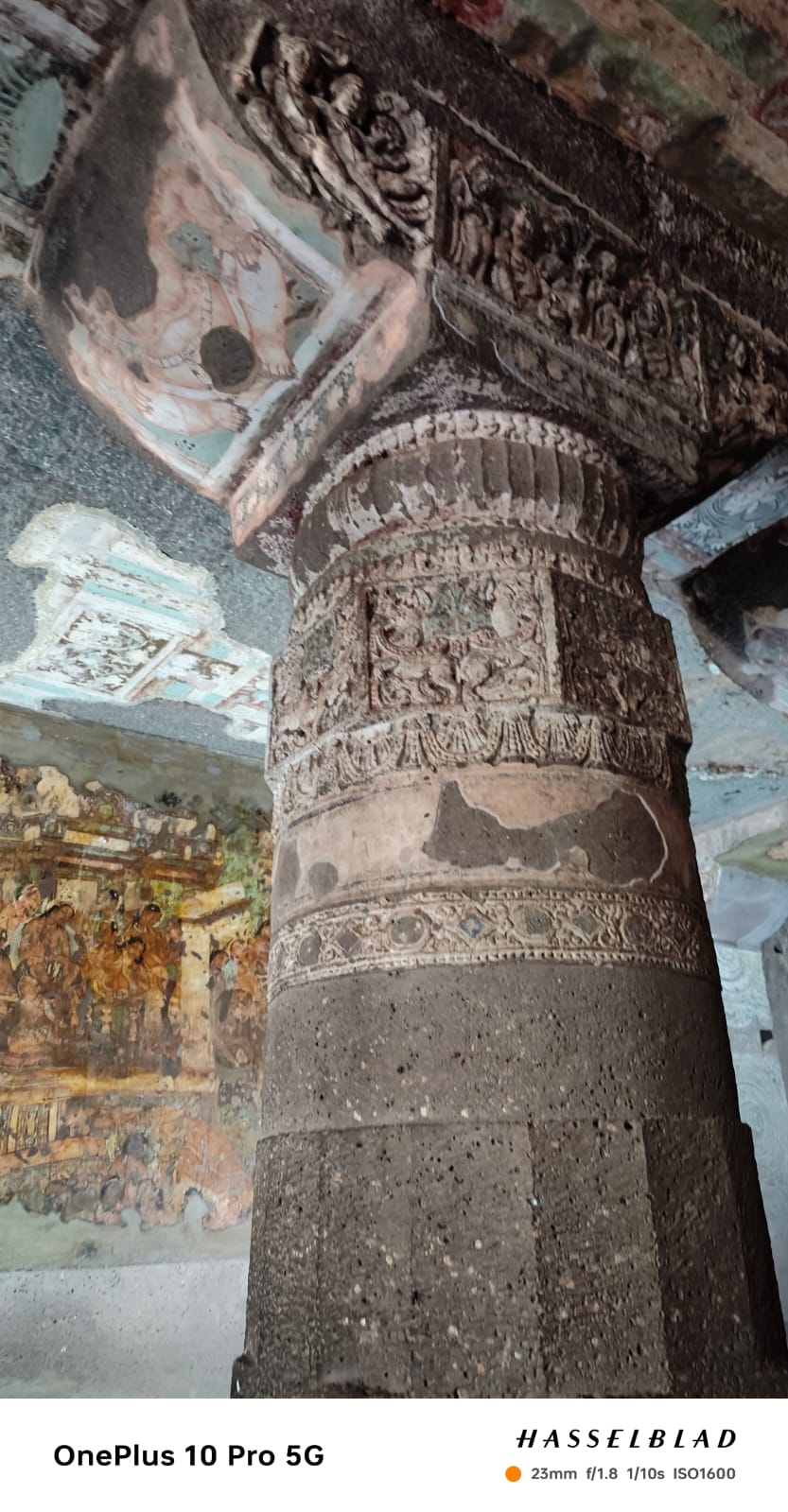


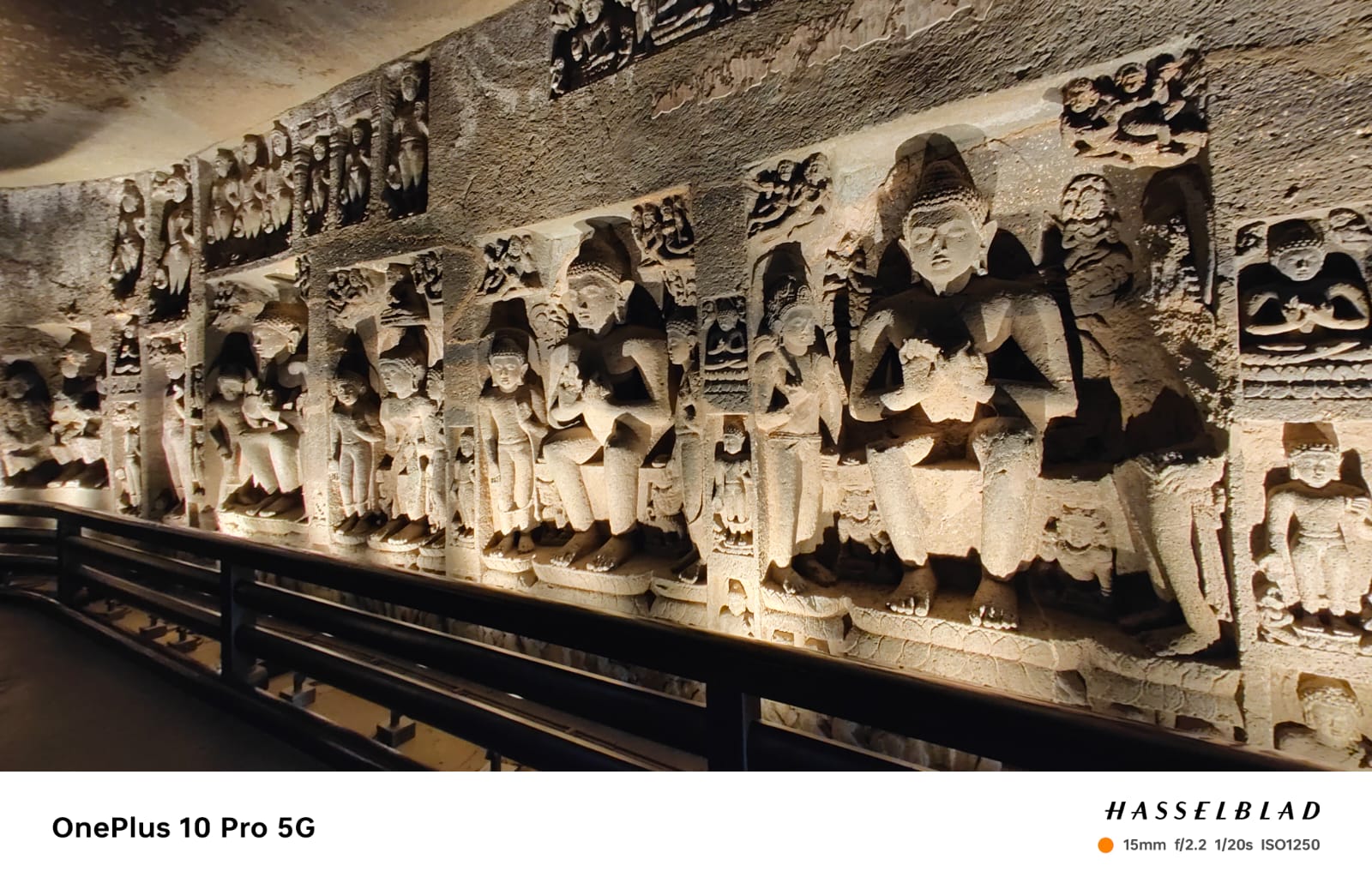
The Ajanta Caves dates back to 2nd century BCE through 6th century CE and had been a sanctuary for the Buddhist Monks and their disciples. The caves are adorned with sculptures as well as paintings that still reflect vibrant colours. There are 30 caves but some of them remains unfinished…the important ones to explore are 1, 2, 16, 17 & 19 for mural paintings and 1, 4, 17, 24 & 26 for sculptures. The cave number 9, 10, 19, 26 & 29 are Chaitya Halls while the others are Viharas. Out of these, Chaitya caves 9, 10 and Viharas 8, 12, 13 & 30 belongs to Hinayan system where instead of the Buddha Idol, the symbols associated with Gautam Buddha such as Dharma Chakra in the shape of Lotus, Stupa and the Bodhi Tree were worshipped through 2nd century BCE to 2nd century CE. The other caves excavated after long break belongs to the 5th & 6th century CE and belongs to the Mahayana sect. These caves have the image and idol of Gautam Buddha in various postures.
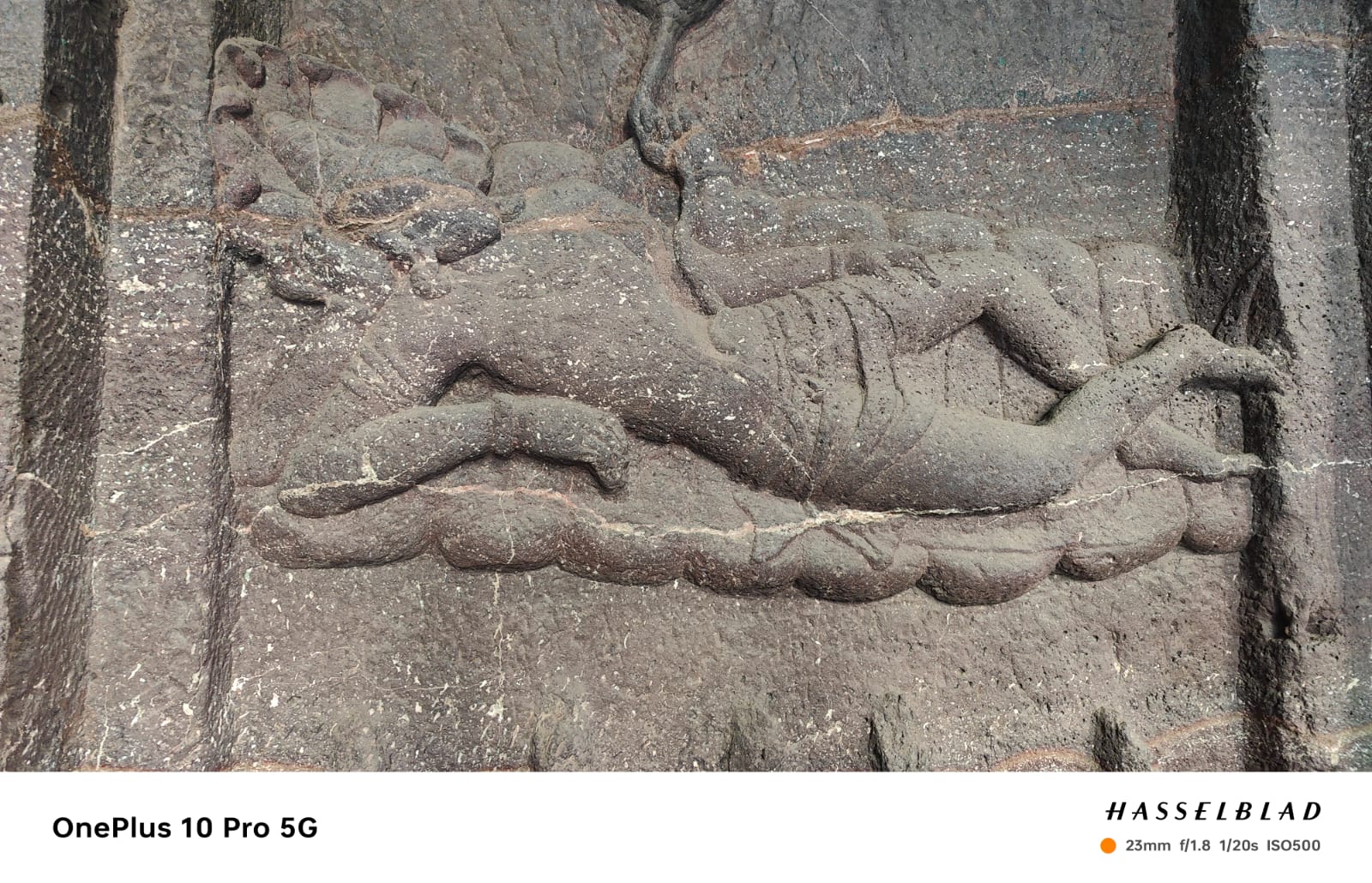

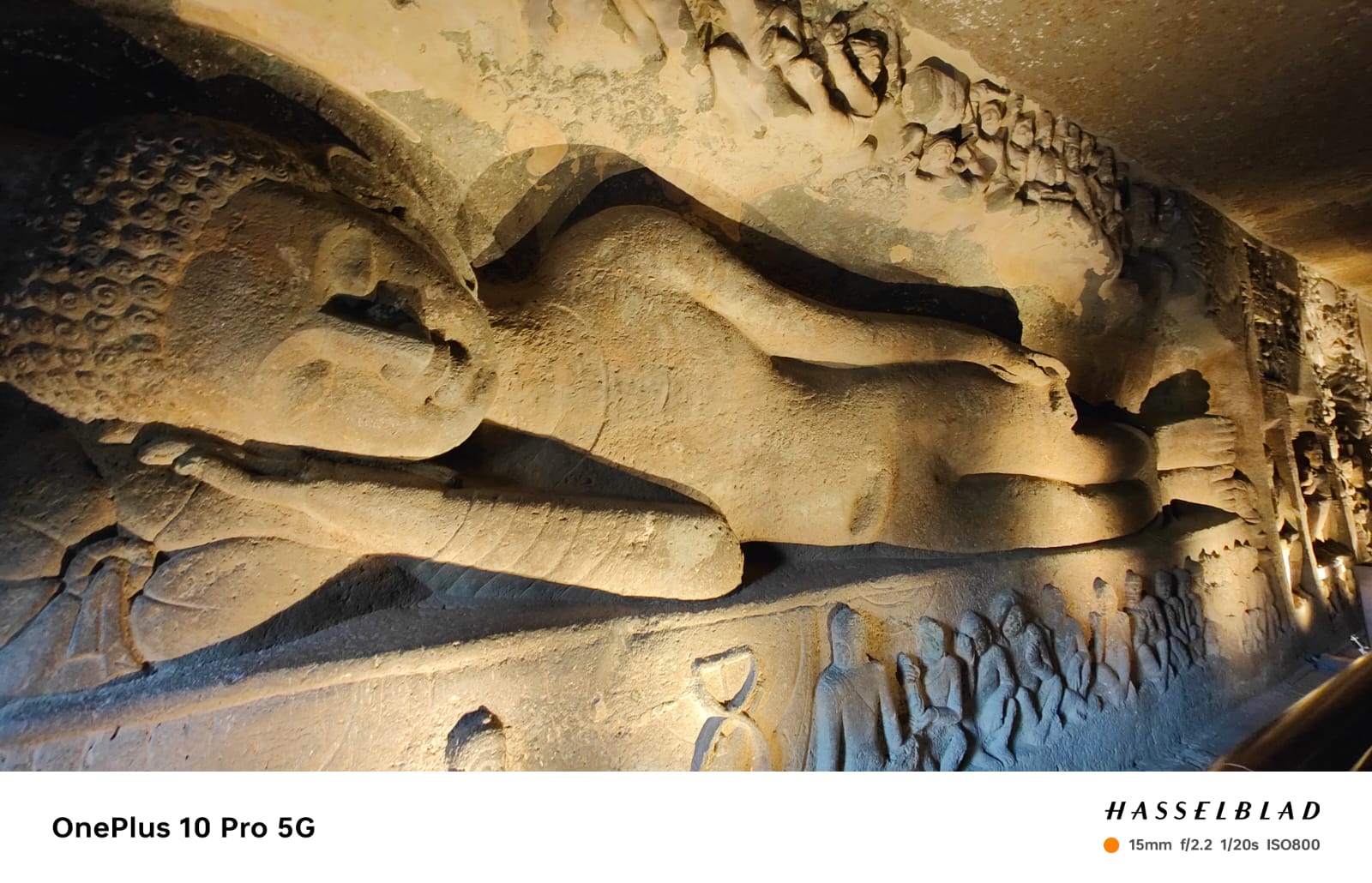
The theme of the paintings is Jataka Tales right from the birth of Buddha to his attaining Moksha. Similar themes can be found in the sculptures as well. The fascinating details in the sculptures and the use of vivid colours in the paintings made us wonder at the creativity and workmanship of our ancestors. They not only hand carved those caves cutting up the mountains, large enough for habitation but created chambers for different activities without any modern tools and machines. We were told that the caves were carved out at different periods over many centuries. After the decline of Buddhism some time in the 6th century CE, the caves were abandoned and remain hidden behind thick foliage and jungle for many centuries. It was accidentally discovered by a British Cavalry Officer named Captain John Smith in 1819 while hunting a tiger, he stumbled upon the horseshoe shaped rock with many caves having Buddhist artifacts inside…couldn’t resist to leave a graffiti message on a painting in the cave number 10, “John Smith, 28th Cavalry, 28th April 1819”.
We spent more than 3.5 hours exploring the caves and each one fascinated us with its creativity and workmanship…told us stories of the bygone era. Even the unfinished caves have their own stories to tell if only someone has the patience to sit back and meditate.
On the way back to the parking, we stopped at a shop to buy few rough-cut stones like amethyst and crystal. I bought two idols of Ganesha and Radha-Krishna as an act of charity from a roadside vendor.
While driving back, Samadhan, our driver received a call from his uncle that his father had a paralytic stroke and taken to the hospital. On returning to the city, he still took us to the shop specializing in Paithani Silk sarees and dress material as he had promised to Deepika and Sumita. I pray to Madhav for his father’s quick and complete recovery.
We rested for about half hour in our rooms while our phones were charging then went to another famous restaurant of Aurangabad called The Great Sagar specialising in Mughal cuisine. We were told their specialty dish is Naan Khaliya, a non-veg preparation of either chicken or mutton and served with thick naan or Khamiri Roti. It sounded to be a good dish and Sumita decided to try it out the chicken version, I wasn’t so sure, so opted for the tried n tested mutton biriyani while poor vegetarian Deepika was stuck with dal-tadka, paneer and roti. As it turned out, the Naan Khaliya is a overhyped dish…it is basically a spicy soupy curry of chicken or mutton with naan, a damp squib. Deepika found the vegetarian dishes below par, but the biriyani was decent flavourful with well cooked mutton pieces. Overall, it was not a pleasant dining experience especially after our visit to the Bhoj Restaurant.
Back in the hotel, we played Rummy till midnight… needless to say I did not win a single hand.
Ellora Caves
We started a bit late for the Ellora caves as the cab designated to us had a flat tyre and came late to pick us. We had earmarked few other places to see besides Ellora. Our first destination was Ghrishneshwar Temple, close to the Ellora caves. Ghrishneshwar means “lord of compassion”.
Ghrishneshwar Jyotirlinga is a Hindu temple of Shiva in Verul village of Aurangabad district and considered as the 12th Jyotirlinga mandir. The mandir is a national protected site, 1.5 Km away from the Ellora Caves and approx. 30 kilometres north-west of the city Aurangabad. Ghrishneshwar finds mention in various scriptures such as Shiva Purana, Skanda Purana, Ramayana and the Mahabharata.
The temple structure, just like the Somnath Temple in Gujarat, was relentlessly attacked and destroyed by the Delhi Sultanate in 13th and 14th centuries. It was re-built by Maloji Bhosale, grandfather of Shivaji Maharaj in the 16th century only to see another destruction by the barbaric Mughal empire. The current form of the temple was re-built in the 18th century under the sponsorship of Queen Ahilyabai Holkar of Indore. Today, it is an important and active pilgrimage site of the Hindus and attracts devotees from across the country. There is no bar in entering the temple premises and its inner chambers, but to enter the sanctum sanctorum or garbha-gruha of the temple, the local Hindu tradition demands that men must go bare-chested just like in Guruvayur Temple in Kerala.
Deepika and Sumita went inside the temple while I remained outside guarding their belongings. Mobile phones and cameras are not allowed inside, like in many other Hindu pilgrimage sites, a practice, I neither understand nor support. It took them more than half hour to perform the rituals and we started off for the Ellora Caves.


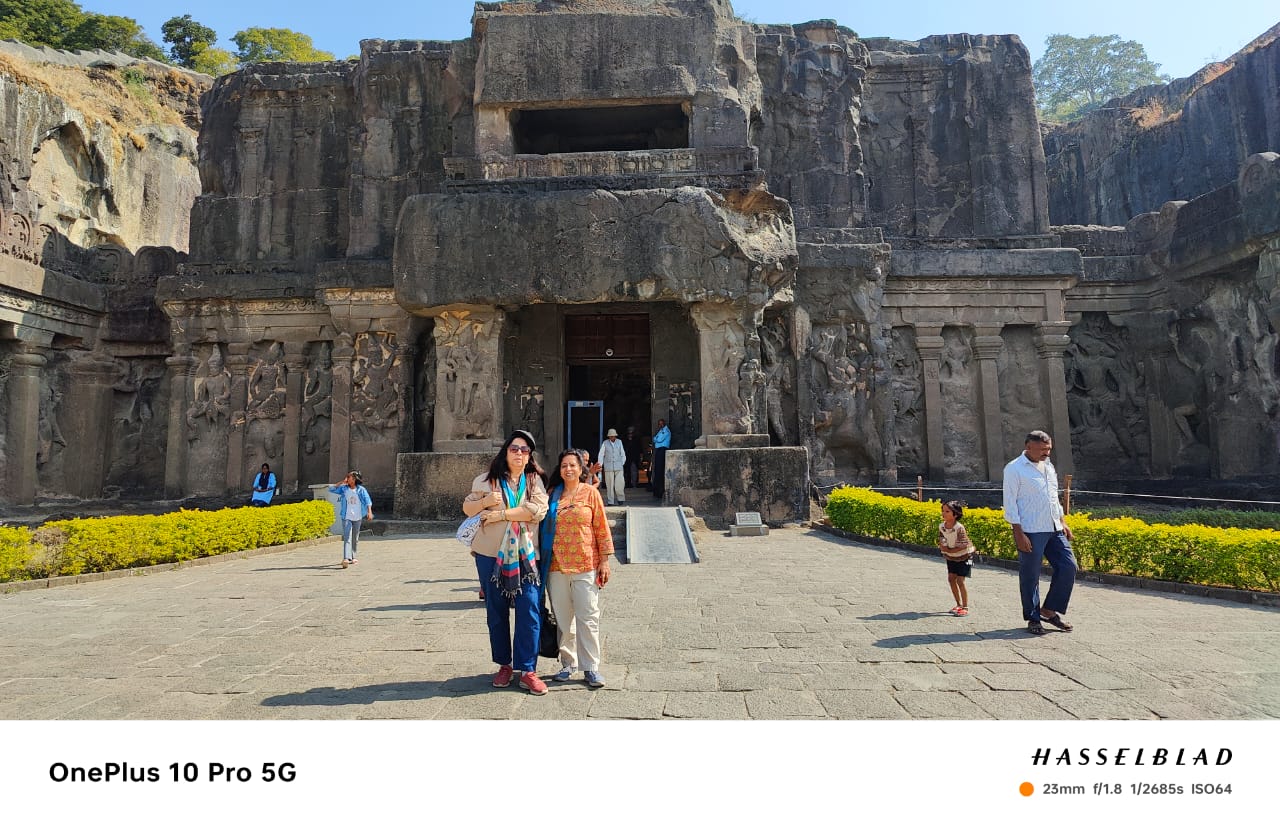
As you enter the Ellora Cave complex, the majestic Kailasha Temple (cave no.16) welcomes you. The Kailasha temple is the largest of the rock-cut temples at the Ellora Caves. A megalith carved from a cliff face, it is considered one of the most remarkable cave temples in the world because of its size, architecture, and sculptural treatment. It has been called “the climax of the rock-cut phase of Indian architecture“. The top of the structure over the sanctuary is 107 ft above the level of the court below. Although the rock face slopes downwards from the rear of the temple to the front, archaeologists believe it was sculpted from a single rock. The complete temple complex gives an impression of a Chariot on the move.
The Kailasa Temple (Cave 16) is the largest of the 34 Brahminical, Buddhist, and Jain cave temples and monasteries known collectively as the Ellora Caves, ranging for over two kilometers along the sloping basalt cliff at the site. Most of the excavation of the temple is generally attributed to the eighth century Rashtrakuta King Krishna-I (756 – 773), with some elements completed later. The temple architecture shows traces of Pallava and Chalukya styles. The temple contains a number of relief and free-standing sculptures on a grand scale equal to the architecture, though only traces remain of the paintings which originally decorated it.
The Kailasa Temple is notable for its vertical excavation—carvers started at the top of the original rock and excavated downward. The traditional methods were rigidly followed by the master architect which could not have been achieved by excavating from the front.


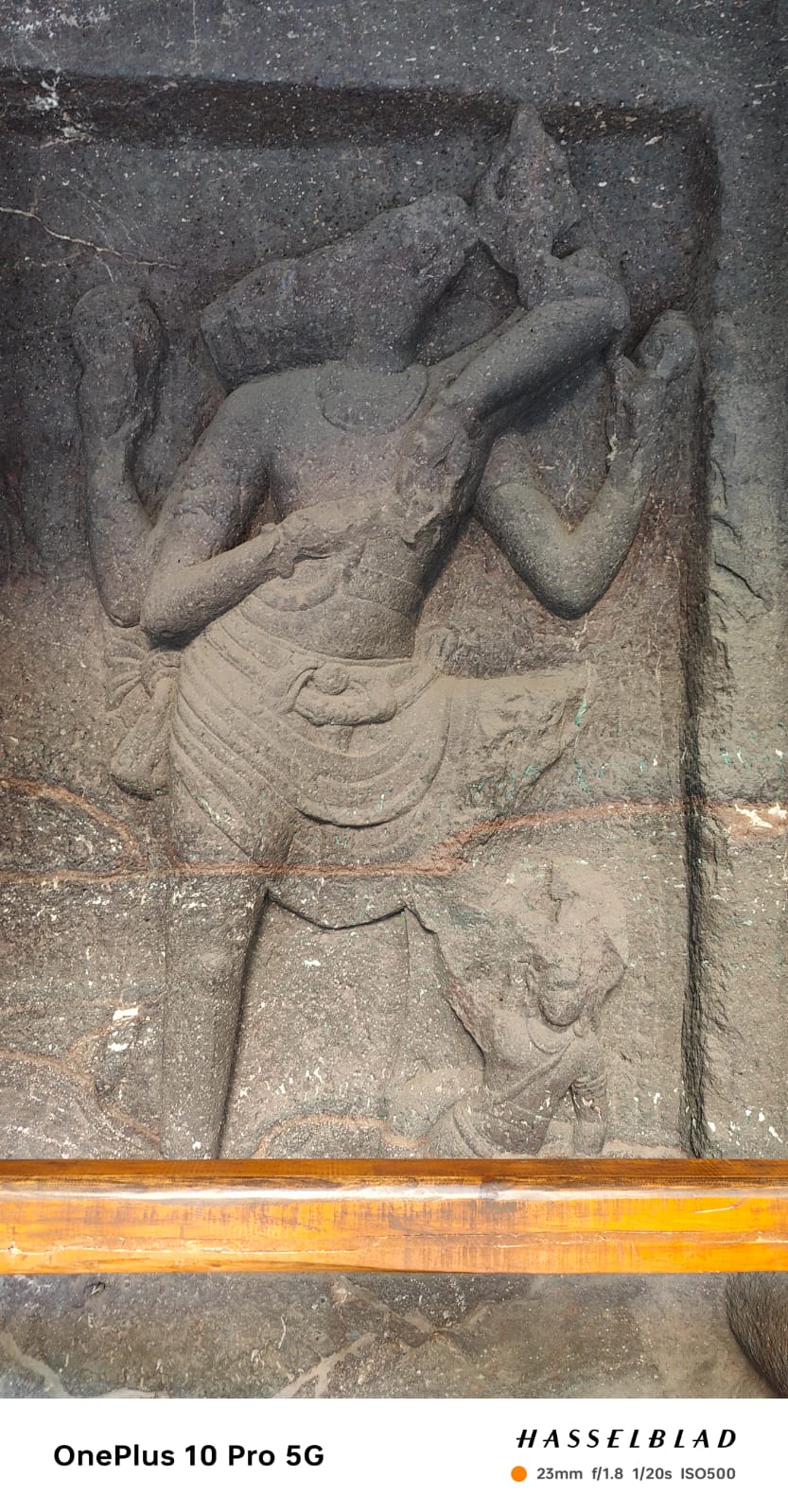

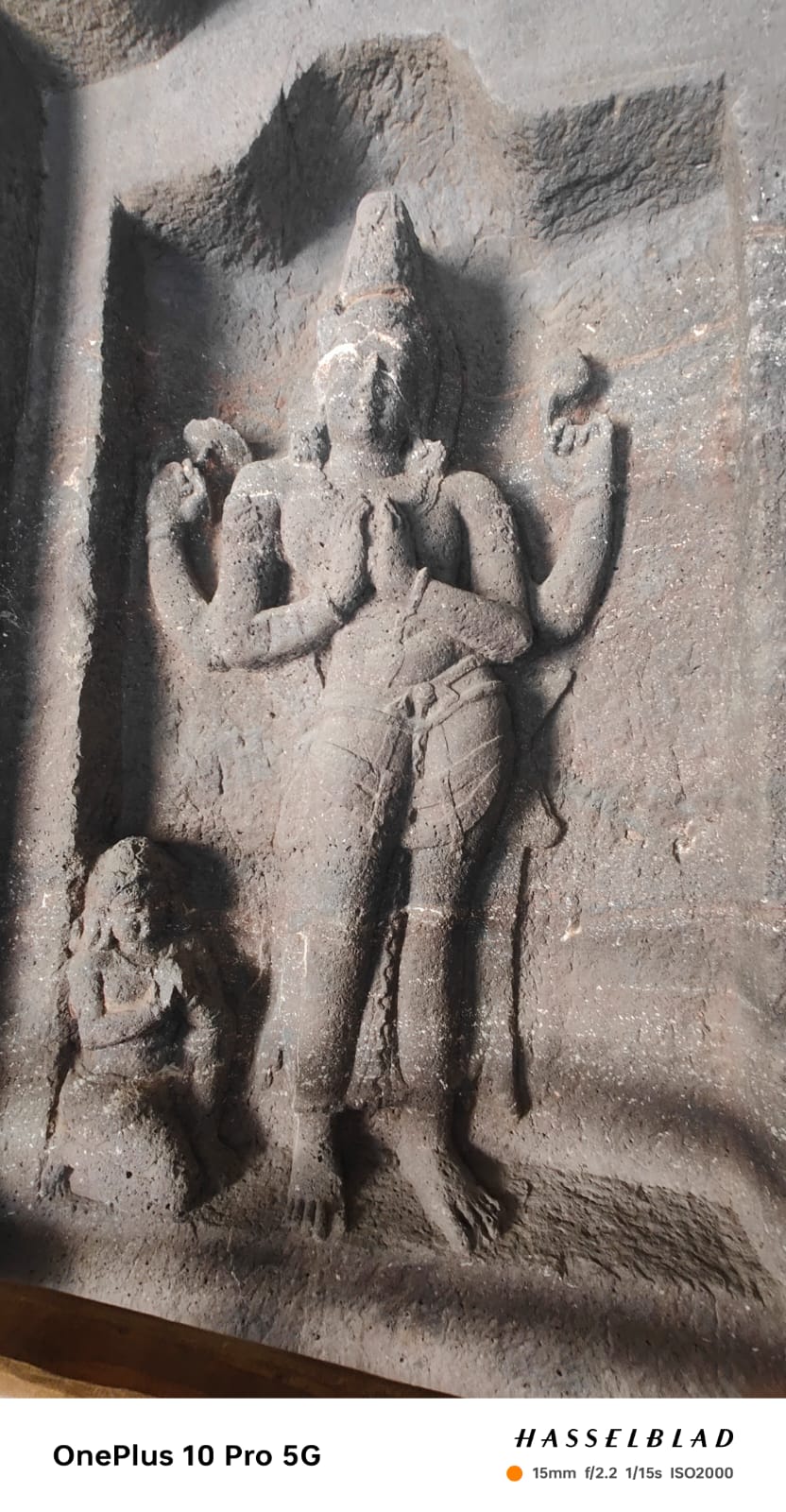


“The local Marathi legend, Katha-Kalpataru by Krishna Yajnavalki (c. 1470-1535 CE) mentions that the local king suffered from a severe disease. His queen prayed to the god Ghrishneshwar (Shiva) at Elapura (Ellora) to cure her husband. She vowed to construct a temple if her wish was granted, and promised to observe a fast until she could see the shikhara (top) of this temple. After the king was cured, she requested him to build a temple immediately, but multiple architects declared that it would take months to build a temple complete with a shikhara. One architect named Kokasa assured the king that the queen would be able to see the shikhara of a temple within a week’s time. He started building the temple from the top, by carving a rock. He was able to finish the shikhara within a week’s time, enabling the queen to give up her fast. The temple was named Manikeshwar after the queen.”
The entrance to the temple courtyard features a low Gopuram. Most of the deities at the left of the entrance are Shaivite (followers of Shiva) while on the right-hand side the deities are Vaishnavites (followers of Vishnu). A two-storeyed gateway opens to reveal a U-shaped courtyard, edged by a columned arcade three storeys high. The arcades are punctuated by huge sculpted panels, and alcoves containing enormous sculptures of a variety of deities. Some of the most famous sculptures are Shiva the ascetic, Shiva the dancer, Shiva being warned by Parvati about the demon Ravana and river goddess Ganges coming out of Shiva’s knotted hair.
Within the courtyard, there is a central shrine dedicated to Shiva, and an image of his mount Nandi (the sacred bull). The central shrine housing the lingam features a flat-roofed mandapa supported by 16 pillars, and a Dravidian shikhara. The shrine – complete with pillars, windows, inner and outer rooms, gathering halls, and an enormous stone lingam at its heart – is carved with niches, plasters, windows as well as images of deities, maithuna (erotic male and female figures) and other figures. As is traditional in Shiva temples, Nandi sits on a porch in front of the central temple. The Nandi mandapa and main Shiva temple are each about 7 metres high, and built on two storeys. The lower storeys of the Nandi mandapa are both solid structures, decorated with elaborate illustrative carvings. The base of the temple has been carved to suggest that elephants are holding the structure aloft. A rock bridge connects the Nandi mandapa to the porch of the temple. The base of the temple hall features scenes from Mahabharata and Ramayana. There are five detached shrines in the temple premises; three of these are dedicated to the river goddesses: Ganga, Yamuna and Saraswati. There are two Dwajasthambs (pillars with flagstaff) in the courtyard. A notable sculpture is that of the Ravana attempting to lift Mount Kailasa.
After being awestruck by the magnitude of the marvelous Kailasha Temple, we proceeded to see the cave nos. 30 to 34, the Jain excavations. We were taken there by an electric van… the distance almost 2 km from the entrance gate. The cave number 32 is the biggest of the caves having a large hall with antechambers and the sculpture of Lord Mahavira. Its 2-storey cave with steep unequal stairs going up to reveal a serene room fit for meditation. There is a connecting narrow corridor to the cave no.34. We were sceptical of the unequal stairs and decided to climb down carefully, no point in injuring oneself at this ripe age.
The EV took us to the cave number 29, another massive cave structure, 46 metre wide and almost 6 metre high. It has a group of halls in the form of a cross with wide columns and a pair stone lion guarding the entrance. Everything in this cave is huge… Lord Siva with eight arms depicting the fearsome destroyer. Another colossal Shiva in Nataraj dance posture in the portico.

We were dropped back to the main entrance gate from where we walked towards the cave nos. 10 to 1 but midway, Sumita decided to stay back because of exhaustion. These are primarily Buddhist excavation quite similar to the ones at Ajanta. We quickly reviewed these and left for the Bhadra Maruti Temple dedicated to Lord Hanuman.
At the Bhadra Maruti Temple, located in Khuldabad, the idol of Lord Hanuman is portrayed in a reclining or sleeping posture. It is one of only three places where Lord Hanuman is represented in a sleeping posture. The other two places are on the banks of Ganges at Triveni Sangam in Prayagraj, Uttar Pradesh and at Jam Sawali, Madhya Pradesh.
“According to a folklore, in ancient times the Khuldabad was known as Bhadravati and the ruler was a noble king named Bhadrasena, who was an ardent devotee of Lord Rama and used to sing songs in His praise. One day Lord Hanuman descended in the place, listening to the devotional songs sung in praise of his master, Lord Rama. He was mesmerized and without his knowledge took a reclining posture – called ‘Bhava-samadhi’ (yogic posture). King Bhadrasena, when he had finished his song, was astonished to find Hanuman in Samadhi before him. He requested Hanuman to reside there forever and bless his as well as Lord Rama’s devotees.”
Normally, I don’t go inside any religious places unless it has some architectural, historical significance but it had very little crowd and on Deepika’s insistence went inside. It’s a comparatively small temple, quite clean. Inside the temple it was clearly mentioned that photography is not allowed but there were people, not devotees…(they can’t be called devotees if they do not have the basic sense of discipline) rampantly ignoring/ disobeying the order and taking pictures as well as selfies. I felt disgusted at their callousness. Within the complex, there exists another small open temple dedicated to Shani Dev. Just outside the temple perimeter, some vendors were selling Puja Samagri including mustard oil in a small bottle, Deepika was about to buy when I noticed that only male members are allowed to do the puja. I do not know the reason behind it and will ask my learned friend Acharya Indrajit Ji but found it very patriarchal, especially in these modern times. Another interesting thing I learned recently that the Shani Dev idol is never covered from the top, it stands under the open sky irrespective of weather.
Sumita wanted to buy Paithani Saree and Himroo Shawl right from the time we decided to come to Aurangabad. These are speciality items of the region and well known even beyond the borders. While coming from the city, we had seen few shops selling such items. I went with them in the first shop but realised that it was not for me, I decided to sit in the car while my phone got charged, allowing me to take a quick power nap that got me recharged for the evening.
We visited the Bibi ka Maqbara in the evening after sunset, it was all lighted up making it look surreal and beautiful. I haven’t seen Taj Mahal at night… I thought if this looks so beautiful, then Taj would be magnificent majestic with its overpowering presence under skilful lighting arrangements.
“The Bibi Ka Maqbara is a tomb located in the city of Aurangabad, Maharashtra. It was commissioned in 1660 by the Mughal emperor Aurangzeb’s son, Prince Azam Shah in the memory of his loving mother Dilras Banu Begum also known as Rabia-ul-Durrani. It bears a striking resemblance to the Taj Mahal, the mausoleum of Aurangzeb’s mother, Mumtaz Mahal and that is why it is also called the Taj of the Deccan. The mausoleum was intended to rival the Taj Mahal, but the decline in architecture and proportions of the structure (both due to the severe budgetary constraints imposed by Aurangzeb) had resulted in a different and particular monument with its own significant beauty.”

It was time for dinner by the time we finished exploring the monument… we were hungry too as the last meal we had was our breakfast. Initially, we thought of visiting Lok Seva Restaurant, a multi-cuisine restaurant serving both veg and non-veg dishes but Deepika and Sumita wanted to revisit Bhoj Thali Restaurant. We are living in democracy!!
This time we went to their second outlet, newer and well-appointed décor’ at Pushpa Nagari, Samarth Nagar. We knew what to expect and were ready to rejoice the dishes. I can’t say about my companions but I had a hearty dinner to my complete satisfaction even though it was vegetarian.
Later, coming back to our room, we played Rummy again and this time I won few hands. We slept late after a video chat with Ayush-Rajashree calling from Rome.
Freestyle Roaming
After breakfast, we checked out from the hotel but kept our luggage in the cloakroom of the hotel. We have kept the day for local sightseeing and shopping, though I doubted if we would get anything worthwhile to carry back to Delhi.

Our first destination was Soneri Mahal, located inside the campus of Dr. Bhim Rao Ambedkar University. The main building is constructed across the ridge of a hill and is surrounded by lush green trees, gardens, and fields. The palace was said to feature paintings made of real gold, thus giving it its name. The entrance is a solidly built structure with fortifications. The Hathikhana gate has ornate arches and is adorned with intricate carvings. From this gate, a central pathway leads to the main palace. On either side of the pathway are gardens and in the middle of this pathway is a large rectangular water reservoir.
Unfortunately, the palace was closed for renovation and I hope they will do justice to the gardens which were full of weeds and other unwanted foliage.
The next destination was Aurangabad Caves, quite similar to the Ajanta and Ellora caves but much more recent excavation. We had to climb more than 82 stairs to reach the caves and it killed me, I was panting like never before. When I looked at Deepika and Sumita, realized they were in no better condition. The caves are divided in three separate sections, we managed to see only one section and had no energy to climb again, moreover, the architecture and ornamentation of the caves are quite similar to Ajanta and Ellora and we had seen them all.
The Aurangabad Caves, are twelve rock-cut Buddhist shrines located on a hill running roughly east to west, close to the city. The Aurangabad Caves were dug out of comparatively soft basalt rock during the 6th and 7th century. The caves are divided into three separate groups, the “Western Group”, with Caves 1 to 5, the “Eastern Group”, with Caves 6 to 9, and a “Northern Cluster”, with the unfinished Caves 9 to 12. The carvings at the Aurangabad Caves are notable for including Hinayana style stupa, Mahayana art work and Vajrayana goddess. These caves are among those in India that show 1st millennium CE Buddhist artwork with goddesses such as Durga, and gods such as Ganesha besides numerous Buddhist deities of the Tantra tradition are also carved in these caves.
With that we completed our touristy exploration, Sumita now wanted to see the local markets, so we proceeded to Gul Mandi Market/ Nirala Bazaar. They are very similar to the markets of Lajpat Nagar, Ajmal Khan markets of Delhi, only scaled down substantially. Deepika bought a suit piece for gifting. Sumita couldn’t find anything interesting and after searching the net, decided to check Paithani Silk Store situated at the Connaught Shopping Market. While they went in, I stayed back in the car, my phone battery had drained out to only 30% and needed immediate recharging… the car charger was old and wasn’t charging the phone, so I went to a nearby shop and bought one. By the time the girls came, my phone showed 82% charged, so one can imagine how quickly they did their shopping!!
As per our tradition, we have one meal in a star rated hotel to complete our travel, so we went to Taj Vivanta for lunch and relaxed there till evening. Later, the cab dropped us to the hotel as the driver had other assignments promising that another cab would come to drop us at the airport. I knew that the owner, Suresh himself would be coming to collect the money and drop us at the airport. I found Suresh to be friendly and amiable person. On request from Deepika and Sumita took us to a shop specializing in Paithani Silk sarees from where Sumita bought a saree.
We reached the airport early and had a long waiting time, so took out the pack of cards and played Rummy till our boarding was announced. Sumita stayed overnight with us and went home in the morning. On a scale of 1 to 10, I would place this escapade at least 8.9 because of certain hiccups we faced which I avoided mentioning. We also skipped two historical places, Daulatabad Fort, because of steep climbing/ trekking of almost 4 km and Tomb of Aurangazeb, for obvious reasons.
 Aranyascope
Wonderful description of the trip with lots of information. Enjoyed reading it as much as you enjoyed the trip.
LikeLiked by 1 person
Thank you bro 🙏
LikeLiked by 1 person
Very informative blog! Thanks for sharing!!
LikeLike