
This year (2025) Independence Day (15 August) offered a long weekend of 3 days and if one could add 2 more days, it became a fabulous 5-day break. We couldn’t have missed this chance. Together with Topshe and Gora, a road trip was planned in the hills, Shangarh and Sissu, both in Himachal Pradesh, are quaint non-commercialized urban villages offering breathtaking view of the mountains besides doable treks. Everything was fine and going as per plan till the nature decided to open up the skies to wash and cleanse the mountains, every day, news of cloudburst and landslides blocking the roads floated in and we were forced to focus on Plan-B, Madhya Pradesh. The sites closer home viz Khajuraho was already covered by us separately, earlier. I have heard of Bhim Betka Rock Shelters and its rock paintings dating back to 30000 to 10000 years, beginning of human race, and proposed it to Topshe. He in turn made a grand plan of not just Bhim Betka but included Udaigiri Caves, Sanchi Stupa (3rd Century BCE) and Mandu (Jahaj Mahal) Fort in the itinerary. We also thought of visiting Mahakaleshwar Jyotir Linga Temple in Ujjain, if time permitted. The proposed tour spanning 5 days started on 13th and culminated on the late evening of 17th August 2025 and was planned in two days’ time.
The tour party comprised of Tapas & Sudipta, Manojit, Amalda, Mitali & Shraboni (sister-in-law of Amalda), Sumita (Deepika’s friend), Deepika & I. Traveling in Kia Carens and Jeep Compass.
With so much content, I decided to do it in two parts… the account of first part is here.
Day One: The Day of Travel
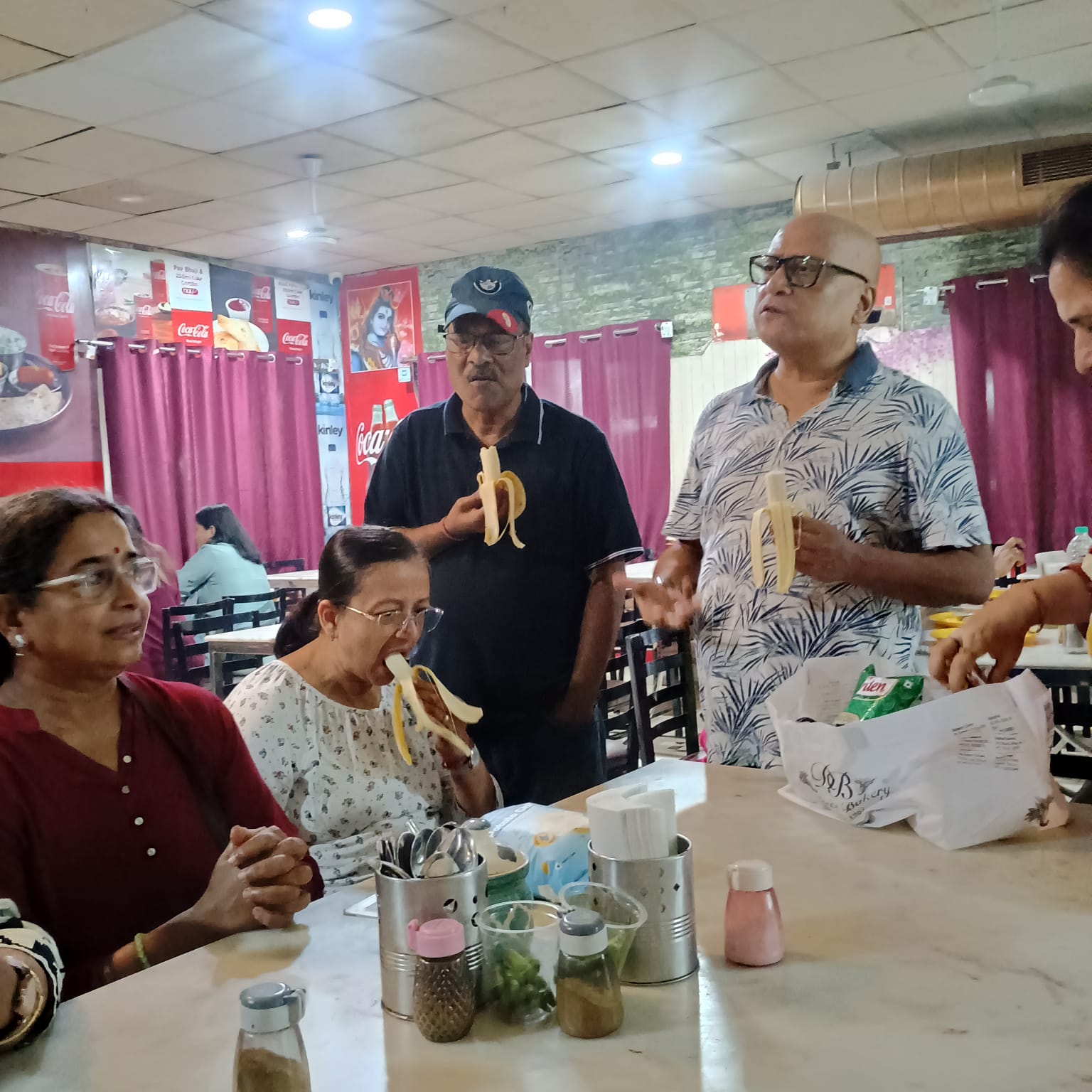
We started from my home around 5:45 am, a clear 30 minutes delay from the proposed time and caught up with Topshe & others at the Mahamaya Flyover at 6:05 am. After a brief chat we began our journey. The first break came at Jewar Toll Plaza where we stopped for tea and bathroom break. And I realized in the hurried departure from home, I had forgotten to carry my black coffee flask.


We had our proper breakfast at the Chambal Spice restodhaba, Dholpur, where I had visited 3 years ago while traveling to Bengaluru by road with my son Ayush. At that time, we were informed that the place had started operation only a week ago; in three years, it had lost its shine both in ambiance as well as the quality of food and service.
The journey from thereon was a long one through NH44 and we were greeted with light showers on and off. Right after Morena, we took the NH46 towards Gwalior-Shivpuri. Unlike the NH44, this National Highway, a 2-lane road took us inside the towns and villages with local traffic pouring on it, maneuvering through such condition affected our time and consumption of fuel. After crossing Guna, we found some reprieve with lesser local traffic but rain and narrow 2-lane road did not allow us to speed up beyond 60-70 kmph. Since we had a heavy breakfast, we did not stop for the lunch but halted at a BP fuel station to freshen up. Unfortunately, the toilet at this place was extremely dirty prompting us to abandon the idea till we found the IO fuel station 100 meters away with a clean one. I was carrying boiled egg while Mitali had some homemade delicious cake which were devoured in quick time standing under the open skies ready to open up and it did.
As soon as we started for the final leg of our journey, we were greeted with light to heavy rains most of way to Udaigiri but the advantage was practically empty road allowing us zip through whenever the visibility improved. We reached our destination, Village Deck Resort around 7 pm, a good 13 hours journey. The lowest point in our travel from Delhi to Udaigiri was the abandoned cattle on the road, any distraction or slight mistake could have been fatal.


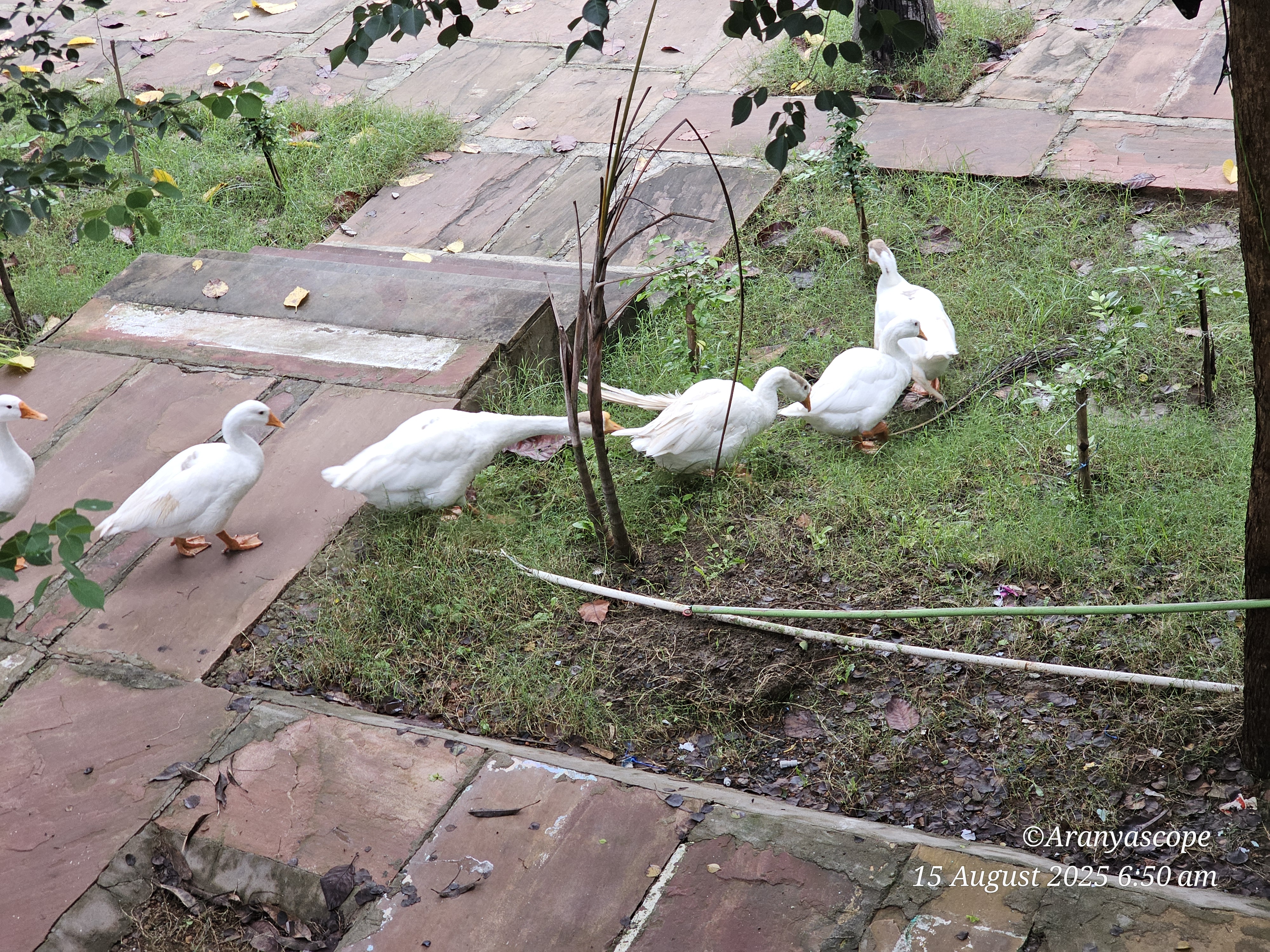
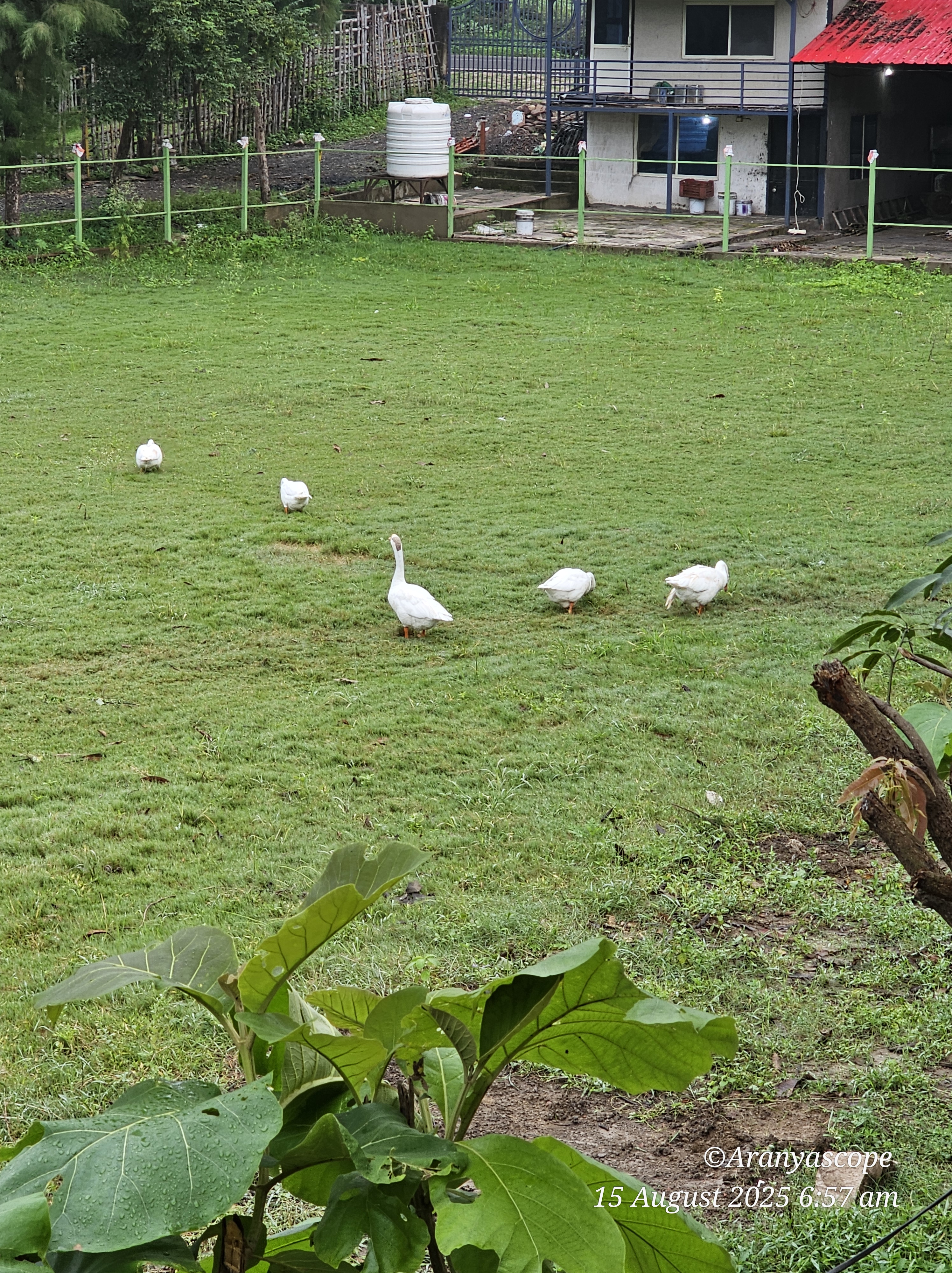
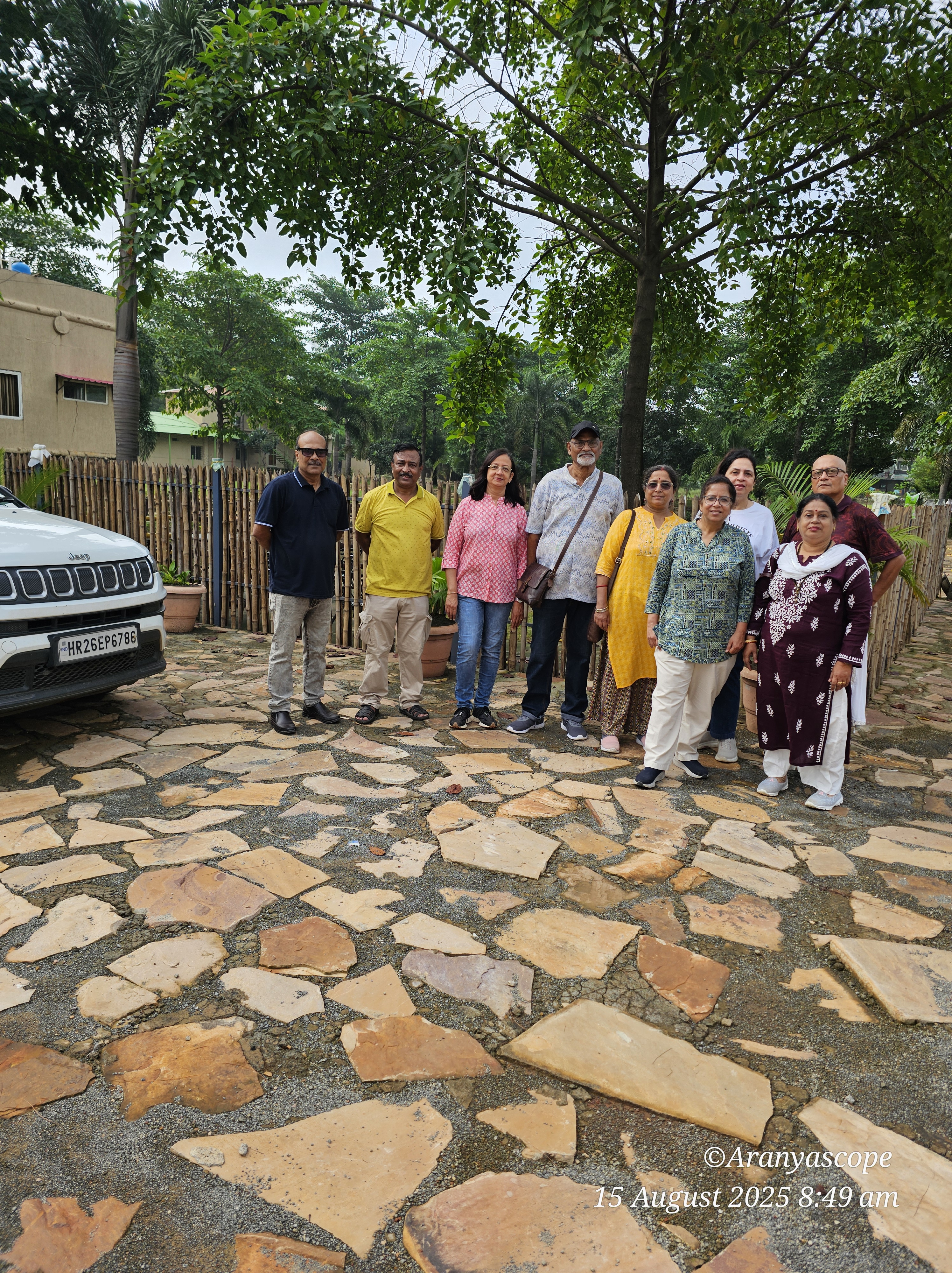


The Village Deck Resort can hardly be classified as a resort. It was spread over 3000 sq mtr with habitable rooms, a swimming pool, a water body with a flock of swans besides open grassland kept for future development. In their website the name was prefixed with “MPT” denoting “Madhya Pradesh Tourism”, a govt owned property but it was a misnomer…the place is privately owned and managed property. We were allotted 3 rooms in the main block and 2 rooms on the other side of the water body, supposed to be cottages. The wild smell around it suggested they were less frequently occupied. The rooms were of decent size with functional air conditions that quickly cooled down the temperature and evaporated the wild smell. We settled down and gathered at Sumita’s room to play a few rounds of Tambola that I had carried with us. Later, we had dinner at their dining hall, the food, we were told will be vegetarian throughout our stay as the property followed a strict vegetarian only principle.
Day Two: Exploring the Bygone Era
All of us were tired from the day-long road journey and therefore needed good sleep and rest for the day trip exploring the Sanchi Stupa and Udaigiri Caves, very close to our place of residence.
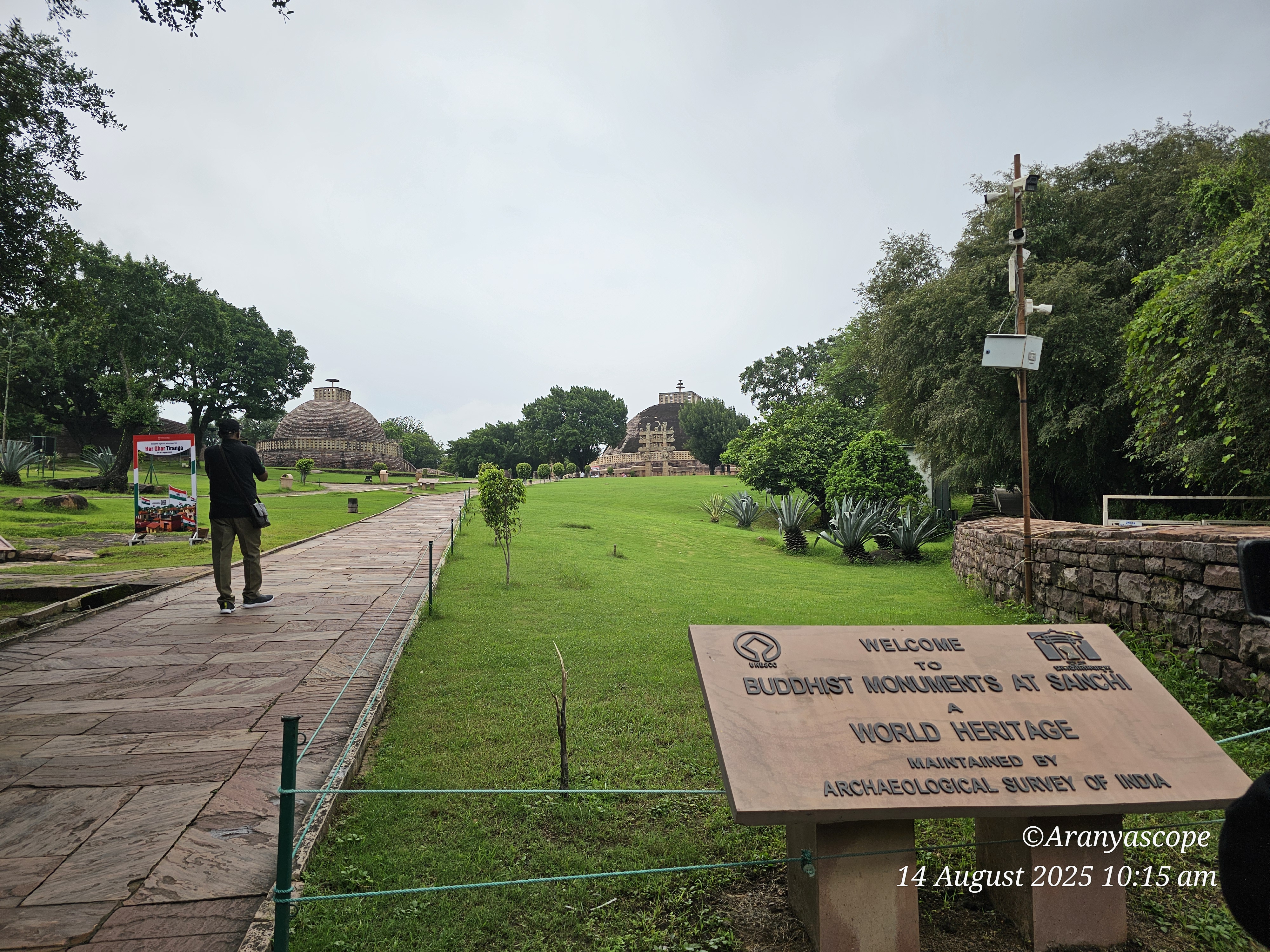
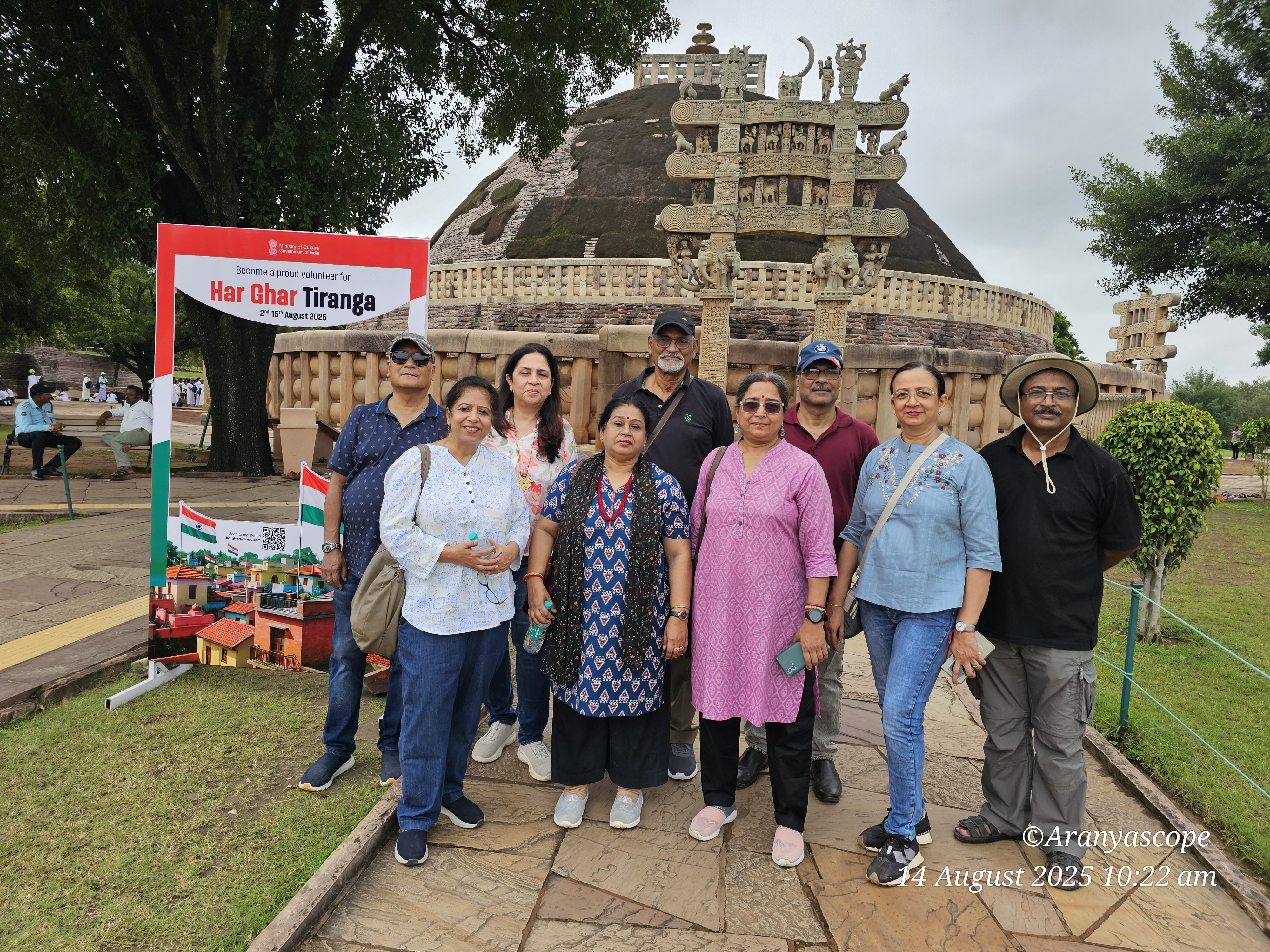
Sanchi Stupa is a Buddhist complex, famous for its Great Stupa, on a hilltop at Sanchi Town, district Raisen, Madhya Pradesh, India. It is located, about 23 kilometres from Raisen town and 46 kilometres north-east of Bhopal, capital of Madhya Pradesh.

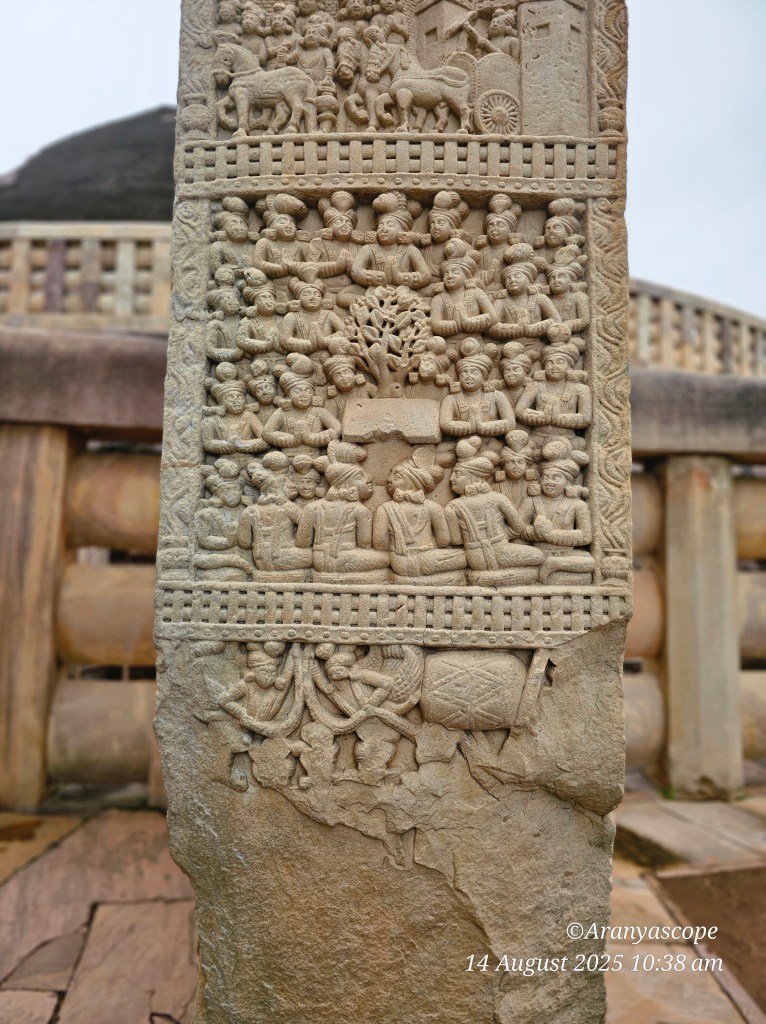
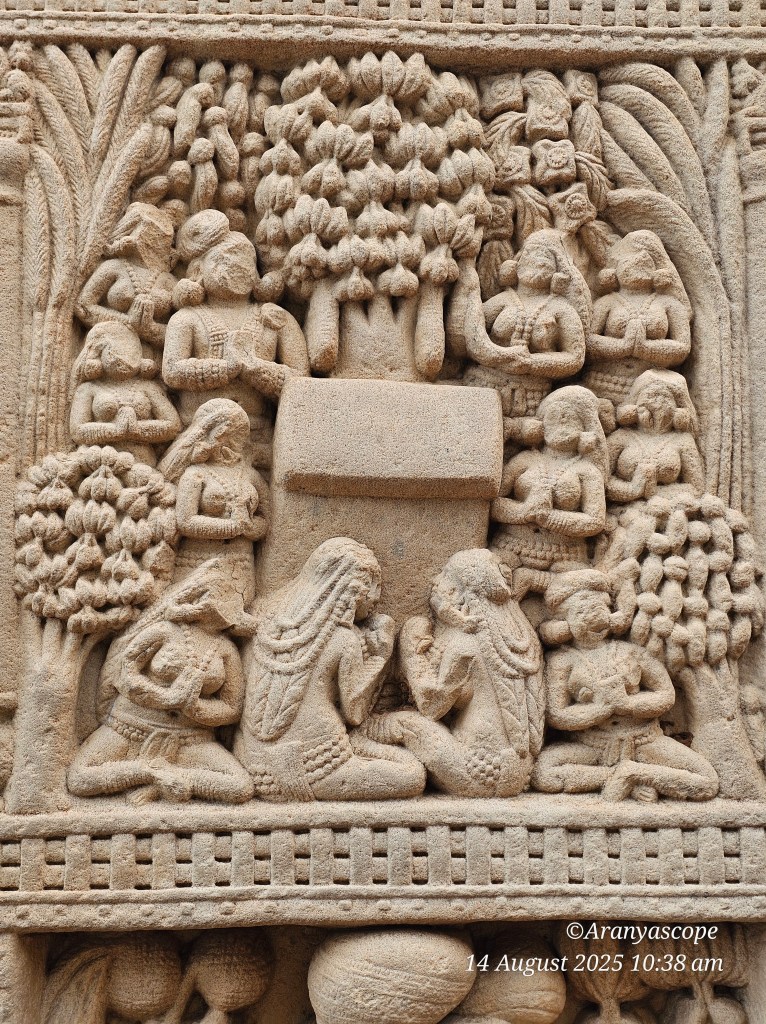
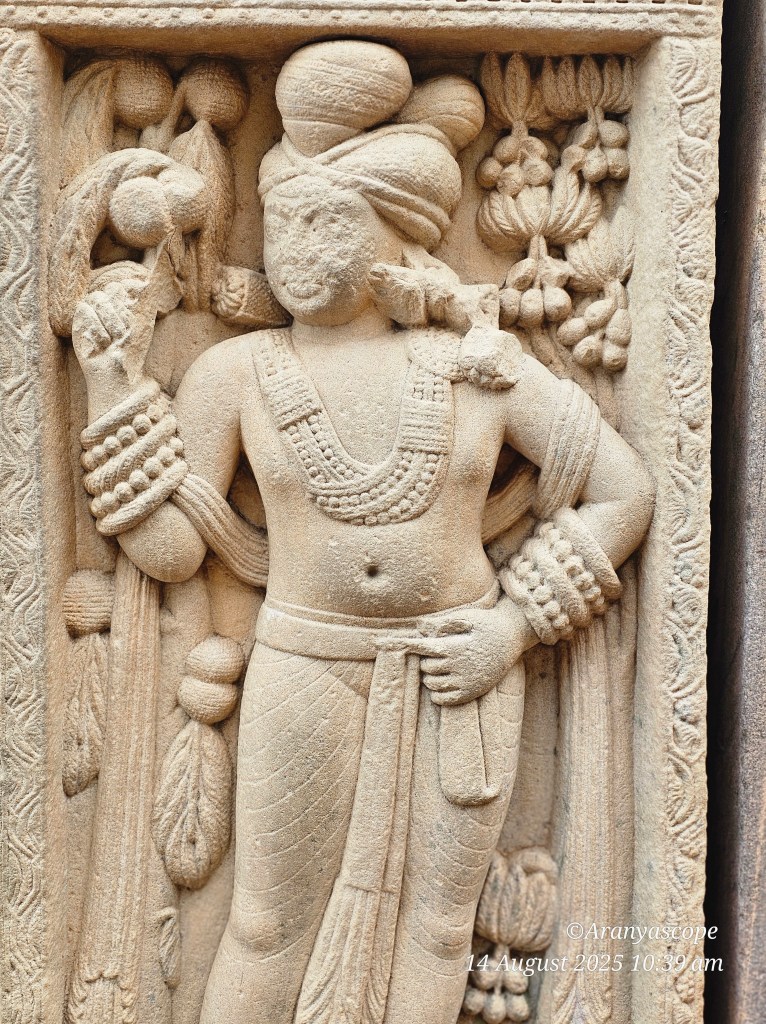

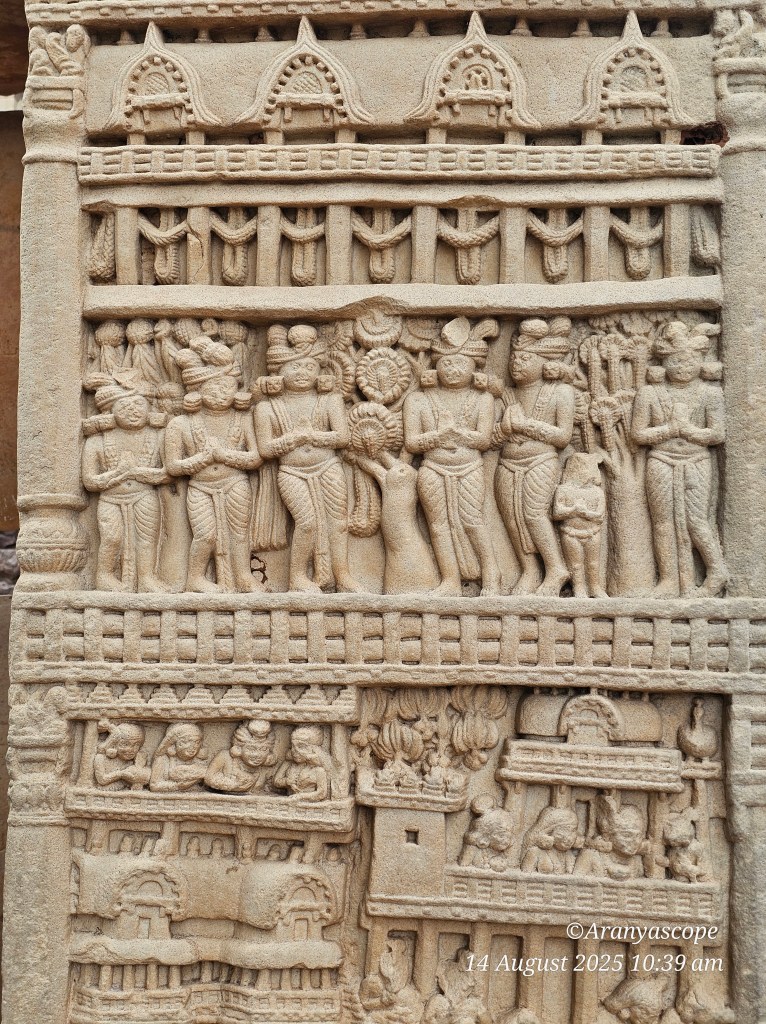
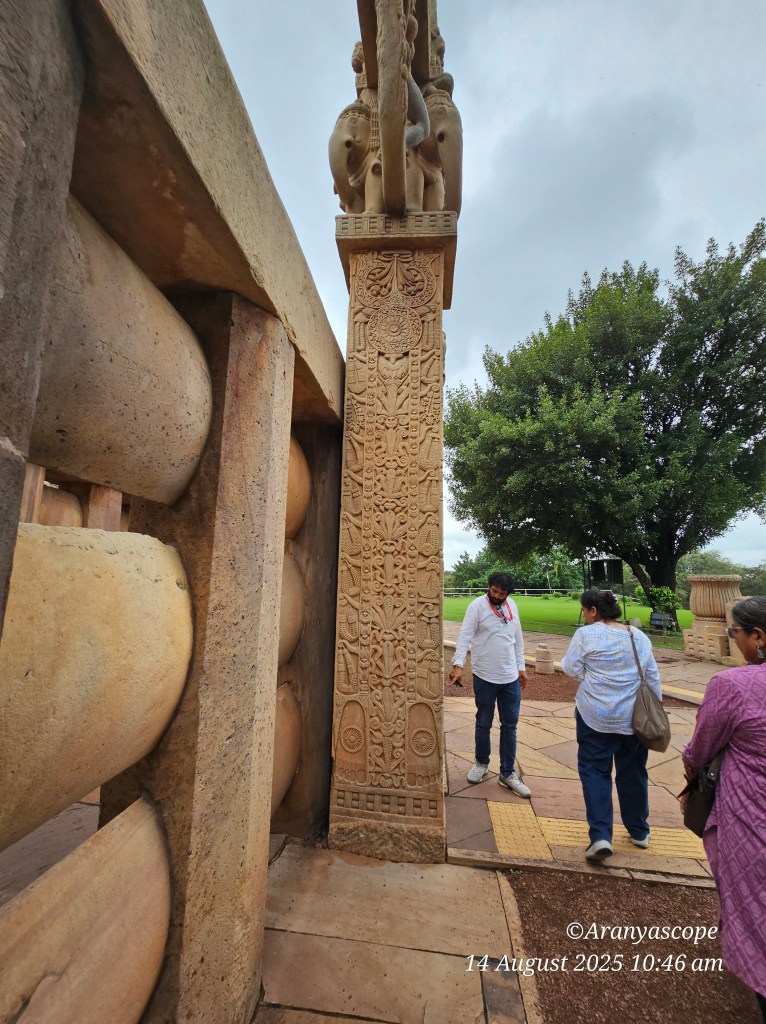

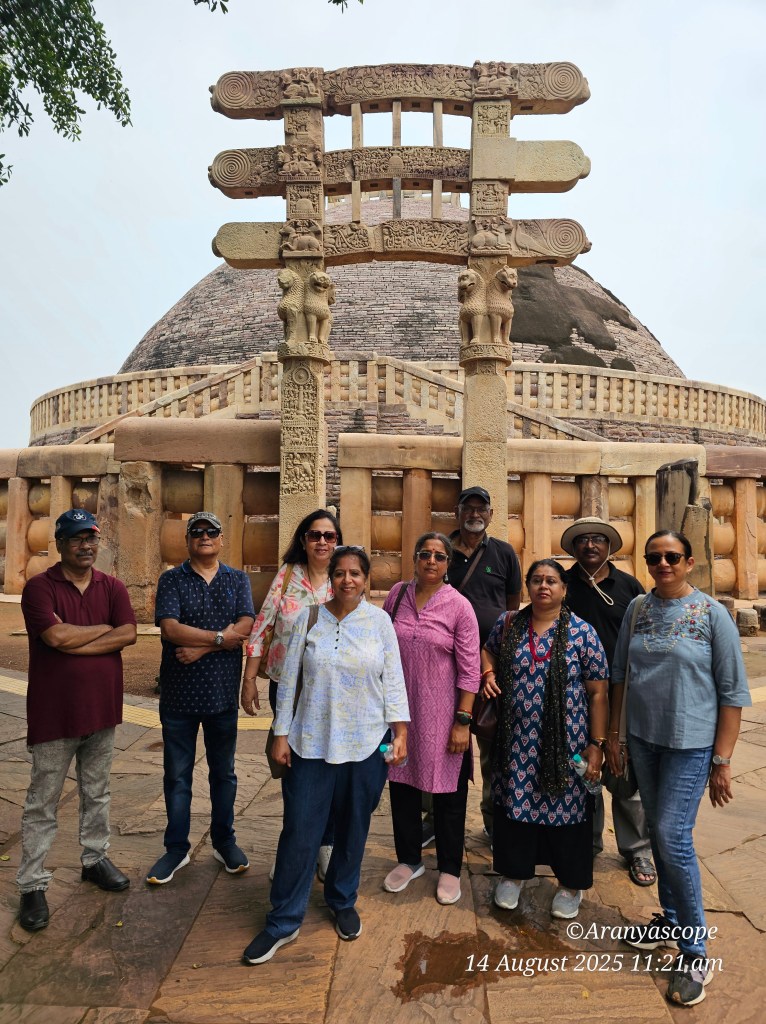


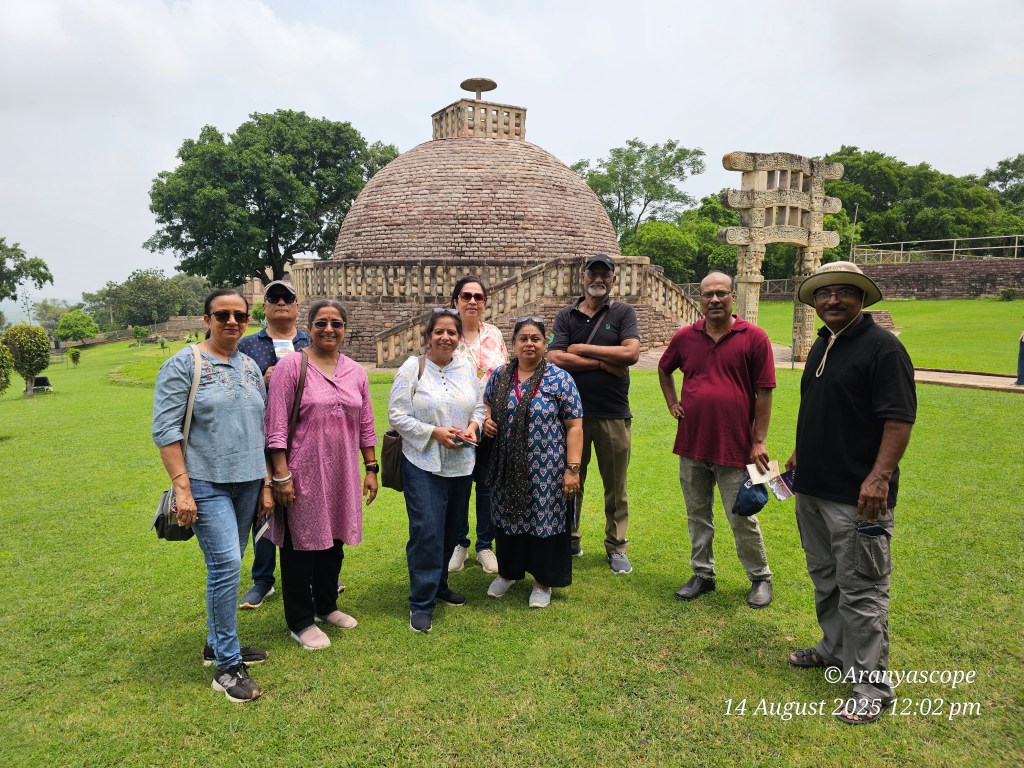
The Great Stupa at Sanchi is one of the oldest stone structures in India, and an important monument to the historical architecture of India. The Sanchi Stupa was originally commissioned by the Mauryan emperor Ashoka in the 3rd century BCE. Its nucleus was a simple hemispherical brick structure built over the relics (bones) of the Buddha. It was crowned by the chhatra, a parasol-like structure symbolising high rank, which was intended to honour and shelter the relics. The original construction work of this stupa was overseen by Ashoka, whose wife Devi was the daughter of a merchant of Vidisha who was born in Sanchi which incidentally happened to be the venue their wedding. In the 1st century BCE, four elaborately carved toranas (ornamental gateways) and a balustrade encircling the entire structure were added. The stupa at Sanchi built during the Mauryan period was made of bricks which over the centuries and dynasties were overlayed with stones to stand in its current form. There are numerous stupas around Sanchi including the Relics of Sariputra and Mahamoggallana, now enshrined in the new Vihara. Sanchi Stupa is depicted on the reverse side of the Indian currency note of ₹200 to signify its importance to Indian cultural heritage.
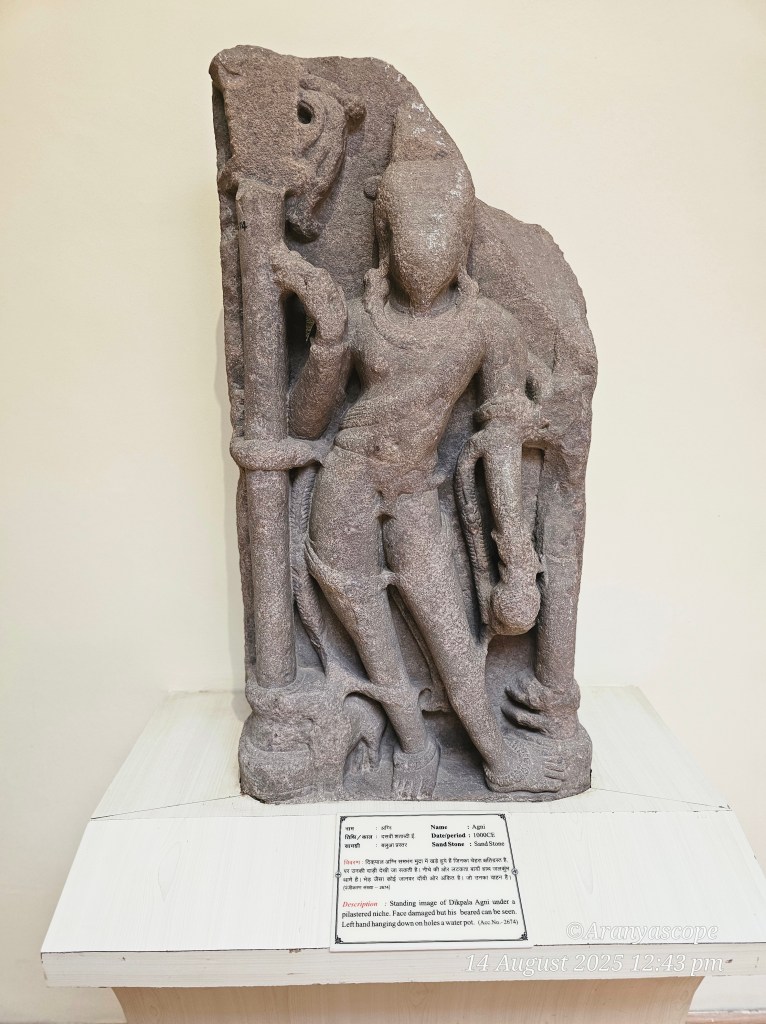


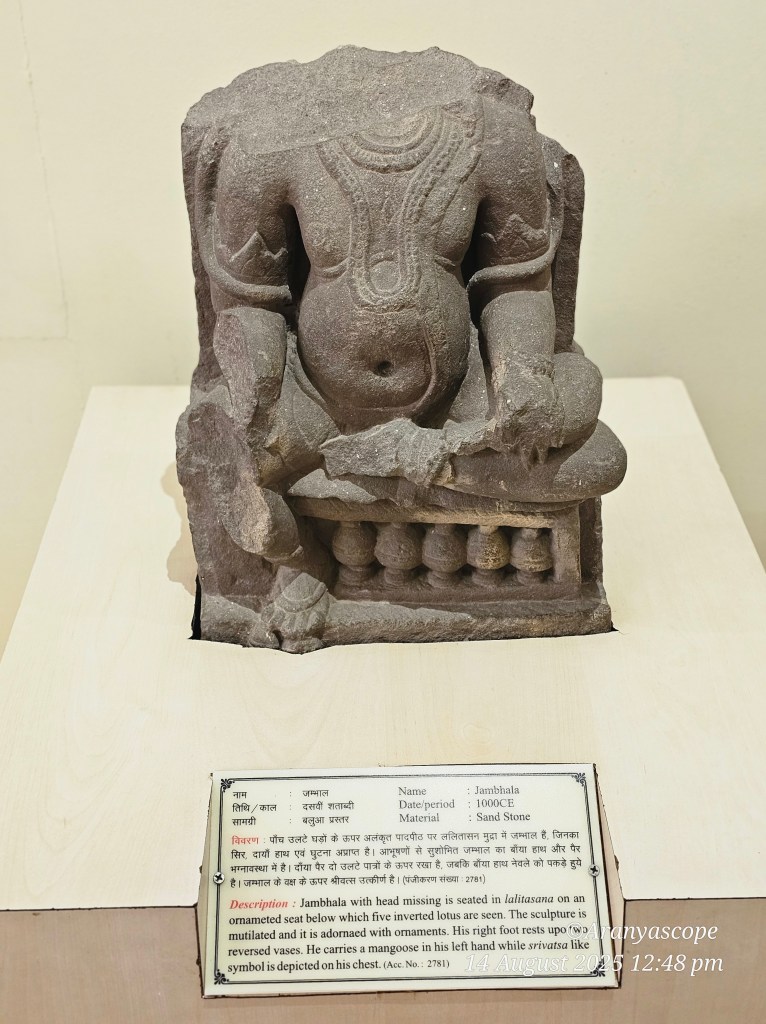

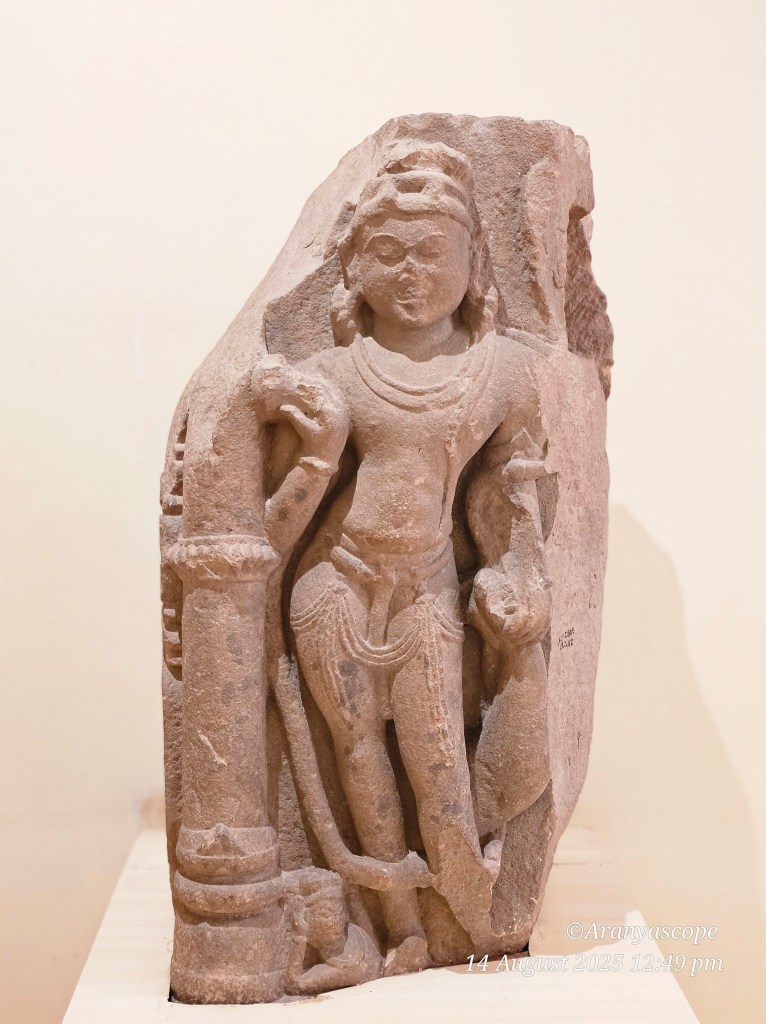


During the later rule of the Shunga, the stupa no.1 (popularly called the Great Sanchi Stupa) was expanded with stone slabs to almost twice its original size. The dome was flattened near the top and crowned by three superimposed parasols within a square railing signifying the symbol of the dharma, the Wheel of the Law. The dome was set on a high circular drum meant for circumambulation, which could be accessed via a double staircase. A second stone pathway at ground level was enclosed by a stone balustrade. The railings around Stupa 1 do not have artistic reliefs, these are only slabs, with some dedicatory inscriptions. These elements are dated to circa 175–125 BCE. Although the railings are made up of stone, they resemble wooden fence, the joints between the coping stones have been cut at a slant, as wood is naturally cut, and not vertically as stone should be cut. There are short records of the donors inscribed on the railings as well as stone slabs in Brahmi script.
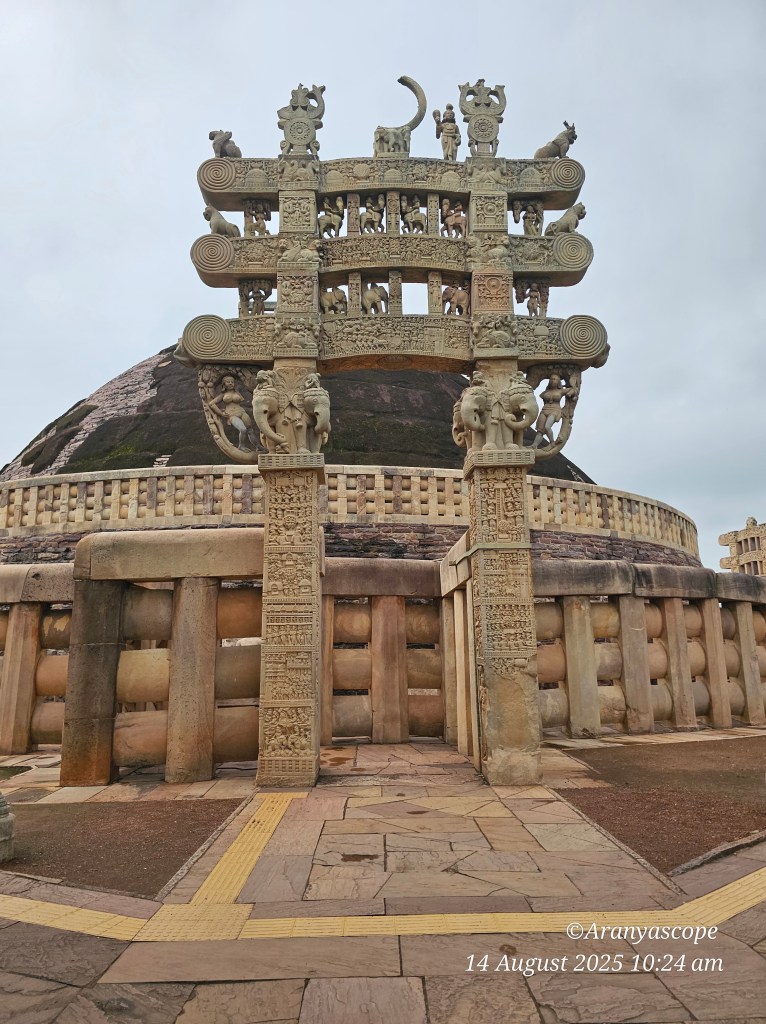

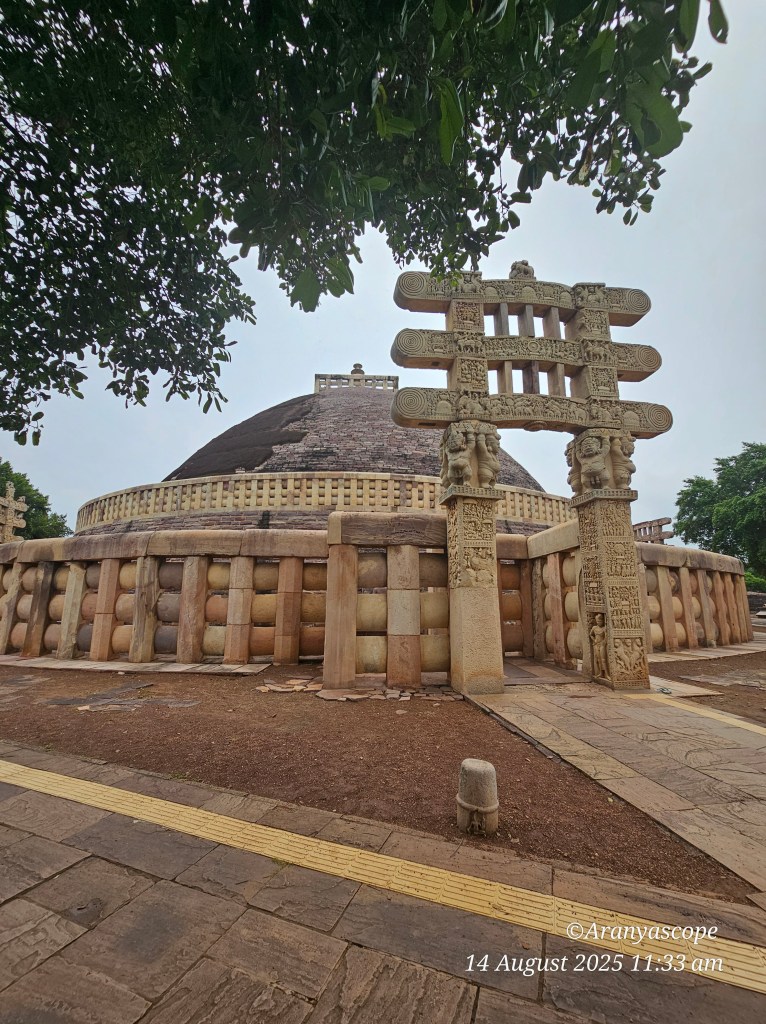


The decorations of Stupa No. 2 are probably the oldest extensive stupa decoration in existence and this Stupa is considered as the birthplace of Jataka illustrations. The reliefs at Stupa No.2 bear mason marks in Kharoshthi, as opposed to the local Brahmi script. This seems to imply that foreign workers from the north-west (from Gandhara, where Kharoshthi was the script in use) were responsible for the motifs and figures that can be found on the railings of the stupa. For the first time, clearly Buddhist themes are represented, particularly the four events in the life of the Buddha that are: the Nativity, the Enlightenment, the First Sermon and the Death.
Stupa No. 3 was built during the time of the Shungas, who also built the railing around it as well as the staircase. The Relics (bones) of Sariputra and Mahamoggallana, the disciples of the Buddha are said to have been placed in Stupa No. 3, these relics boxes were excavated in 1950’s and are kept in the vault of the nearby museum. Every year, they are taken out and displayed for public viewing on the last Sunday of the month of November coinciding the inauguration of the museum by Pandit J L Nehru, the first Prime Minister.


We had commissioned the services of an ASI certified guide, Rakesh, a very knowledgeable person, who took us through the site explaining each facet of the monument often interspersing with local folklore, e.g. the 40ft high Ashoka Pillar was cut into pieces and the lion head was taken by a local zamindar or land owner to adorn his home. We saw the black stone pieces of the pillar on site, the top portion with lion heads is now on display at the Bhopal Museum.
We did not realise that we spent more than 3.5 hours touring the Grand Stupa and the surroundings. There were groups of Buddhist devotees from Sri Lanka wearing a kind of uniform of similar T-Shirts with badges and caps for easy identification, were seen offering prayers at the site and doing parikrama or circumambulation of the Great Stupa. Some of us bought a few souvenirs from the vendors at the parking lot before leaving for our next destination, Udaigiri Caves.
The Udayagiri Caves are twenty rock-cut caves near Vidisha, Madhya Pradesh primarily denoted to the Hindu gods Vishnu and Shiva from the early years of the 3rd century CE to 5th century CE. They contain some of the oldest surviving Hindu temples and iconography in India. They are the only site that can be verifiably associated with a Gupta period monarch from its inscriptions. One of India’s most important archaeological sites, the Udayagiri hills and its caves are protected monuments managed by the Archaeological Survey of India.
Udayagiri caves contain iconography of Hinduism and Jainism. They are notable for the ancient monumental relief sculpture of Vishnu in his incarnation as the man-boar Varaha, rescuing the earth symbolically represented by Bhudevi clinging to the boar’s tusk as described in Hindu mythology. The site has important inscriptions of the Gupta dynasty belonging to the reigns of Chandragupta II (c. 375-415) and Kumaragupta I (c. 415-55). In addition to these, Udayagiri has a series of rock-shelters and petroglyphs, ruined buildings, inscriptions, water systems, fortifications and habitation mounds, all of which remain a subject of continuing archaeological studies. The Udayagiri Caves complex consists of twenty caves, of which one is dedicated to Jainism and all others to Hinduism.
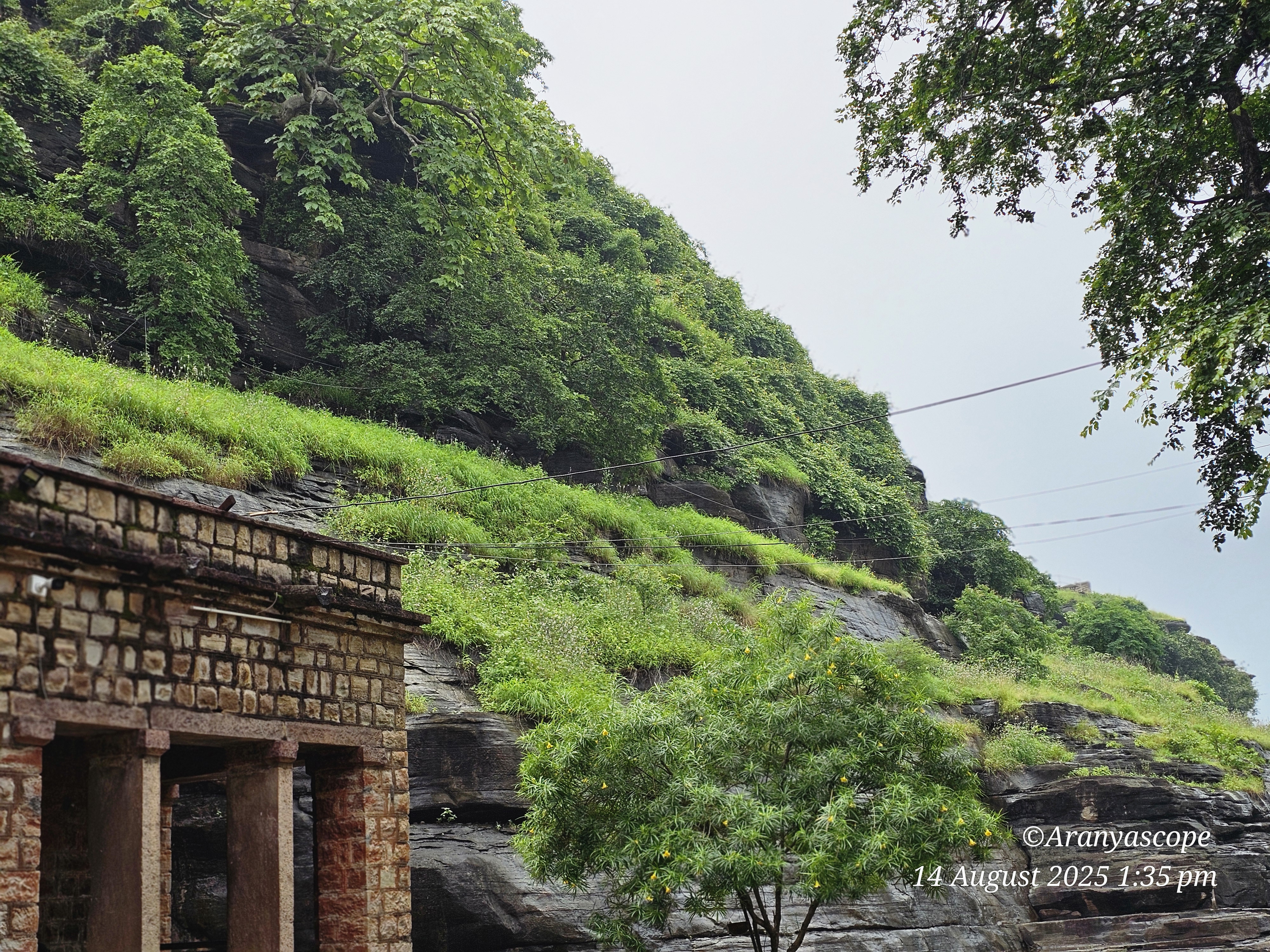
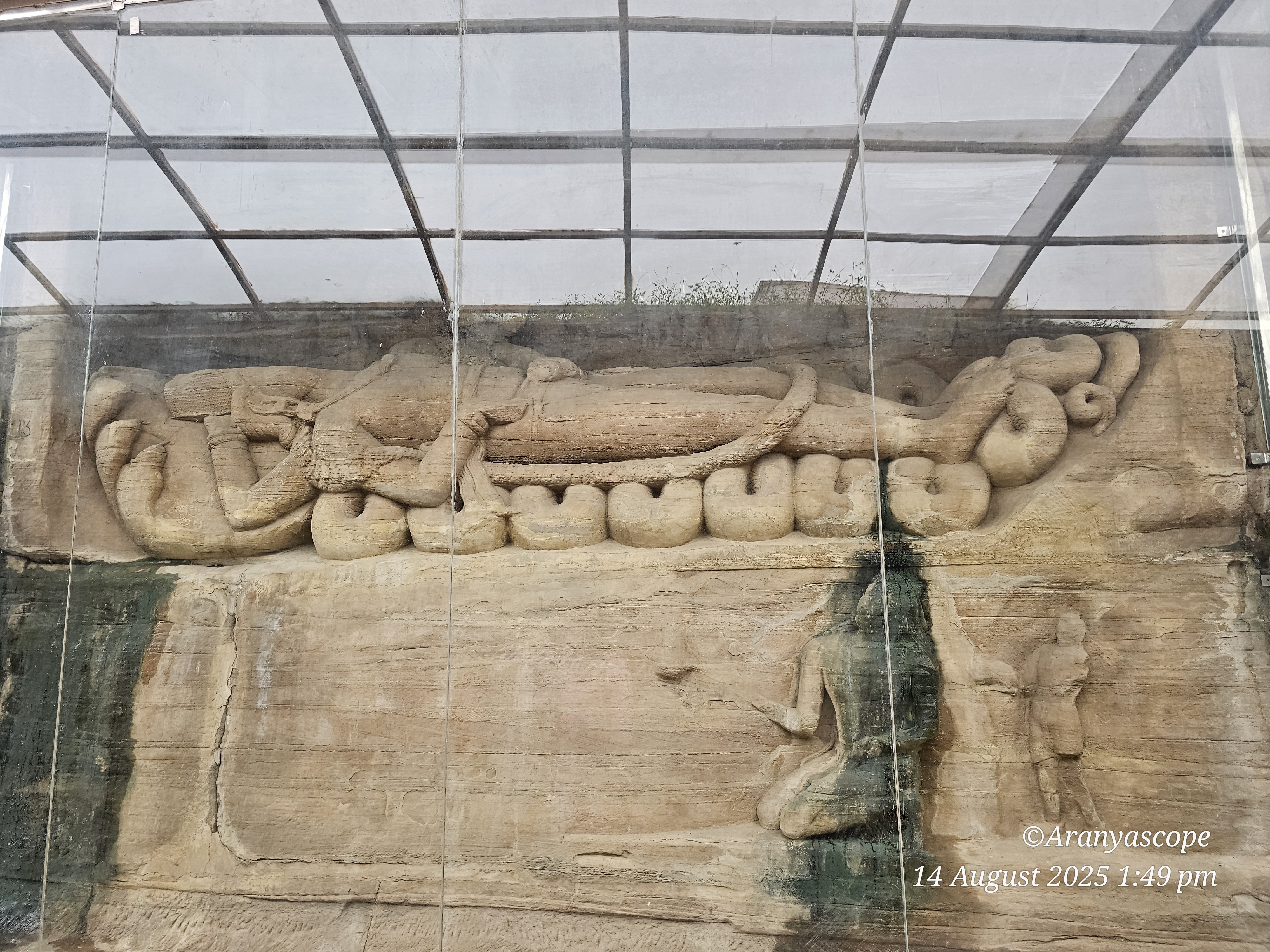


The Udaigiri Caves was on our way back from Sanchi towards our hotel. We were told that only a portion on the ground level is open to public as a Leopard family with 4 cubs have taken shelter in one of the upper caves and it would not be wise to disturb them. The caves at the ground level were all gated and locked without any source of light inside, so we had to be satisfied with the inscriptions outside each cave. At the cave number 13, we could see the rock-cut image of reclining (sheshshayi) Lord Vishnu on the coil of primeval snake, Sheshnag with his head resting on one of his four hands. It is one of the earliest and largest single-rock sculpture of reclining Vishnu. In another cave, visible clearly was the image of Lord Vishnu in Varaha Avatar rescuing the earth depicted as Bhudevi.
I had a mild hope of seeing the leopard family in the wild but it remained unfulfilled. We came back to the Village Deck Resort, very hungry, just in time as the skies opened up for the next one hour with torrential rain. We enjoyed our food and the rains from the safety of the dining hall.
We rested for couple of hours and then played tambola through the evening before dinner time. Later, I teamed up with Topshe while Amalda partnered Manojit for few hands of TwentyNine to end the first leg of our journey.
To be continued…
 Aranyascope
Lovely. Glad to be part of the journey. Waiting for next part.
LikeLiked by 1 person
Well articulated and very informative..
LikeLiked by 1 person
Very interesting. The photographs are so well taken. I felt I was with you all on the trip after reading the post. Thanks for sharing dada!
LikeLiked by 1 person